• A veterinarian gives medicine to camels in an outdoor yard at The Salman Veterinary Hospital in Buraidah, Al Qassim, Saudi Arabia. Courtesy: Reuters
    A veterinarian gives medicine to camels in an outdoor yard at The Salman Veterinary Hospital in Buraidah, Al Qassim, Saudi Arabia. Courtesy: Reuters
  • A camel is seen near a billboard reading "sanitisation point" at an outdoor yard of The Salam Veterinary Hospital. Courtesy: Reuters
    A camel is seen near a billboard reading "sanitisation point" at an outdoor yard of The Salam Veterinary Hospital. Courtesy: Reuters
  • A veterinarian stores blood samples of camels at The Salam Veterinary Hospital. Courtesy: Reuters
    A veterinarian stores blood samples of camels at The Salam Veterinary Hospital. Courtesy: Reuters
  • Assistants monitor a camel's condition as a veterinarian performs a surgery in an operating theatre at the hospital. Courtesy: Reuters
    Assistants monitor a camel's condition as a veterinarian performs a surgery in an operating theatre at the hospital. Courtesy: Reuters
  • A veterinarian looks on as his assistants provide insulin to a baby camel at The Salam Veterinary Hospital. Courtesy: Reuters
    A veterinarian looks on as his assistants provide insulin to a baby camel at The Salam Veterinary Hospital. Courtesy: Reuters
  • Assistants monitor a camel's condition as a veterinarian performs a surgery in an operating theatre at the hospital. Courtesy: Reuters
    Assistants monitor a camel's condition as a veterinarian performs a surgery in an operating theatre at the hospital. Courtesy: Reuters

World Camel Day: Inside the Saudi vet hospital the size of Buckingham Palace


  • English
  • Arabic

A version of this article was first published in September 2020

Saudi Arabia is already known as a destination for camel beauty pageants. Now, it wants to be known for camel healthcare, too.

The country opened the world's largest camel hospital in July 2020 and photographs show what daily life is like inside.

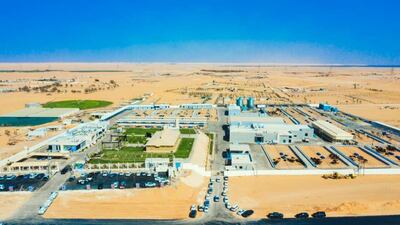
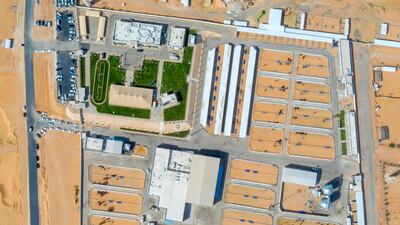
At 70,000 square metres, Al Salam Veterinary Hospital is about the size of Buckingham Palace and a little smaller than the island of Alcatraz.

The centre cost more than Dh134 million but camel racing and pageantry are sports for princes and sheikhs in which a single camel can fetch Dh10 million at the height of pageantry season.

The hospital lies in the interior Qassim region between Madinah and Riyadh, at the site of one of the world’s largest camel markets, and will serve camel owners in Kuwait and northern Saudi Arabia.

The nearest comparable clinics are about 1,000 kilometres away in other Gulf states. Travelling hundreds of kilometres and crossing borders is part of the racing and pageantry lifestyle but the coronavirus pandemic has made this impossible, even as local competitions continue.

Al Salam Veterinary Hospital can treat 144 camels, has stables for 400 racing camels and will employ up to 300 staff ready to meet a camel’s every need, from surgery to accommodation and blood testing.

Camels can be treated for infectious disease, injuries and chronic illness at the hospital, but its main business will be fertilisation.

The hospital has already conducted more than 500 embryo transfers, resulting in 350 successful pregnancies.

Vets plan to transfer 2,500 embryos next season, an ambitious amount by camel-breeding standards.

Embryo transfer has led to some of the biggest names in the world of camel racing.

A camel pregnancy lasts two years, which previously meant female racers could produce a few offspring only after retiring from the racetrack.

The advancement of camel surrogacy has meant prized female racers can now pass winning genes on to dozens of calves in one year.

This has transformed the world of racing and made some she-camels as renowned as studs.

Al Samha, from Abu Dhabi, is one such cow known for her prolific progeny.

The best-known breeding centres, such as the Advanced Scientific Group in Abu Dhabi, attract pedigree champs from around the Gulf.

Scientific advances continue to be made in camel fertilisation and breeding programmes.

The camel's adaptation to the desert has led to a unique set of challenges in artificial insemination.

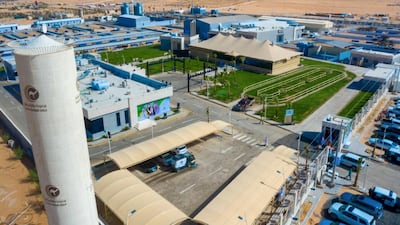
  • Officials take a tour of the new facility in Al Qassim region. All pictures courtesy Salam Veterinary and Camel Hospital
    Officials take a tour of the new facility in Al Qassim region. All pictures courtesy Salam Veterinary and Camel Hospital
  • The new hospital has room for 4,000 camels.
    The new hospital has room for 4,000 camels.
  • The site is spread across 70,000 square metres.
    The site is spread across 70,000 square metres.
  • Officials take a tour of the new facility.
    Officials take a tour of the new facility.
  • The site is spread across 70,000 square metres.
    The site is spread across 70,000 square metres.
  • The new facility is located close to Buraydah, which is believed to be the world’s largest camel market.
    The new facility is located close to Buraydah, which is believed to be the world’s largest camel market.

The animal is so good at conserving water that it produces only 3ml to 8ml of gel-like semen, a fraction compared with that of similarly sized animals such as horses. It freezes poorly.

It was only in 2018 that the first calves were born to females fertilised by frozen semen at Dubai Camel Breeding Centre.

Similar scientific breakthroughs at the Saudi hospital could change the very shape and size of future camels.


Match info

Wolves 0

Arsenal 2 (Saka 43', Lacazette 85')

Man of the match: Shkodran Mustafi (Arsenal)

'Saand Ki Aankh'

Produced by: Reliance Entertainment with Chalk and Cheese Films
Director: Tushar Hiranandani
Cast: Taapsee Pannu, Bhumi Pednekar, Prakash Jha, Vineet Singh
Rating: 3.5/5 stars

Start-up hopes to end Japan's love affair with cash

Across most of Asia, people pay for taxi rides, restaurant meals and merchandise with smartphone-readable barcodes — except in Japan, where cash still rules. Now, as the country’s biggest web companies race to dominate the payments market, one Tokyo-based startup says it has a fighting chance to win with its QR app.

Origami had a head start when it introduced a QR-code payment service in late 2015 and has since signed up fast-food chain KFC, Tokyo’s largest cab company Nihon Kotsu and convenience store operator Lawson. The company raised $66 million in September to expand nationwide and plans to more than double its staff of about 100 employees, says founder Yoshiki Yasui.

Origami is betting that stores, which until now relied on direct mail and email newsletters, will pay for the ability to reach customers on their smartphones. For example, a hair salon using Origami’s payment app would be able to send a message to past customers with a coupon for their next haircut.

Quick Response codes, the dotted squares that can be read by smartphone cameras, were invented in the 1990s by a unit of Toyota Motor to track automotive parts. But when the Japanese pioneered digital payments almost two decades ago with contactless cards for train fares, they chose the so-called near-field communications technology. The high cost of rolling out NFC payments, convenient ATMs and a culture where lost wallets are often returned have all been cited as reasons why cash remains king in the archipelago. In China, however, QR codes dominate.

Cashless payments, which includes credit cards, accounted for just 20 per cent of total consumer spending in Japan during 2016, compared with 60 per cent in China and 89 per cent in South Korea, according to a report by the Bank of Japan.

Ten tax points to be aware of in 2026

1. Domestic VAT refund amendments: request your refund within five years

If a business does not apply for the refund on time, they lose their credit.

2. E-invoicing in the UAE

Businesses should continue preparing for the implementation of e-invoicing in the UAE, with 2026 a preparation and transition period ahead of phased mandatory adoption. 

3. More tax audits

Tax authorities are increasingly using data already available across multiple filings to identify audit risks. 

4. More beneficial VAT and excise tax penalty regime

Tax disputes are expected to become more frequent and more structured, with clearer administrative objection and appeal processes. The UAE has adopted a new penalty regime for VAT and excise disputes, which now mirrors the penalty regime for corporate tax.

5. Greater emphasis on statutory audit

There is a greater need for the accuracy of financial statements. The International Financial Reporting Standards standards need to be strictly adhered to and, as a result, the quality of the audits will need to increase.

6. Further transfer pricing enforcement

Transfer pricing enforcement, which refers to the practice of establishing prices for internal transactions between related entities, is expected to broaden in scope. The UAE will shortly open the possibility to negotiate advance pricing agreements, or essentially rulings for transfer pricing purposes. 

7. Limited time periods for audits

Recent amendments also introduce a default five-year limitation period for tax audits and assessments, subject to specific statutory exceptions. While the standard audit and assessment period is five years, this may be extended to up to 15 years in cases involving fraud or tax evasion. 

8. Pillar 2 implementation 

Many multinational groups will begin to feel the practical effect of the Domestic Minimum Top-Up Tax (DMTT), the UAE's implementation of the OECD’s global minimum tax under Pillar 2. While the rules apply for financial years starting on or after January 1, 2025, it is 2026 that marks the transition to an operational phase.

9. Reduced compliance obligations for imported goods and services

Businesses that apply the reverse-charge mechanism for VAT purposes in the UAE may benefit from reduced compliance obligations. 

10. Substance and CbC reporting focus

Tax authorities are expected to continue strengthening the enforcement of economic substance and Country-by-Country (CbC) reporting frameworks. In the UAE, these regimes are increasingly being used as risk-assessment tools, providing tax authorities with a comprehensive view of multinational groups’ global footprints and enabling them to assess whether profits are aligned with real economic activity. 

Contributed by Thomas Vanhee and Hend Rashwan, Aurifer

Most wanted allegations
  • Benjamin Macann, 32: involvement in cocaine smuggling gang.
  • Jack Mayle, 30: sold drugs from a phone line called the Flavour Quest.
  • Callum Halpin, 27: over the 2018 murder of a rival drug dealer. 
  • Asim Naveed, 29: accused of being the leader of a gang that imported cocaine.
  • Calvin Parris, 32: accused of buying cocaine from Naveed and selling it on.
  • John James Jones, 31: allegedly stabbed two people causing serious injuries.
  • Callum Michael Allan, 23: alleged drug dealing and assaulting an emergency worker.
  • Dean Garforth, 29: part of a crime gang that sold drugs and guns.
  • Joshua Dillon Hendry, 30: accused of trafficking heroin and crack cocain. 
  • Mark Francis Roberts, 28: grievous bodily harm after a bungled attempt to steal a £60,000 watch.
  • James ‘Jamie’ Stevenson, 56: for arson and over the seizure of a tonne of cocaine.
  • Nana Oppong, 41: shot a man eight times in a suspected gangland reprisal attack. 
Ms Yang's top tips for parents new to the UAE
  1. Join parent networks
  2. Look beyond school fees
  3. Keep an open mind
What is a robo-adviser?

Robo-advisers use an online sign-up process to gauge an investor’s risk tolerance by feeding information such as their age, income, saving goals and investment history into an algorithm, which then assigns them an investment portfolio, ranging from more conservative to higher risk ones.

These portfolios are made up of exchange traded funds (ETFs) with exposure to indices such as US and global equities, fixed-income products like bonds, though exposure to real estate, commodity ETFs or gold is also possible.

Investing in ETFs allows robo-advisers to offer fees far lower than traditional investments, such as actively managed mutual funds bought through a bank or broker. Investors can buy ETFs directly via a brokerage, but with robo-advisers they benefit from investment portfolios matched to their risk tolerance as well as being user friendly.

Many robo-advisers charge what are called wrap fees, meaning there are no additional fees such as subscription or withdrawal fees, success fees or fees for rebalancing.

The%20Mandalorian%20season%203%20episode%201
%3Cp%3E%3Cstrong%3EDirector%3A%20%3C%2Fstrong%3ERick%20Famuyiwa%3C%2Fp%3E%0A%3Cp%3E%3Cstrong%3EStars%3A%20%3C%2Fstrong%3EPedro%20Pascal%20and%20Katee%20Sackhoff%3C%2Fp%3E%0A%3Cp%3E%3Cstrong%3ERating%3A%20%3C%2Fstrong%3E4%2F5%C2%A0%3C%2Fp%3E%0A