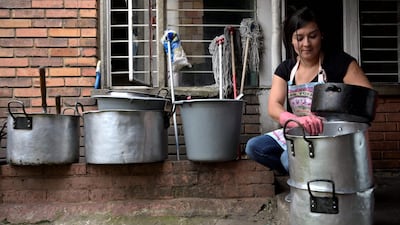

Housework. It is possibly one of the dullest activities – certainly one that many of us don't like doing. But it is one of life's absolute necessities. And talking about it more could help address one of the most important issues of our time: social and economic inequalities between men and women.
According to an Oxfam report released in January 2020, in most parts of the world it is women who do the majority of the housework – even in cases where both partners are employed. The report says women and girls do more than three quarters of all unpaid care work, contributing an estimated $10.8 trillion to the global economy, with a total of 12.5 billion hours a day. That exceeds the combined revenue of the 50 largest companies on the previous year's Fortune Global 500 list.
Those hoping that pandemic-related lockdowns would have closed the so-called "chore gap" will be disappointed. More families working from home has meant that there is more housework to do, with the burden having disproportionately fallen on women.
Research carried out by Procter & Gamble, a US consumer goods firm, on American households in December 2020 reveals some interesting stats: 63 per cent of women say they are doing most of the household chores. Thirty-one per cent of men make a similar claim, but only 2 per cent of women agree. The chore gap has become such a sore point that last month that Procter and Gamble released an advertisement about it on the day of the Super Bowl, the annual American football championship game.

One of the problems with housework is that, even though our lives depend on it, it is unpaid work – unless it is outsourced. And because men are still considered the primary breadwinners in their families, housework is often referred to as "women’s work".
The division of labour at home is, therefore, unequal. That it is unpaid makes it even more unjust. The social implications over the years have been profound, with "women's work" being considered worthless, leading men to not give it the respect it deserves.
This unequal division of labour at home has had an adverse impact on women's careers. Putting in a "second shift" at home has meant having less time and energy to further their careers and increase their pay. It is one of the factors that has contributed to the gender pay gap. In 2018, the World Economic Forum stated that it would take 202 years for the global gender pay gap to close, and that women globally are only paid 63 per cent of what men are paid.
If women were to point this out, they would likely be accused of being too "career-minded" or obsessed with money or having misplaced priorities.
It is, however, important to understand that housework is not nothing. It has a tangible value and can, therefore, be monetised. It is precisely why the Wages for Housework Campaign was launched in 1972 in the US, UK and Italy. The group demanded that laws be passed to ensure wages are paid for the labour that women do at home. They also took the issue to the UN, pointing out that women do two thirds of the world’s work for five per cent of its income.
Building on the momentum, in 1975, the women of Iceland took an entire day off in order to demonstrate the significance of their labour, leaving men to do everything from childcare to cleaning as well as their work. The “Women’s Day Off” also became known as the “Long Friday”, alluding to the painful awakening by men of the crucial nature of “women’s work”. Iceland went on to have Europe’s first female president, Vigdis Finnbogadottir, who credits the strike for her election.
Almost half a century later, there is more progress, this time in Asia.
Last month in Beijing, a court made a landmark ruling in a divorce case that a woman be compensated by her ex-husband for the housework and childcare that she undertook almost singlehandedly while she was married, amounting to five years' worth of unpaid labour.
The crux of the ruling is that, much like property is split between a couple going through divorce, housework is an asset to a household and should be recognised and valued as such. It is not nothing.
It is International Women’s Day next week. And the theme for this year is "choose to challenge". True to this message, the woman in the Beijing divorce case chose to challenge the assumption that her unpaid labour had no value.
This issue is being discussed in neighbouring India, too, which has the largest gender gap when it comes to unpaid work. That women spend almost six hours a day managing their homes, while men dedicate just 52 minutes to this endeavour, according to the Oxfam report, deserves urgent attention there. Thankfully, an up-and-coming political party, called Makkal Needhi Maiam, is making the case for paid housework. Whether it succeeds or not, raising the issue is a start.
Housework might seem a dull topic to even talk about. But if the very idea of paying someone in the family to carry out chores is animating ordinary people, it shows how little those chores are thought of in terms of their value. And that in itself offers a way in to talk about the underlying gender issues.
Shelina Janmohamed is an author and a culture columnist for The National

