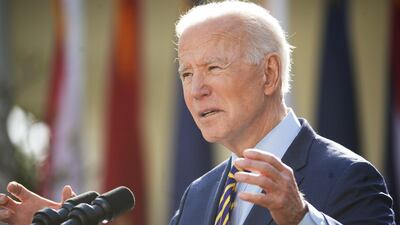

With his ceaseless boasting, former president Donald Trump vowed to be a transformative American leader. Yet he proved more a symptom of disruption than an agent of change. Instead, it is his highly focused and low-key successor, Joe Biden, who is already well under way with the most ambitious transformative agenda in half a century.
In just a few weeks, Mr Biden secured a $1.9 trillion pandemic relief package that alone constitutes a comprehensive reorientation of government policy.
Its huge size isn’t terribly unusual, but the allocation is genuinely revolutionary.
Mr Trump's 2017 tax cut cost about $2tn over 10 years but was heavily focused on benefiting the wealthy and corporations.
Barack Obama oversaw at least two major spending bills, the first targeting recovery from the economic meltdown in 2008. George W Bush, too, oversaw major spending for that recovery, his various wars and so on.
What’s unheard of is not the amount but that the spending is focused clearly at aiding disadvantaged Americans, including direct, one-time payments, extended unemployment benefits and, especially, measures targeting childhood poverty.
Since the mid-1960s, there hasn't been any comparable effort to mobilise the power of government to assist working people and, especially, the poor. Republican critics grumble that this is Venezuela-style "socialism". While it's obviously nothing of the kind, it is clearly a step towards redistributing wealth in a society in which income stratification has become grotesquely unfair.
The changes will be truly significant.
The poorest fifth of households will see 20 per cent increases in income. A Washington-based think tank the Urban Institute estimates that just four provisions of the bill will reduce the national poverty rate by fully one third.
And the attack on poverty will be most beneficial to the neediest communities, with African-American poverty being reduced by 42 per cent, Hispanic by 39 per cent and 34 per cent for poor whites.
Perhaps the most far-reaching change is a new refundable child tax credit, which for the poorest will come in the form of monthly cash transfers, at a rate of $250 for each child over five and $300 for those younger.
No family can live off of those amounts, but they are clearly a major step towards a guaranteed minimum income, at least for children. And unlike with past support for children, these payments will not be tied to work requirements or other conditions.
-
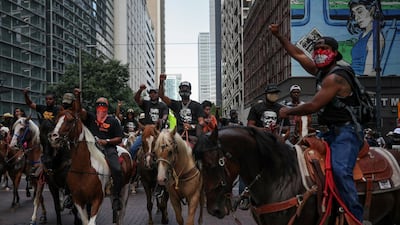
Protesters on horseback rally against the death in Minneapolis police custody of George Floyd, through central Houston, Texas. Reuters -

A broken Statue of Liberty figure is seen between glass shatters outside a looted souvenir shop after a night of protest against the death of an African-American man George Floyd in Minneapolis in Manhattan in New York City. AFP -
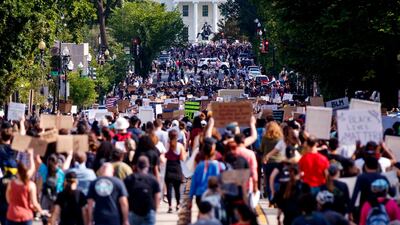
People, who gathered in protest against the death of George Floyd, peacefully march to the White House in Washington DC. EPA -
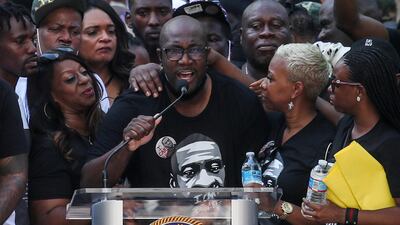
Philonise Floyd, brother of George Floyd, who died in Minneapolis police custody, is surrounded by family members as he speaks at a protest rally against his brother’s death, in Houston, Texas. Reuters -

George Floyd's daughter, Gianna Floyd, 6, is seen during a press conference at Minneapolis City Hall following the death in Minneapolis police custody of George Floyd in Minneapolis, Minnesota. Reuters -
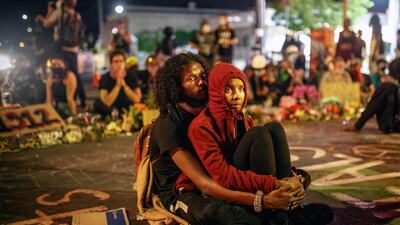
A Somali-American couple, alongside protesters calling for justice for the death of George Floyd, waits after curfew outside the Cup Foods in Minneapolis, Minnesota. AFP -
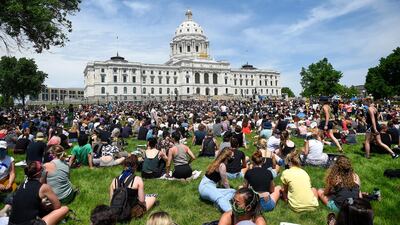
Thousands of protesters turn out for a sit-in at the State capitol, more than a week after George Floyd's death while under arrest, in St Paul, Minnesota. EPA -

A police officer kneels during a protest against the death in Minneapolis police custody of George Floyd, outside LAPD headquarters in Los Angeles, California. Reuters -
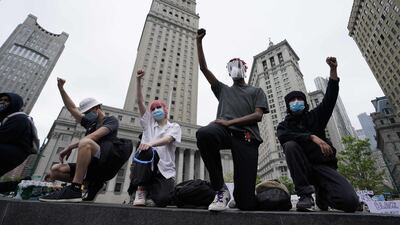
Protesters during a 'Black Lives Matter' demonstration in New York City. AFP -
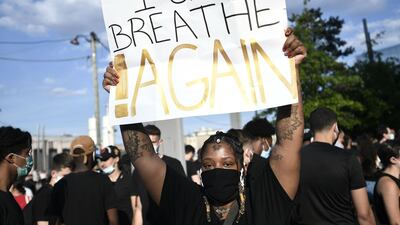
A protester holds a placard during a demonstration after French medical experts exonerated the gendarmes involved in the arrest of Adama Traore, a young black man who died in police custody in 2016, outside the 'Tribunal de Paris' courthouse in Paris. AFP -

Turkish leftist demonstrators clash with police at Kadikoy in Istanbul, as leftist groups gather in support of US protesters against the death of George Floyd in Minneapolis police custody, and against police violence in Turkey. AFP -
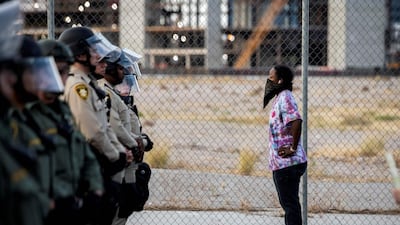
A woman stands in front of Police officers, in downtown Las Vegas, as they take part in a 'Black lives matter' rally in response to the recent death of George Floyd, an unarmed black man who died in police custody. AFP -
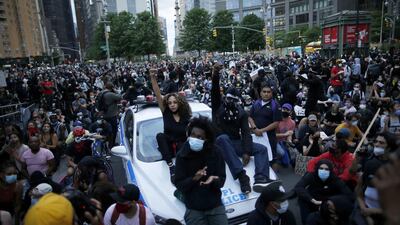
People take part in a protest against the death in Minneapolis police custody of George Floyd, at Trump International Hotel in New York. Reuters -
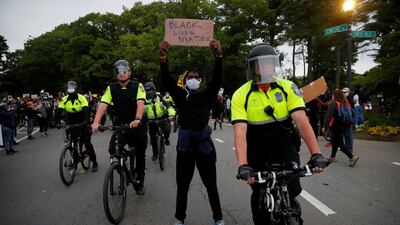
A demonstrator holds a sign during a rally following the death in Minneapolis police custody of George Floyd, in Boston, Massachusetts. Reuters -
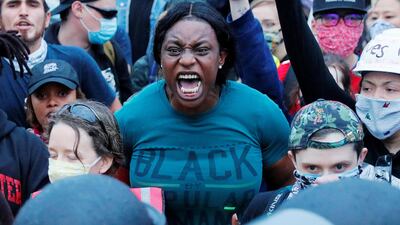
A demonstrator reacts during a rally following the death in Minneapolis police custody of George Floyd, in Boston, Massachusetts. Reuters -
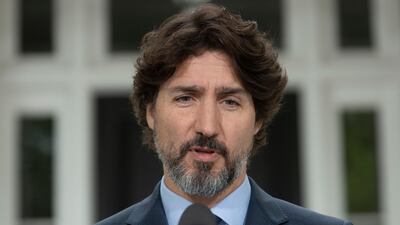
Canadian Prime Minister Justin Trudeau responds to a question on racism during a news conference outside Rideau Cottage in Ottawa. Mr Trudeau said Canadians were watching what’s unfolding in the US with 'horror and consternation'. AP -
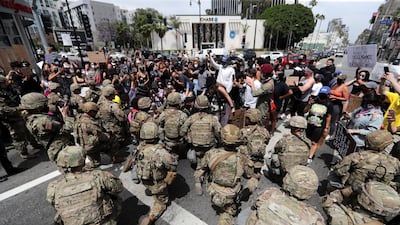
Members of the National Guard take a knee as people protest against the death of George Floyd in Minneapolis police custody, in Hollywood, Califronia. EPA


Health insurance subsidies are greatly increased. There’s even a hint towards reparations for slavery, with $4 billion set aside to help black farmers.
When the dust settles on such spending, especially if measures such as the child tax credit become permanent, as Democrats confidently predict, the socio-economic landscape of the US will have been nudged in favour of the neediest people, particularly children.
It’s already clear that the role of the US government in shaping the lives of its citizens has been revolutionised.
The Republican mantra that tax cuts pay for themselves has been tested many times and irrefutably disproven. Democrats are now going to try to demonstrate that, over time, it is well-targeted social and economic spending that really can pay for itself.
As whoever authors the pseudonymous “James Medlock” Twitter account brilliantly phrased it: “The era of ‘the era of big government is over’ is over.”
That refers to a phrase used by former president Bill Clinton when he effectively eliminated traditional welfare in the 1990s.
But the idea is far older.
Since at least Ronald Reagan’s election in 1980, Republicans have been united around the claim that “government is not the solution to our problem, government is the problem". Even many Democrats eventually came to share such suspicions.
Several factors have reversed this process, reviving the view, including among many Republicans, that government is a necessary force in shaping social and economic conditions.
Underlying the antipathy to social spending was a racist conviction among many whites that too much help was being given, at their expense, to presumptively unworthy citizens, particularly African Americans and Hispanics.
But in recent years, problems that used to plague minority-dominated inner cities, particularly chronic unemployment and the despair, alcoholism and addiction, and crime this produces, have migrated into white-majority rural areas while many cities are thriving.
The coronavirus pandemic also reminded everyone that there's no alternative to federal authorities when coping with huge disasters.
Suddenly the government doesn’t look so bad to many Republicans.
Mr Trump also played a crucial role. He isn’t and never was a conservative. In fact, he was a fairly liberal Democrat (except on racial issues) for most of his life. As a Republican leader, he championed a populist agenda that in theory promised to use the government to deliver tangible benefits to ordinary voters.
Yet working with Republican Senate leader Mitch McConnell and other conservatives, his only real domestic accomplishment was the tax cut for the rich. But he never stopped boasting about all the marvellous programmes he was just about to secure for working people.

His constituency was already primed to dump the Reagan-era allergy to government programmes. But Mr Trump delivered a rhetorical framework and political legitimacy.
So, the Biden spending bill is popular among Republicans, especially the less affluent.
That's why Republicans in Congress, although none of them voted for the bill, and right-wing commentators put up no serious fight against the legislation. Instead, they raged impotently about preposterous non-issues – discontinued Dr Seuss children's books and re-branded Mr Potato Head toys – completely unrelated to governance.
Four years ago, I wrote in these pages that Mr Trump had a remarkable opportunity to secure a lasting US political realignment by combining his economic nationalism with major government spending programmes, particularly on infrastructure, designed to create large numbers of good working-class jobs. His inability to do so undoubtedly contributed to his electoral defeat.
Frantic Republican claims to now be the party of the working-class ring desperately hollow, especially as Mr Biden has just taken a huge step towards such a realignment and embraced a lot of Mr Trump’s economic nationalism.
If he can maintain party unity, reform or repeal the Senate filibuster, or gain significant Republican co-operation in Congress, Mr Biden could become one of the most consequential presidents in US history.
Hussein Ibish is a senior resident scholar at the Arab Gulf States Institute and a US affairs columnist for The National

