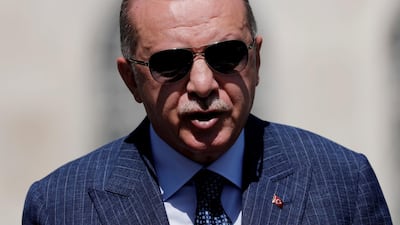
“Turkey will get back its fair share in the Mediterranean, Aegean and the Black Sea,” Turkish President Recep Tayyip Erdogan declared in August. It was a bold statement in an increasingly heated dispute over maritime boundaries.
What does Mr Erdogan see as fair? The answer lies in Turkey's latest foreign policy doctrine “Mavi Vatan”, or “Blue Homeland”, an irredentist vision that aims to resuscitate an almost-Ottoman level of maritime influence.
In the mid-16th century, the Ottoman Empire held sway over the entire Mediterranean Sea, mainly thanks to a pair of bold seafaring brothers. Born on what is now the Greek island of Lesbos, Oruc and his younger brother Khizr emerged as internationally renowned corsairs for hire.
The brothers gained the backing of one of the world’s most powerful leaders, Yavuz Sultan Selim, and built a capable Ottoman navy. The empire soon extended its reach to Algeria, and after Khizr, by then known as Barbarossa (“red beard”), defeated a Venetian-Spanish alliance off the Greek coast in 1538, the Ottomans controlled all the islands in the Aegean.
Most historians view the brothers as pirates and slave traders, yet Turkish schoolchildren are taught the brave exploits of Oruc Reis (Turkish for “chief”) and Barbarossa Hayrettin (“best of the faith”). Now, Mr Erdogan uses seismic research vessels named after them to signal his country’s desire to defend its maritime rights and challenge regional powers.
Devised by retired naval officer Cem Gürdeniz, it views the eastern Mediterranean, the Aegean and the Black Sea – to be Turkey’s Blue Homeland. It first made headlines a year ago when Mr Erdogan gave a speech in front of a map laying out Turkish control over more than 460,000 square kilometres in those three seas.
Two weeks ago, the Turkish presidency marked the anniversary of that 1538 victory over Christian powers with a video re-enactment of Hayrettin battling Crusaders. “The blood of my ancestors flows through my veins,” the President’s communications head, Fahrettin Altun, said in a tweet releasing the video. “We die and take lives for the blue homeland.”
Erdogan uses seismic research vessels to challenge regional powers
The appearance of the Turkish survey vessel Oruc Reis and its accompanying warships in waters off the Greek island of Kastellorizo last month spurred Athens to place its armed forces on high alert, putting the fellow Nato members on the verge of war. Only when the Oruc Reis returned to port in Antalya a few weeks later were Turkey and Greece able to begin preliminary talks. The same day, however, another ship, the Barbaros Hayrettin Pasha, was sent to drill in waters claimed by Cyprus, where it is expected to remain until the second week of November.
Over the past two years, Turkey has sent half a dozen research vessels accompanied by warships to drill in waters claimed by Cyprus. Last year, it signed a maritime borders deal with Libya’s Tripoli-based Government of National Accord that vastly expands its Mediterranean claims, enveloping all of the waters around the Greek island of Crete.
Yet this maritime assertiveness is less about natural gas and potential energy revenues than it might appear. For one thing, most analysts are now convinced that any natural gas recovered from the eastern Mediterranean will be unlikely, by the time it reaches the market, to find buyers in either Europe or Asia.
In line with Blue Homeland, Turkey has in recent years sharply increased its naval power. This includes domestically produced ships and submarines and a light aircraft carrier due next year. It has flexed this renewed maritime might repeatedly in drills at sea, with another planned for later this month.
But the flexing is not only at sea. The naval build-up is part of a massive expansion of Turkey’s arms industry that has instilled greater military assertiveness. Turkey has a troop presence or is backing proxy forces in as many as seven Arab states – Qatar, Iraq, Syria, Libya, Sudan, Somalia and possibly Yemen – and has begun using foreigners to fight its wars.
Thanks to Turkey’s sizable footprint in northern Syria, Mr Erdogan is able to dispatch thousands of Syrian rebels to fight in Libya and in the latest Armenia-Azerbaijan conflict for little pay. This avoids the potential political disaster of Turkish troops returning from some distant conflict in body bags, which would be a particularly bitter pill during an acute economic crisis.
Such practices, however, draw regional ire. Last month, Egypt called on allies in the Arab League to join forces to counter Turkish aggressions in the region, particularly in Syria. Saudi Arabia has been boycotting Turkish goods for more than a year, and recent reports suggest that Oman, Bahrain and others might soon join that effort.
What about foes further afield? A key element of Blue Homeland is a worldview that blames Turkey’s troubles on Western powers and positions the US and Europe as rivals, in spite of their formal military alliances with Ankara. But the US is neck-deep in a presidential election season while its leader struggles to beat covid-19 on multiple levels. And though Nato is hoping to broker Turkey-Greece talks, the EU has done little more than repeatedly denounce Turkish aggressions and warn of sanctions. At a summit early this month, EU leaders kicked the sanctions can down the road yet again, to a December meeting.
The clock is ticking. On the sidelines of the latest session of the UN General Assembly in New York, the main actors in Libya inched toward a peace deal. As things stand now, any resolution to that conflict is likely to leave the GNA in control of Tripoli, which would encourage Turkey to fulfil the ambitions of its maritime borders deal and extend drilling further into the Mediterranean.
The Oruc Reis left port and headed into open waters last week. Days later, Turkish news outlets reported that its next drilling destination would be Crete.
David Lepeska is a veteran journalist who has been covering Turkey for the past decade

The specs
Engine: four-litre V6 and 3.5-litre V6 twin-turbo
Transmission: six-speed and 10-speed
Power: 271 and 409 horsepower
Torque: 385 and 650Nm
Price: from Dh229,900 to Dh355,000
Tips for newlyweds to better manage finances
All couples are unique and have to create a financial blueprint that is most suitable for their relationship, says Vijay Valecha, chief investment officer at Century Financial. He offers his top five tips for couples to better manage their finances.
Discuss your assets and debts: When married, it’s important to understand each other’s personal financial situation. It’s necessary to know upfront what each party brings to the table, as debts and assets affect spending habits and joint loan qualifications. Discussing all aspects of their finances as a couple prevents anyone from being blindsided later.
Decide on the financial/saving goals: Spouses should independently list their top goals and share their lists with one another to shape a joint plan. Writing down clear goals will help them determine how much to save each month, how much to put aside for short-term goals, and how they will reach their long-term financial goals.
Set a budget: A budget can keep the couple be mindful of their income and expenses. With a monthly budget, couples will know exactly how much they can spend in a category each month, how much they have to work with and what spending areas need to be evaluated.
Decide who manages what: When it comes to handling finances, it’s a good idea to decide who manages what. For example, one person might take on the day-to-day bills, while the other tackles long-term investments and retirement plans.
Money date nights: Talking about money should be a healthy, ongoing conversation and couples should not wait for something to go wrong. They should set time aside every month to talk about future financial decisions and see the progress they’ve made together towards accomplishing their goals.
Company%C2%A0profile
%3Cp%3E%3Cstrong%3EDate%20started%3A%20%3C%2Fstrong%3EMay%202022%3Cbr%3E%3Cstrong%3EFounder%3A%20%3C%2Fstrong%3EHusam%20Aboul%20Hosn%3Cbr%3E%3Cstrong%3EBased%3A%20%3C%2Fstrong%3EDIFC%3Cbr%3E%3Cstrong%3ESector%3A%20%3C%2Fstrong%3EFinTech%20%E2%80%94%20Innovation%20Hub%3Cbr%3E%3Cstrong%3EEmployees%3A%20%3C%2Fstrong%3Eeight%3Cbr%3E%3Cstrong%3EStage%3A%20%3C%2Fstrong%3Epre-seed%3Cbr%3E%3Cstrong%3EInvestors%3A%20%3C%2Fstrong%3Epre-seed%20funding%20raised%20from%20family%20and%20friends%20earlier%20this%20year%3C%2Fp%3E%0A
IF YOU GO
The flights: FlyDubai offers direct flights to Catania Airport from Dubai International Terminal 2 daily with return fares starting from Dh1,895.
The details: Access to the 2,900-metre elevation point at Mount Etna by cable car and 4x4 transport vehicle cost around €57.50 (Dh248) per adult. Entry into Teatro Greco costs €10 (Dh43). For more go to www.visitsicily.info
Where to stay: Hilton Giardini Naxos offers beachfront access and accessible to Taormina and Mount Etna. Rooms start from around €130 (Dh561) per night, including taxes.
The%20specs
%3Cp%3E%3Cstrong%3EEngine%3A%20%3C%2Fstrong%3E2.3-litre%204cyl%20turbo%0D%3Cbr%3E%3Cstrong%3EPower%3A%20%3C%2Fstrong%3E299hp%20at%205%2C500rpm%0D%3Cbr%3E%3Cstrong%3ETorque%3A%20%3C%2Fstrong%3E420Nm%20at%202%2C750rpm%0D%3Cbr%3E%3Cstrong%3ETransmission%3A%20%3C%2Fstrong%3E10-speed%20auto%0D%3Cbr%3E%3Cstrong%3EFuel%20consumption%3A%20%3C%2Fstrong%3E12.4L%2F100km%0D%3Cbr%3E%3Cstrong%3EOn%20sale%3A%20%3C%2Fstrong%3ENow%0D%3Cbr%3E%3Cstrong%3EPrice%3A%20%3C%2Fstrong%3EFrom%20Dh157%2C395%20(XLS)%3B%20Dh199%2C395%20(Limited)%3C%2Fp%3E%0A
The specs
Engine: Dual 180kW and 300kW front and rear motors
Power: 480kW
Torque: 850Nm
Transmission: Single-speed automatic
Price: From Dh359,900 ($98,000)
On sale: Now
Mercer, the investment consulting arm of US services company Marsh & McLennan, expects its wealth division to at least double its assets under management (AUM) in the Middle East as wealth in the region continues to grow despite economic headwinds, a company official said.
Mercer Wealth, which globally has $160 billion in AUM, plans to boost its AUM in the region to $2-$3bn in the next 2-3 years from the present $1bn, said Yasir AbuShaban, a Dubai-based principal with Mercer Wealth.
“Within the next two to three years, we are looking at reaching $2 to $3 billion as a conservative estimate and we do see an opportunity to do so,” said Mr AbuShaban.
Mercer does not directly make investments, but allocates clients’ money they have discretion to, to professional asset managers. They also provide advice to clients.
“We have buying power. We can negotiate on their (client’s) behalf with asset managers to provide them lower fees than they otherwise would have to get on their own,” he added.
Mercer Wealth’s clients include sovereign wealth funds, family offices, and insurance companies among others.
From its office in Dubai, Mercer also looks after Africa, India and Turkey, where they also see opportunity for growth.
Wealth creation in Middle East and Africa (MEA) grew 8.5 per cent to $8.1 trillion last year from $7.5tn in 2015, higher than last year’s global average of 6 per cent and the second-highest growth in a region after Asia-Pacific which grew 9.9 per cent, according to consultancy Boston Consulting Group (BCG). In the region, where wealth grew just 1.9 per cent in 2015 compared with 2014, a pickup in oil prices has helped in wealth generation.
BCG is forecasting MEA wealth will rise to $12tn by 2021, growing at an annual average of 8 per cent.
Drivers of wealth generation in the region will be split evenly between new wealth creation and growth of performance of existing assets, according to BCG.
Another general trend in the region is clients’ looking for a comprehensive approach to investing, according to Mr AbuShaban.
“Institutional investors or some of the families are seeing a slowdown in the available capital they have to invest and in that sense they are looking at optimizing the way they manage their portfolios and making sure they are not investing haphazardly and different parts of their investment are working together,” said Mr AbuShaban.
Some clients also have a higher appetite for risk, given the low interest-rate environment that does not provide enough yield for some institutional investors. These clients are keen to invest in illiquid assets, such as private equity and infrastructure.
“What we have seen is a desire for higher returns in what has been a low-return environment specifically in various fixed income or bonds,” he said.
“In this environment, we have seen a de facto increase in the risk that clients are taking in things like illiquid investments, private equity investments, infrastructure and private debt, those kind of investments were higher illiquidity results in incrementally higher returns.”
The Abu Dhabi Investment Authority, one of the largest sovereign wealth funds, said in its 2016 report that has gradually increased its exposure in direct private equity and private credit transactions, mainly in Asian markets and especially in China and India. The authority’s private equity department focused on structured equities owing to “their defensive characteristics.”
