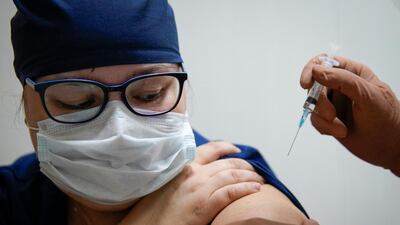
The UAE will be the first country in the Middle East to hold clinical trials of Sputnik V, the Russian-developed vaccine against Covid-19, after having begun testing a joint trial with China last summer. Developing an effective vaccine or treatment for coronavirus is humanity’s best chance at beating the pandemic and securing a path to normality. It is therefore vital that countries continue to work together to find a solution.
Final-phase trials of Sputnik V are expected to begin in the Emirates by the end of November. The vaccine is currently being tested in Russia and Belarus, with a further trial planned in Venezuela. Kirill Dmitriev, the head of the Russian Direct Investment Fund, which has financed Russia's vaccine work, told CNN that his country plans to begin mass inoculation by November. There are currently more than 150 coronavirus vaccines in development worldwide, as countries compete over which nation will develop the first viable Covid-19 jab.
The Emirates has played an active part in the fight against Covid-19 by boosting international co-operation in healthcare and research. The country has sent vital medical aid to nations in need, and launched mass-testing campaigns at home. More than 11 million tests have been carried out thus far; an impressive figure in a nation of 9.6m people. The Emirates’ advanced healthcare sector and research centres have been instrumental in attracting pharmaceutical companies to roll out final phase testing for residents. Since July, more than 30,000 volunteers participated in such trials for a vaccine developed by Sinopharm, a Chinese drugmaker.
The Emirates makes for an ideal testing ground for vaccines, in large part thanks to the diversity of those living in it, which is comprised of local nationals as well as a large pool of expatriates and their families, who hail from virtually all parts of the world. The country is home to close to 200 different nationalities.
Having such variety in a pool of volunteers is crucial when testing treatments, as it reveals whether the drug works properly across race, gender and genetic factors. In the pandemic era, it is a fortunate side effect of the country’s long-term investments in the advancement of vaccine research, health care, technology and science more generally. Perhaps most of all, it is a result of long-term investment in drawing talent from around the globe, through a focus on education, promoting a welcoming environment and a culture of pluralism and tolerance.
Although vaccine development is making great strides in the UAE and elsewhere, ending the pandemic is not expected to be a straightforward process. There have been obstacles. A coronavirus vaccine study by US company Johnson & Johnson, for instance, was temporarily halted because a participant became ill.
Final-phase trials of Sputnik V are expected to begin in the Emirates by the end of November
Unfortunately, these kinds of setbacks have given fuel to concerns from anti-vaccine groups. For others, they exacerbate fears that a total cure may never be found. Severe acute respiratory syndrome, known as SARS, is a strain of coronavirus first discovered in 2003. To this day, it has no known remedy.
But our current experience with Covid-19 presents a completely different landscape – epidemiologically, scientifically, socially and politically. The efforts put into searching for a Covid-19 cure are much greater, and so are hopes for a solution. Scientific research and international co-operation, especially in the medical and pharmaceutical fields, are crucial to ending the pandemic and finding a path back to a new, safer normal. With enough resolve, we can not only find better ways to protect those most vulnerable, but to ensure that our whole society thrives.

Mercer, the investment consulting arm of US services company Marsh & McLennan, expects its wealth division to at least double its assets under management (AUM) in the Middle East as wealth in the region continues to grow despite economic headwinds, a company official said.
Mercer Wealth, which globally has $160 billion in AUM, plans to boost its AUM in the region to $2-$3bn in the next 2-3 years from the present $1bn, said Yasir AbuShaban, a Dubai-based principal with Mercer Wealth.
“Within the next two to three years, we are looking at reaching $2 to $3 billion as a conservative estimate and we do see an opportunity to do so,” said Mr AbuShaban.
Mercer does not directly make investments, but allocates clients’ money they have discretion to, to professional asset managers. They also provide advice to clients.
“We have buying power. We can negotiate on their (client’s) behalf with asset managers to provide them lower fees than they otherwise would have to get on their own,” he added.
Mercer Wealth’s clients include sovereign wealth funds, family offices, and insurance companies among others.
From its office in Dubai, Mercer also looks after Africa, India and Turkey, where they also see opportunity for growth.
Wealth creation in Middle East and Africa (MEA) grew 8.5 per cent to $8.1 trillion last year from $7.5tn in 2015, higher than last year’s global average of 6 per cent and the second-highest growth in a region after Asia-Pacific which grew 9.9 per cent, according to consultancy Boston Consulting Group (BCG). In the region, where wealth grew just 1.9 per cent in 2015 compared with 2014, a pickup in oil prices has helped in wealth generation.
BCG is forecasting MEA wealth will rise to $12tn by 2021, growing at an annual average of 8 per cent.
Drivers of wealth generation in the region will be split evenly between new wealth creation and growth of performance of existing assets, according to BCG.
Another general trend in the region is clients’ looking for a comprehensive approach to investing, according to Mr AbuShaban.
“Institutional investors or some of the families are seeing a slowdown in the available capital they have to invest and in that sense they are looking at optimizing the way they manage their portfolios and making sure they are not investing haphazardly and different parts of their investment are working together,” said Mr AbuShaban.
Some clients also have a higher appetite for risk, given the low interest-rate environment that does not provide enough yield for some institutional investors. These clients are keen to invest in illiquid assets, such as private equity and infrastructure.
“What we have seen is a desire for higher returns in what has been a low-return environment specifically in various fixed income or bonds,” he said.
“In this environment, we have seen a de facto increase in the risk that clients are taking in things like illiquid investments, private equity investments, infrastructure and private debt, those kind of investments were higher illiquidity results in incrementally higher returns.”
The Abu Dhabi Investment Authority, one of the largest sovereign wealth funds, said in its 2016 report that has gradually increased its exposure in direct private equity and private credit transactions, mainly in Asian markets and especially in China and India. The authority’s private equity department focused on structured equities owing to “their defensive characteristics.”
The%20Roundup
%3Cp%3EDirector%3A%20Lee%20Sang-yong%3Cbr%3EStars%3A%20Ma%20Dong-seok%2C%20Sukku%20Son%2C%20Choi%20Gwi-hwa%3Cbr%3ERating%3A%204%2F5%3C%2Fp%3E%0A
Gulf Under 19s final
Dubai College A 50-12 Dubai College B
The%20specs%3A%202024%20Mercedes%20E200
%3Cp%3E%3Cstrong%3EEngine%3A%20%3C%2Fstrong%3E2.0-litre%20four-cyl%20turbo%20%2B%20mild%20hybrid%0D%3Cbr%3E%3Cstrong%3EPower%3A%20%3C%2Fstrong%3E204hp%20at%205%2C800rpm%20%2B23hp%20hybrid%20boost%0D%3Cbr%3E%3Cstrong%3ETorque%3A%20%3C%2Fstrong%3E320Nm%20at%201%2C800rpm%20%2B205Nm%20hybrid%20boost%0D%3Cbr%3E%3Cstrong%3ETransmission%3A%20%3C%2Fstrong%3E9-speed%20auto%0D%3Cbr%3E%3Cstrong%3EFuel%20consumption%3A%20%3C%2Fstrong%3E7.3L%2F100km%0D%3Cbr%3E%3Cstrong%3EOn%20sale%3A%20%3C%2Fstrong%3ENovember%2FDecember%0D%3Cbr%3E%3Cstrong%3EPrice%3A%20%3C%2Fstrong%3EFrom%20Dh205%2C000%20(estimate)%3C%2Fp%3E%0A
Jetour T1 specs
Engine: 2-litre turbocharged
Power: 254hp
Torque: 390Nm
Price: From Dh126,000
Available: Now
Masters%20of%20the%20Air
%3Cp%3E%3Cstrong%3EDirectors%3A%3C%2Fstrong%3E%20Cary%20Joji%20Fukunaga%2C%20Dee%20Rees%2C%20Anna%20Boden%2C%20Ryan%20Fleck%2C%20Tim%20Van%20Patten%3C%2Fp%3E%0A%3Cp%3E%3Cstrong%3EStarring%3A%3C%2Fstrong%3E%20Austin%20Butler%2C%20Callum%20Turner%2C%20Anthony%20Boyle%2C%20Barry%20Keoghan%2C%20Sawyer%20Spielberg%3C%2Fp%3E%0A%3Cp%3E%3Cstrong%3ERating%3A%3C%2Fstrong%3E%202%2F5%3C%2Fp%3E%0A
More on Quran memorisation:
