

Health authorities are using an electronic database to help doctors detect potential cases of coronavirus during medical checkups.
The Wareed system - in place at Ministry of Health facilities - flags potential cases based on a patient’s symptoms and travel history.
Doctors enter the patient’s details during the consultation, as an algorithm scans the patient’s medical record to decide whether they could be at risk of suffering from the new coronavirus.
Dr Ravi Arora, a specialist in internal medicine at NMC Speciality Hospital in Abu Dhabi, which has dealt with seven suspected coronavirus cases, all of which turned out to be negative, said the Wareed system is in use in Dubai and the Northern Emirates.
He said the standardized procedure is useful to flag possible sufferers.
“It’s a beautiful fail-safe procedure to detect cases,” he said.
“We do not as yet have an effective treatment. When we had swine flu, we had Tamiflu. It had an effect. Right now we don’t have an effective treatment, so the focus has to be on preventing the spread. Yes, the fatality rate is 2 per cent, but I would say even 2 per cent is significant. Why should of anyone die because of a virus?”
The global number of confirmed coronavirus cases surpassed 28,000 on Thursday, with 25 countries affected. The UAE has registered five cases of the virus, all of which have occurred in Chinese tourists from Wuhan.
At least 565 people have now died as a result of the virus, which has a suspected fatality rate of 2 per cent, based on an early estimate from the World Health Organisation. That is significantly higher than seasonal flu, that kills around 0.1 per cent of people it infects.
-

Residents in Singapore stock up on food and necessities after the Singapore Ministry of Health raised its Disease Outbreak Response System Condition (DORSCON) level from yellow to orange with regards to the coronavirus outbreak, meaning that the virus is spreading but is still being contained. EPA -

A Chinese woman wears a protective mask and rubber gloves as she walks by the Drum Tower in Beijing, China. Getty Images -
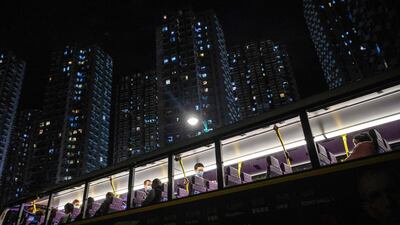
Passengers on board a bus shortly before their departure from Tuen Mun in Hong Kong to Shenzhen, via the Shenzhen Bay Bridge. AFP -
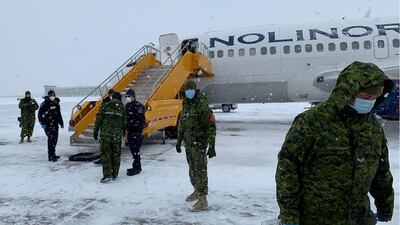
Canadian Forces personnel stand by to assist Canadians evacuated from China as they disembark from a plane at Canadian Forces Base Trenton in Trenton, Ontario, Canada. Reuters -
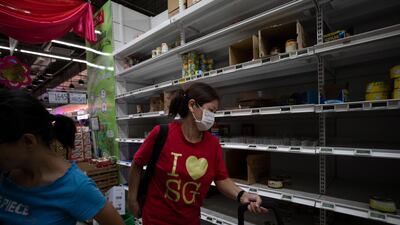
Customers walk by an almost empty shelf of canned food and instant noodles at a supermarket in Singapore. EPA -
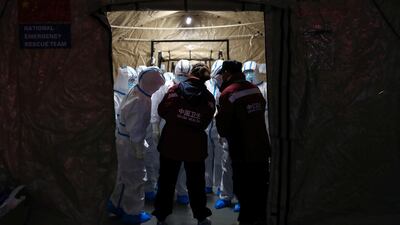
Medical workers in protective suits are seen at the Wuhan Parlor Convention Center, which has been converted into a makeshift hospital following an outbreak of the novel coronavirus, in Wuhan, Hubei province, China. Reuters -
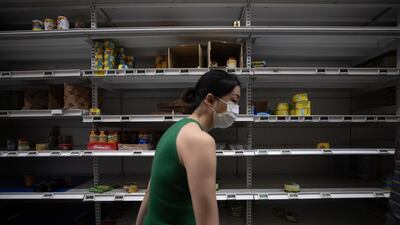
A customer walks by an almost empty shelf of canned food and instant noodles at a supermarket in Singapore. EPA -
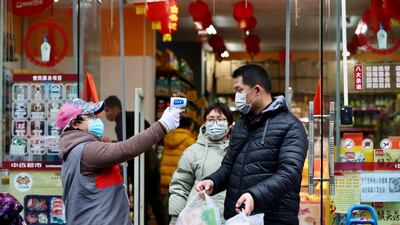
A worker measures body temperature of people leaving a supermarket in Qingshan district following an outbreak of the novel coronavirus in Wuhan, Hubei province, China. Reuters -

A volunteer helps residents who are affected by the measures to prevent and control the novel coronavirus to purchase daily necessities from a store in Tangshan, Hebei province, China. Reuters -
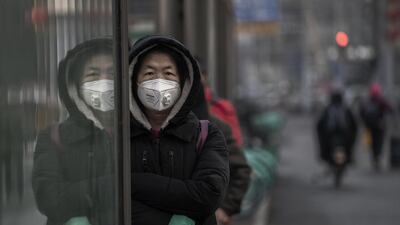
A Chinese woman wears a protective mask as she waits for a bus in Beijing, China. Getty Images -
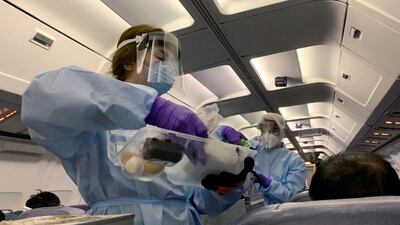
Flight attendants wearing protective clothing and masks serve snacks to Canadians, who had been evacuated from China due to the outbreak of novel Coronavirus on an American charter plane, on another aircraft taking them to Canadian Forces Base (CFB) Trenton, from Vancouver International Airport in Richmond, British Columbia, Canada. Reuters -

A Royal Canadian Mounted Police officer wearing a mask checks Canadians evacuated from China. Reuters -
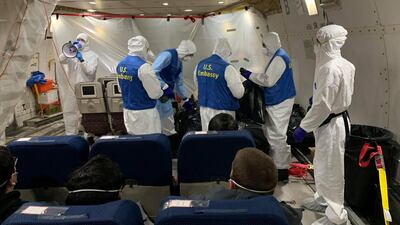
Staff from the US embassy board a cargo plane, chartered by the US State Department to evacuate Americans and Canadians from China. Reuters -
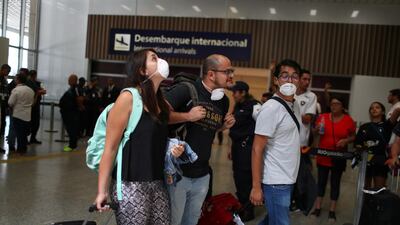
Passengers wearing masks, following the coronavirus outbreak in China, arrive at the Tom Jobim International Airport in Rio de Janeiro, Brazil. Reuters


Although doctors have stressed the fatality rate may be revised down as more mild cases come to light, the mortality rate of the coronavirus just now is more akin to the death rate of Spanish flu. That caused a global pandemic in 1918, infecting around 500 million people, a third of the global population at the time, killing between 20 to 50 million of them. Researchers estimate the case fatality rate of the Spanish flu was around 2.5 per cent.
Dr Rajeshwari Patil, specialist in microbiology at Medeor Hospital Abu Dhabi, said healthy people will likely only experience a mild illness if they are infected.
But it is important to identify all cases in order to prevent it from spreading in the community.
“People with heart disease, diabetes or respiratory allergy are particularly at risk. They are already in an immunocompromised state and are prone to developing a more serious illness,” she said.

