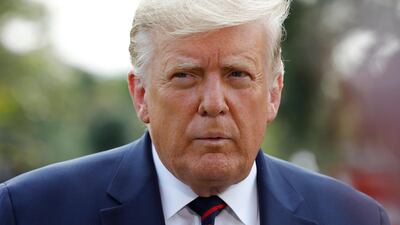
Donald Trump has a personal style that seldom follows political norms. EPA

Trump has left his mark on the Middle East


  • English
  • Arabic

Whether they support him or not, political observers have to concede that US President Donald Trump has changed the way his nation does politics. While he is seen as a divisive figure at home, his legacy in the Middle East has been praised by a number of Arab nations and even by Syrian opposition groups and Iraqi activists - particularly after the killing of Iran’s Al Quds Force leader Qassem Suleimani, who oversaw militias that wreaked havoc across the region.

Mr Trump has a personal style that seldom follows political norms. Instead of making repeated grand speeches about peace in the Middle East, the US president resorted to taking action, bringing his allies closer together and demonstrating the US’s resolve to find practicable solutions to long-standing problems.

Mr Trump’s first official trip abroad was to Saudi Arabia, one of America’s closest allies. Since coming into office in January 2017, he has fostered closer relations with other Arab nations in line with American interests. He has also listened closely to their concerns. By pulling the US out of the flawed Iran nuclear deal, Mr Trump highlighted proximity in views with other Arab countries.

Arab leaders had expressed concerns that the deal failed to address Iranian funding to armed proxies that destabilised the entire region. Europe has joined the US and its Gulf allies in taking a tougher stance on Iranian proxies such as Hezbollah, which is now considered a terrorist group in the UK and Germany.

Mr Trump plans to forge a new, better deal, yet Iran has repeatedly refused to accept the need to tackle wider issues. Tehran must resort to diplomacy if it is to reintegrate the international community.

Sectarian warfare, fuelled by Iran-backed proxies and terrorist groups, has plagued the region. The US has led international efforts to destroy ISIS, and its so-called caliphate was quashed during Mr Trump’s tenure. However, the conditions needed to render ISIS a thing of the past have yet to be met. These include peace, economic opportunities, and access to basic rights and services. As a result, sleeper cells continue to terrorise innocents.

The region has been divided by conflict for too long, and its people yearn for peace. In the words of UAE Minister of Foreign Affairs and International Co-operation Sheikh Abdullah bin Zayed: "Our region has suffered far too long. We want to show our people, the region and the world that there is good news."

Mr Trump has undoubtedly played a positive role in changing the dynamics on the ground. Normalisation between the UAE, Bahrain and Israel was made possible in part thanks to US mediation. Mr Trump's unorthodox approach to the Palestinian-Israeli conflict has, however, angered Palestinian leadership and has not furthered their aspirations for statehood. The Palestinian Authority decided to cut ties with the Trump administration after the US moved its embassy to Jerusalem in 2018, recognising the divided city as the capital of Israel.

Mr Trump will be remembered in the Middle East for his direct yet unorthodox approach

The PA is also angered by the Abraham Accords. Dr Anwar Gargash, UAE Minister of State for Foreign Affairs, hopes that “once the dust settles” the Palestinians will appreciate that “having a functioning relationship [with Israel] will put us in a better place to support and help them.” He also said that it was up to the Palestinian to lead the way, and that the UAE would continue to support efforts to resolve the conflict with Israel.

Mr Trump will be remembered in the Middle East for his direct yet unorthodox approach, when it comes to achieving peace, and fighting terrorism and extremism. Whatever the outcome of the US presidential election in November, Mr Trump would have left his mark on a region whose affairs are often tied to that of Washington.

In numbers: China in Dubai

The number of Chinese people living in Dubai: An estimated 200,000

Number of Chinese people in International City: Almost 50,000

Daily visitors to Dragon Mart in 2018/19: 120,000

Daily visitors to Dragon Mart in 2010: 20,000

Percentage increase in visitors in eight years: 500 per cent

How it works

A $10 hand-powered LED light and battery bank

Device is operated by hand cranking it at any time during the day or night 

The charge is stored inside a battery

The ratio is that for every minute you crank, it provides 10 minutes light on the brightest mode

A full hand wound charge is of 16.5minutes 

This gives 1.1 hours of light on high mode or 2.5 hours of light on low mode

When more light is needed, it can be recharged by winding again

The larger version costs between $18-20 and generates more than 15 hours of light with a 45-minute charge

No limit on how many times you can charge


ANATOMY%20OF%20A%20FALL
%3Cp%3E%3Cstrong%3EDirector%3A%20%3C%2Fstrong%3EJustine%20Triet%3C%2Fp%3E%0A%3Cp%3E%3Cstrong%3EStarring%3A%20%3C%2Fstrong%3ESandra%20Huller%2C%20Swann%20Arlaud%2C%20Milo%20Machado-Graner%3C%2Fp%3E%0A%3Cp%3E%3Cstrong%3ERating%3A%3C%2Fstrong%3E%205%2F5%3C%2Fp%3E%0A

Mercer, the investment consulting arm of US services company Marsh & McLennan, expects its wealth division to at least double its assets under management (AUM) in the Middle East as wealth in the region continues to grow despite economic headwinds, a company official said.

Mercer Wealth, which globally has $160 billion in AUM, plans to boost its AUM in the region to $2-$3bn in the next 2-3 years from the present $1bn, said Yasir AbuShaban, a Dubai-based principal with Mercer Wealth.

Within the next two to three years, we are looking at reaching $2 to $3 billion as a conservative estimate and we do see an opportunity to do so,” said Mr AbuShaban.

Mercer does not directly make investments, but allocates clients’ money they have discretion to, to professional asset managers. They also provide advice to clients.

“We have buying power. We can negotiate on their (client’s) behalf with asset managers to provide them lower fees than they otherwise would have to get on their own,” he added.

Mercer Wealth’s clients include sovereign wealth funds, family offices, and insurance companies among others.

From its office in Dubai, Mercer also looks after Africa, India and Turkey, where they also see opportunity for growth.

Wealth creation in Middle East and Africa (MEA) grew 8.5 per cent to $8.1 trillion last year from $7.5tn in 2015, higher than last year’s global average of 6 per cent and the second-highest growth in a region after Asia-Pacific which grew 9.9 per cent, according to consultancy Boston Consulting Group (BCG). In the region, where wealth grew just 1.9 per cent in 2015 compared with 2014, a pickup in oil prices has helped in wealth generation.

BCG is forecasting MEA wealth will rise to $12tn by 2021, growing at an annual average of 8 per cent.

Drivers of wealth generation in the region will be split evenly between new wealth creation and growth of performance of existing assets, according to BCG.

Another general trend in the region is clients’ looking for a comprehensive approach to investing, according to Mr AbuShaban.

“Institutional investors or some of the families are seeing a slowdown in the available capital they have to invest and in that sense they are looking at optimizing the way they manage their portfolios and making sure they are not investing haphazardly and different parts of their investment are working together,” said Mr AbuShaban.

Some clients also have a higher appetite for risk, given the low interest-rate environment that does not provide enough yield for some institutional investors. These clients are keen to invest in illiquid assets, such as private equity and infrastructure.

“What we have seen is a desire for higher returns in what has been a low-return environment specifically in various fixed income or bonds,” he said.

“In this environment, we have seen a de facto increase in the risk that clients are taking in things like illiquid investments, private equity investments, infrastructure and private debt, those kind of investments were higher illiquidity results in incrementally higher returns.”

The Abu Dhabi Investment Authority, one of the largest sovereign wealth funds, said in its 2016 report that has gradually increased its exposure in direct private equity and private credit transactions, mainly in Asian markets and especially in China and India. The authority’s private equity department focused on structured equities owing to “their defensive characteristics.”
