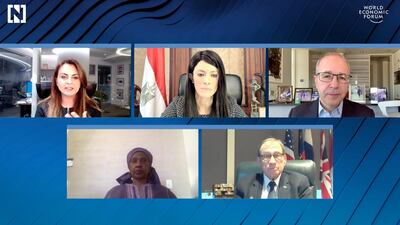
The panel at the Placing Gender Parity at the Heart of the Recovery session at the virtual World Economic Forum event. Panellists included Rania Al-Mashat, minister of international cooperation of Egypt; Phumzile Mlambo-Ngcuka, unndersecretary- general and executive director at UN WOMEN, Michael Neidorff, chairman, president and chief executive at Centene, Kevin Sneader, global managing partner at McKinsey & Company, while the moderator was Mina Al-Oraibi, editor-in-chief, The National. Courtesy WEF
The panel at the Placing Gender Parity at the Heart of the Recovery session at the virtual World Economic Forum event. Panellists included Rania Al-Mashat, minister of international cooperation of Egy

Investing in gender parity 'makes good business sense' in a post-pandemic world


Alice Haine
  • English
  • Arabic

It makes "good business sense" for companies to invest in gender parity to boost the global recovery from the pandemic because firms that are more diverse tend to outperform those that are not, according to a virtual meeting at the World Economic Forum on Monday.

Kevin Sneader, global managing partner at the management consultancy McKinsey & Company, said companies that have a more diverse workforce are 25 per cent more likely to outperform those that do not.

“It’s worth reminding ourselves that diversity does connect with performance,” Mr Sneader told the Placing Gender Parity at the Heart of the Recovery panel, hosted by Mina Al-Oraibi, The National’s editor-in-chief.

“If we look across the labour force and think about what's needed to respond to the challenges that we've got now, it's good business to make that investment in parity and not to think it’s optional – it’s not optional.”

The WEF panel session focused on the challenges women have faced since the start of the Covid crisis, including what the Forum calls a “double-double shift” of at least 20 hours per week of additional work for women at home.

Women’s careers have been more adversely affected than men’s during the coronavirus pandemic, with female jobs 1.8 times more vulnerable to this crisis than men’s jobs globally, at 5.7 per cent versus 3.1 per cent, according to McKinsey.

“Statistics show that while women make up 39 per cent of the global workforce, they've accounted for 54 per cent of total job losses,” Ms Al-Oraibi told delegates at the session, quoting McKinsey data.

“Informal workers experienced a 60 per cent fall in income in the first month of the pandemic. And according to the ILO (International Labour Organisation), 714 million women are in informal employment, and most likely are the most vulnerable.”

Mr Sneader said the gender parity setback women now face as a result of the Covid crisis is “very serious” and "dramatic".

“We're really at a crossroads now,” he said. “After decades of progress, and let's be clear, the progress has been slow … we now see very a significant impact on multiple dimensions.

“Women's jobs are 20 per cent more at risk simply because of the sectors that have been hardest hit in this moment - think accommodation, hospitality, and retail. That's a huge setback."

Michael Neidorff, chairman, president and chief executive of the healthcare multinational, Centene Corporation, said two of his board members are women and that from the top down the message is clear: “you can achieve it if you’re women in this company”.

With 75 per cent of the company’s workforce made up of women, as well as 55 per cent at director level and above, he said the company does not have specific programmes to hire women because “we want everybody in this company to know that somebody is in the job because they’re the best person for the job”.

However, he conceded that he had achieved his company's healthy gender balance through some of the flexible measures put in place to attract women to the company.

These include offering more flexibility for women with children during the pandemic and a child development centre that not only offers childcare but tutoring as well.

The company also offers “robust” leadership inclusion programmes.

“What's important is to have these programmes in place and maintain them. And I think we'd like to be the example that it can be done and it is being done,” Mr Neidorff said.

Putting policies in place to help women during Covid is something Egypt has prioritised, according to the country’s minister of International cooperation, Rania Al-Mashat.

When the nation’s workers were suddenly forced to work from home at the start of the pandemic, training was offered to enhance women’s digital skills to help them cope with the change while a decree was issued to allow women with children under the age of 12 to take leave.

“This was done in legislation,” said Ms Al-Mashat. “So policymaking was quite important in formulating that.”

“If we move towards parity, GDP (gross domestic product) globally goes up by $13 trillion. And that is a big number. And given where we are today, that extra addition to GDP and to productivity is quite important. Women's participation in the economy is macro critical. So it's no longer just the number, but it's actually an increase in GDP and an increase in productivity."

Mr Sneader said 80% of the 1.1 million who dropped out of the US workforce in September were women. Courtesy WEF

Mr Sneader said retention will be the big issue going forward, because a quarter of senior American women in the labour force are now considering stepping out of their roles because of the crisis.

"Eighty per cent of the 1.1 million who dropped out of the US workforce in September alone were women. That is an enormous cost to business,” Mr Sneader said.

"Think about the investments made in training and developing people. To lose that talent, it's almost unthinkable from an economic point of view.”

Some of the things needed to achieve gender parity also make sense for all employees, he added, such as family-friendly policies, childcare and rethinking how performance reviews are done

"I absolutely reject the notion that there's a trade-off here … that we're trading off a green recovery for gender parity recovery, or for just a plain economic recovery - this is all connected, we need to move forward in all fronts,” Mr Sneader said.


UAE currency: the story behind the money in your pockets

Mercer, the investment consulting arm of US services company Marsh & McLennan, expects its wealth division to at least double its assets under management (AUM) in the Middle East as wealth in the region continues to grow despite economic headwinds, a company official said.

Mercer Wealth, which globally has $160 billion in AUM, plans to boost its AUM in the region to $2-$3bn in the next 2-3 years from the present $1bn, said Yasir AbuShaban, a Dubai-based principal with Mercer Wealth.

Within the next two to three years, we are looking at reaching $2 to $3 billion as a conservative estimate and we do see an opportunity to do so,” said Mr AbuShaban.

Mercer does not directly make investments, but allocates clients’ money they have discretion to, to professional asset managers. They also provide advice to clients.

“We have buying power. We can negotiate on their (client’s) behalf with asset managers to provide them lower fees than they otherwise would have to get on their own,” he added.

Mercer Wealth’s clients include sovereign wealth funds, family offices, and insurance companies among others.

From its office in Dubai, Mercer also looks after Africa, India and Turkey, where they also see opportunity for growth.

Wealth creation in Middle East and Africa (MEA) grew 8.5 per cent to $8.1 trillion last year from $7.5tn in 2015, higher than last year’s global average of 6 per cent and the second-highest growth in a region after Asia-Pacific which grew 9.9 per cent, according to consultancy Boston Consulting Group (BCG). In the region, where wealth grew just 1.9 per cent in 2015 compared with 2014, a pickup in oil prices has helped in wealth generation.

BCG is forecasting MEA wealth will rise to $12tn by 2021, growing at an annual average of 8 per cent.

Drivers of wealth generation in the region will be split evenly between new wealth creation and growth of performance of existing assets, according to BCG.

Another general trend in the region is clients’ looking for a comprehensive approach to investing, according to Mr AbuShaban.

“Institutional investors or some of the families are seeing a slowdown in the available capital they have to invest and in that sense they are looking at optimizing the way they manage their portfolios and making sure they are not investing haphazardly and different parts of their investment are working together,” said Mr AbuShaban.

Some clients also have a higher appetite for risk, given the low interest-rate environment that does not provide enough yield for some institutional investors. These clients are keen to invest in illiquid assets, such as private equity and infrastructure.

“What we have seen is a desire for higher returns in what has been a low-return environment specifically in various fixed income or bonds,” he said.

“In this environment, we have seen a de facto increase in the risk that clients are taking in things like illiquid investments, private equity investments, infrastructure and private debt, those kind of investments were higher illiquidity results in incrementally higher returns.”

The Abu Dhabi Investment Authority, one of the largest sovereign wealth funds, said in its 2016 report that has gradually increased its exposure in direct private equity and private credit transactions, mainly in Asian markets and especially in China and India. The authority’s private equity department focused on structured equities owing to “their defensive characteristics.”

The Laughing Apple

Yusuf/Cat Stevens

(Verve Decca Crossover)

TRAP

Starring: Josh Hartnett, Saleka Shyamalan, Ariel Donaghue

Director: M Night Shyamalan

Rating: 3/5

Avatar%3A%20The%20Way%20of%20Water
%3Cp%3E%3Cstrong%3EDirector%3A%20%3C%2Fstrong%3EJames%20Cameron%3C%2Fp%3E%0A%3Cp%3E%3Cstrong%3EStars%3A%20%3C%2Fstrong%3ESam%20Worthington%2C%20Zoe%20Saldana%2C%20Sigourney%20Weaver%3C%2Fp%3E%0A%3Cp%3E%3Cstrong%3ERating%3A%20%3C%2Fstrong%3E3.5%2F5%3C%2Fp%3E%0A
Key facilities
  • Olympic-size swimming pool with a split bulkhead for multi-use configurations, including water polo and 50m/25m training lanes
  • Premier League-standard football pitch
  • 400m Olympic running track
  • NBA-spec basketball court with auditorium
  • 600-seat auditorium
  • Spaces for historical and cultural exploration
  • An elevated football field that doubles as a helipad
  • Specialist robotics and science laboratories
  • AR and VR-enabled learning centres
  • Disruption Lab and Research Centre for developing entrepreneurial skills
Avatar: Fire and Ash

Director: James Cameron

Starring: Sam Worthington, Sigourney Weaver, Zoe Saldana

Rating: 4.5/5

The years Ramadan fell in May

1987

1954

1921

1888

It Was Just an Accident

Director: Jafar Panahi

Stars: Vahid Mobasseri, Mariam Afshari, Ebrahim Azizi, Hadis Pakbaten, Majid Panahi, Mohamad Ali Elyasmehr

Rating: 4/5