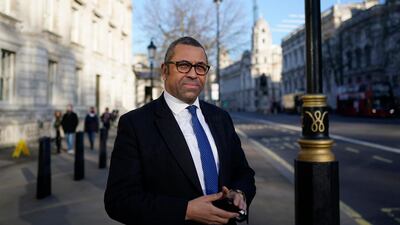
Britain’s Middle East minister James Cleverly had previously warned that the Muslim Brotherhood would capitalise on the hardships brought on by Covid-19 to broaden its influence. EPA
Europe has awakened to the challenges posed by networks of political Islamist movements within its social and political institutions. Country after country is moving to address the particular challenges of groups operating within the law but working steadily to challenge the common values underpinning the system.
In doing so, the policy makers are focusing beyond the threat of terrorism that has dominated global security responses for two decades. Instead, there is a wider issue at play. How does the state gain insight about, and ultimately sanction, groups that exert ideological control over segments of the population?
Since many of the people targeted by European groups are immigrants, or from migrant backgrounds, there is a longer-term calculation to make about how society is evolving. No nation wants to deal with a situation in which different communities live largely separate existences.
Yusuf Al Qaradawi is a leading Muslim Brotherhood figurehead based in Qatar. Reuters
The most pressing concerns on the continent surround the Muslim Brotherhood, the Turkish state’s "consular" reach into its diaspora and Iran’s intelligence network there.
Last week the French government relaunched its state of the nation agenda around tackling Islamism. It has promised legislation to target activity directed against the republican traditions of the state. The Austrian government separately launched an observatory that has been tasked with monitoring Islamist activities within the public sphere. This month a committee of Dutch parliamentarians submitted an urgent report calling for an urgent official response to underground Brotherhood networks in the country.
There has been fierce pressure on the Swedish government to intervene to prevent exploitation of public schools and even kindergartens. Known Islamist extremists have been receiving state money to work as head teachers but are not providing recognised and standard Swedish education. Denmark's intelligence and security services have reported their concerns over ideological hostility to the kingdom within certain community organisations.
Last week a report from the Slovakia-based think tank Globsec Policy Institute noted that the Brotherhood's pan-European Federation of Islamic Organisations (FIOE) in Europe has set up a central and eastern Europe division. It echoed the concerns of Britain's Middle East minister James Cleverly, who said that the Brotherhood would capitalise on the hardships brought on by Covid-19 to broaden its influence.
The Brotherhood tops the list of groups that exert this kind of influence. Its mindset is a threat to social integration and cohesion in Europe.
Within Europe, the Doha-based chief ideologue Yusuf Al Qaradawi has directly instructed the chapters not to directly engage in terrorism – but only for the practical reason that he does not think it would prevail. In the eyes of many Europe intelligence agencies, however, the Brotherhood creates a fertile environment for other groups to build on for radicalisation purposes.
According to the researcher Lorenzo Vidino, European governments are defending their constitutional systems from Islamist influence. Getty Images
According to the leading researcher in the field, Lorenzo Vidino, author of the book The Closed Circle – Joining and Leaving the Muslim Brotherhood in the West, European governments are increasingly going on the offensive to defend their constitutional systems from Islamist influence.
When the British-based Anas Al Tikriti appeared before the House of Commons Foreign Affairs Committee in 2016, he claimed that the UK did not have a Muslim Brotherhood organisation. But Mr Al Tikriti, who runs an advisory group that supposedly aims to "bridge the gap of understanding between the Muslim world and the West”, conceded that the Muslim Association of Britain (MAB) did espouse its basic tenets.
Mr Vidino’s book states that there is an extensive European Muslim Brotherhood that makes membership arduous to gain and even more traumatic to leave.
In a 2018 report, the influential French think tank Institut Montaigne profiled the spread of the Brotherhood. It said the programme of expansion was built on a militant logic and its definition of Muslim citizenship to which its adherents belonged. This has allowed activists to focus on issues of identity, education, inclusiveness and their own broadly drawn concepts of Islamophobia.
Anas Al Tikriti has conceded that the Muslim Association of Britain espouses the basic tenets of the Muslim Brotherhood. Getty Images
This has also allowed Brotherhood-controlled groups to have both a subversive agenda and to interpose as an interlocutor between the state and community groups. For this purpose, organisations such as the MAB, FIOE and others have become power brokers that influence politicians and the media. In France there is Union of Islamic Organisations of France and in Italy there is the Union of Islamic Communities and Organisations.
A common trait is the exploitation of charitable status by the organisations to advance their outreach. It was notable, for instance, that Qatar had made substantial contributions to the Italian branch of the Brotherhood as Rome struggled to contain its Covid-19 outbreak.
While it is encouraging that European governments have mobilised themselves to tackle the problem at home, that is only half the story. The Institut Montaigne makes the concluding point that it is also necessary for the European Commission and its member-states to set this policy at the heart of the continent's diplomatic agenda. Without broad recognition that Islamist extremism is a common threat, European foreign policy fails to distinguish between friend and foe in an appropriate way. That is the ultimate dividing line.
Damien McElroy is the London bureau chief of The National

Learning to Skateboard in a Warzone (If You're a Girl) – 1
Marriage Story – 1
Rocketman – 1
The Neighbors' Window – 1
Toy Story 4 – 1
Banned items
Dubai Police has also issued a list of banned items at the ground on Sunday. These include:
Drones
Animals
Fireworks/ flares
Radios or power banks
Laser pointers
Glass
Selfie sticks/ umbrellas
Sharp objects
Political flags or banners
Bikes, skateboards or scooters
The burning issue
The internal combustion engine is facing a watershed moment – major manufacturer Volvo is to stop producing petroleum-powered vehicles by 2021 and countries in Europe, including the UK, have vowed to ban their sale before 2040. The National takes a look at the story of one of the most successful technologies of the last 100 years and how it has impacted life in the UAE.
5 - Year sponsorship deal between Hesco and Jebel Ali Dragons
700 - Dubai Hurricanes had more than 700 playing members last season between their mini and youth, men's and women's teams
Dh600,000 - Dubai Exiles' budget for pitch and court hire next season, for their rugby, netball and cricket teams
Dh1.8m - Dubai Hurricanes' overall budget for next season
Dh2.8m - Dubai Exiles’ overall budget for next season
A new relationship with the old country
Treaty of Friendship between the United Kingdom of Great Britain and Northern Ireland and the United Arab Emirates
The United kingdom of Great Britain and Northern Ireland and the United Arab Emirates; Considering that the United Arab Emirates has assumed full responsibility as a sovereign and independent State; Determined that the long-standing and traditional relations of close friendship and cooperation between their peoples shall continue; Desiring to give expression to this intention in the form of a Treaty Friendship; Have agreed as follows:
ARTICLE 1 The relations between the United Kingdom of Great Britain and Northern Ireland and the United Arab Emirates shall be governed by a spirit of close friendship. In recognition of this, the Contracting Parties, conscious of their common interest in the peace and stability of the region, shall: (a) consult together on matters of mutual concern in time of need; (b) settle all their disputes by peaceful means in conformity with the provisions of the Charter of the United Nations.
ARTICLE 2 The Contracting Parties shall encourage education, scientific and cultural cooperation between the two States in accordance with arrangements to be agreed. Such arrangements shall cover among other things: (a) the promotion of mutual understanding of their respective cultures, civilisations and languages, the promotion of contacts among professional bodies, universities and cultural institutions; (c) the encouragement of technical, scientific and cultural exchanges.
ARTICLE 3 The Contracting Parties shall maintain the close relationship already existing between them in the field of trade and commerce. Representatives of the Contracting Parties shall meet from time to time to consider means by which such relations can be further developed and strengthened, including the possibility of concluding treaties or agreements on matters of mutual concern.
ARTICLE 4 This Treaty shall enter into force on today’s date and shall remain in force for a period of ten years. Unless twelve months before the expiry of the said period of ten years either Contracting Party shall have given notice to the other of its intention to terminate the Treaty, this Treaty shall remain in force thereafter until the expiry of twelve months from the date on which notice of such intention is given.
IN WITNESS WHEREOF the undersigned have signed this Treaty.
DONE in duplicate at Dubai the second day of December 1971AD, corresponding to the fifteenth day of Shawwal 1391H, in the English and Arabic languages, both texts being equally authoritative.
Signed
Geoffrey Arthur Sheikh Zayed
Results
5pm: Wadi Nagab – Maiden (PA) Dh80,000 (Turf) 1,200m; Winner: Al Falaq, Antonio Fresu (jockey), Ahmed Al Shemaili (trainer)
5.30pm: Wadi Sidr – Handicap (PA) Dh80,000 (T) 1,200m; Winner: AF Majalis, Tadhg O’Shea, Ernst Oertel
6pm: Wathba Stallions Cup – Handicap (PA) Dh70,000 (T) 2,200m; Winner: AF Fakhama, Fernando Jara, Mohamed Daggash
6.30pm: Wadi Shees – Handicap (PA) Dh80,000 (T) 2,200m; Winner: Mutaqadim, Antonio Fresu, Ibrahim Al Hadhrami
7pm: Arabian Triple Crown Round-1 – Listed (PA) Dh230,000 (T) 1,600m; Winner: Bahar Muscat, Antonio Fresu, Ibrahim Al Hadhrami
7.30pm: Wadi Tayyibah – Maiden (TB) Dh80,000 (T) 1,600m; Winner: Poster Paint, Patrick Cosgrave, Bhupat Seemar
Milestones on the road to union
1970
October 26: Bahrain withdraws from a proposal to create a federation of nine with the seven Trucial States and Qatar.
December: Ahmed Al Suwaidi visits New York to discuss potential UN membership.
1971
March 1: Alex Douglas Hume, Conservative foreign secretary confirms that Britain will leave the Gulf and “strongly supports” the creation of a Union of Arab Emirates.
July 12: Historic meeting at which Sheikh Zayed and Sheikh Rashid make a binding agreement to create what will become the UAE.
July 18: It is announced that the UAE will be formed from six emirates, with a proposed constitution signed. RAK is not yet part of the agreement.
August 6: The fifth anniversary of Sheikh Zayed becoming Ruler of Abu Dhabi, with official celebrations deferred until later in the year.
August 15: Bahrain becomes independent.
September 3: Qatar becomes independent.
November 23-25: Meeting with Sheikh Zayed and Sheikh Rashid and senior British officials to fix December 2 as date of creation of the UAE.
November 29: At 5.30pm Iranian forces seize the Greater and Lesser Tunbs by force.
November 30: Despite a power sharing agreement, Tehran takes full control of Abu Musa.
November 31: UK officials visit all six participating Emirates to formally end the Trucial States treaties
December 2: 11am, Dubai. New Supreme Council formally elects Sheikh Zayed as President. Treaty of Friendship signed with the UK. 11.30am. Flag raising ceremony at Union House and Al Manhal Palace in Abu Dhabi witnessed by Sheikh Khalifa, then Crown Prince of Abu Dhabi.
December 6: Arab League formally admits the UAE. The first British Ambassador presents his credentials to Sheikh Zayed.
December 9: UAE joins the United Nations.
World record transfers
1. Kylian Mbappe - to Real Madrid in 2017/18 - €180 million (Dh770.4m - if a deal goes through)
2. Paul Pogba - to Manchester United in 2016/17 - €105m
3. Gareth Bale - to Real Madrid in 2013/14 - €101m
4. Cristiano Ronaldo - to Real Madrid in 2009/10 - €94m
5. Gonzalo Higuain - to Juventus in 2016/17 - €90m
6. Neymar - to Barcelona in 2013/14 - €88.2m
7. Romelu Lukaku - to Manchester United in 2017/18 - €84.7m
8. Luis Suarez - to Barcelona in 2014/15 - €81.72m
9. Angel di Maria - to Manchester United in 2014/15 - €75m
10. James Rodriguez - to Real Madrid in 2014/15 - €75m
Other acts on the Jazz Garden bill
Sharrie Williams
The American singer is hugely respected in blues circles due to her passionate vocals and songwriting. Born and raised in Michigan, Williams began recording and touring as a teenage gospel singer. Her career took off with the blues band The Wiseguys. Such was the acclaim of their live shows that they toured throughout Europe and in Africa. As a solo artist, Williams has also collaborated with the likes of the late Dizzy Gillespie, Van Morrison and Mavis Staples. Lin Rountree
An accomplished smooth jazz artist who blends his chilled approach with R‘n’B. Trained at the Duke Ellington School of the Arts in Washington, DC, Rountree formed his own band in 2004. He has also recorded with the likes of Kem, Dwele and Conya Doss. He comes to Dubai on the back of his new single Pass The Groove, from his forthcoming 2018 album Stronger Still, which may follow his five previous solo albums in cracking the top 10 of the US jazz charts. Anita Williams
Dubai-based singer Anita Williams will open the night with a set of covers and swing, jazz and blues standards that made her an in-demand singer across the emirate. The Irish singer has been performing in Dubai since 2008 at venues such as MusicHall and Voda Bar. Her Jazz Garden appearance is career highlight as she will use the event to perform the original song Big Blue Eyes, the single from her debut solo album, due for release soon.
A widely accepted definition was made by the All Party Parliamentary Group on British Muslims in 2019: “Islamophobia is rooted in racism and is a type of racism that targets expressions of Muslimness or perceived Muslimness.” It further defines it as “inciting hatred or violence against Muslims”.
