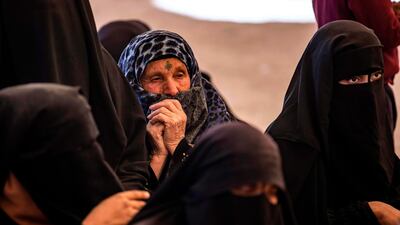

The human toll of the crisis in Syria is well known to everyone who has followed it, even casually, since 2011. Over half a million are dead and half of the country’s pre-war population of 20 million are displaced, some internally and others in neighbouring countries, Europe and farther afield.
It is worth highlighting the impact that the war has had on women, and considering how these challenges have been exacerbated by the coronavirus pandemic, both in Syria and across the region.
A new report by the Syrian Network for Human Rights, a respected watchdog, puts the crisis in stark numbers, even though the organisation’s figures are likely to be more conservative given the stringent verification criteria it employs. It documented the death of 28,405 women during the war, 22,000 of whom were killed by forces loyal to the Syrian government, and 91 of whom were tortured to death. Moreover, 8,746 women have been forcibly disappeared, once again the vast majority at the hands of President Bashar Al Assad’s regime.

The suffering extends further. SNHR documented the birth of 87 children in government detention centres, where they lacked any form of post-natal care, leading to the deaths of seven babies. It also recorded more than 8,000 incidents of sexual violence by government loyalists, including 879 in detention centres and 443 cases against girls under 18. The finding conforms with that of independent UN investigators, who declared in 2018 that rape and sexual violence were pervasive in the conflict.
In addition to direct violence by troops and security personnel, women, especially refugees, have been forced into the role of breadwinners for their families, given the death toll of military-age men. Women have also often borne the brunt of gender-based and domestic violence because of the conditions in refugee camps and the lack of economic opportunities there. As a correspondent, I interviewed women in Jordan and children in Lebanon who had been forced into early marriage or endured beatings by husbands and family members or witnessed violence in the war, all of which caused a myriad mental health issues and lifelong scars.
These economic and social challenges have been worsened in Syria and across the Middle East by the pandemic and all its subsequent effects of lockdowns, financial hardship and scarcity. UN officials have long warned that the pandemic could set back gender equality gains by decades and lead to a surge in gender-based violence. These issues are magnified in much of the Arab world, because women were under-represented in the workplace to begin with and because stronger traditional gender norms mean chores, caring for and educating children. Work-related sacrifices, therefore, are more likely to fall on their shoulders, even beyond the trends seen in western countries.
-
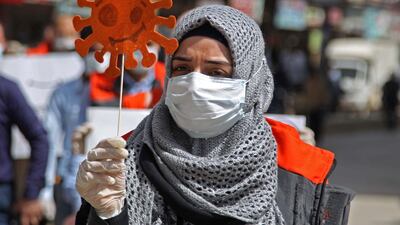
A mask-clad civil society volunteer marches with an effigy depicting the SARS-CoV-2 virion, the agent responsible for the COVID-19 coronavirus disease, during an awareness campaign about the novel coronavirus pandemic, urging people to remain at home, in Syria's northwestern city of Idlib in Idlib province on March 24, 2020. (Photo by Abdulaziz KETAZ / AFP) -
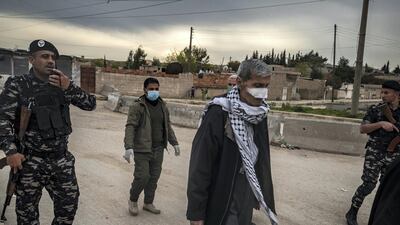
Syrian Kurdish passengers who were stranded in Damascus arrive in Qamishli in Syria's northeastern Hasakeh province on April 5, 2020, after being stranded in Damascus for the past weeks. (Photo by DELIL SOULEIMAN / AFP) -
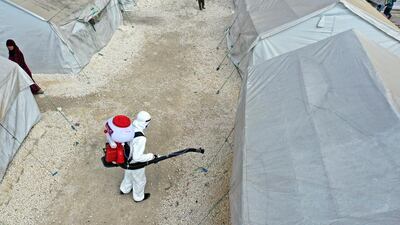
A drone image taken on April 9, 2020, shows a sanitation worker disinfecting a camp for displaced Syrians next to the Idlib municipal stadium in the northwestern Syrian city, during a campaign to limit the spread of the coronavirus (COVID-19) pandemic. (Photo by OMAR HAJ KADOUR / AFP) -
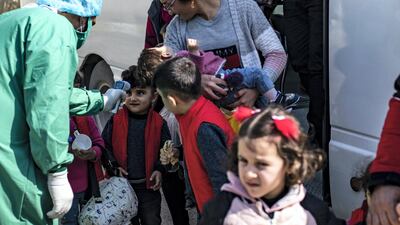
A medic checks the body temperature of young passengers, as a preventive measure against the coronavirus, upon their arrival by bus in Syria's Kurdish area from Iraqi Kurdistan via the Semalka border crossing in northeastern Syria on February 26, 2020. (Photo by Delil SOULEIMAN / AFP) -
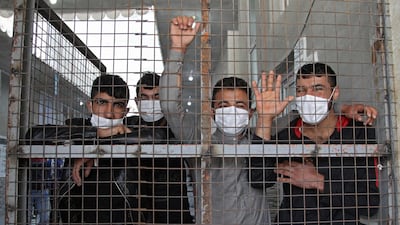
A picture taken on April 27, 2020 shows Syrians who returned from Turkey standing at a quarantine facility in the countryside of the town of Jisr al-Shughur, west of the mostly rebel-held Syrian province of Idlib, on April 27, 2020 during the coronavirus COVID-19 pandemic. / AFP / Abdulaziz KETAZ -
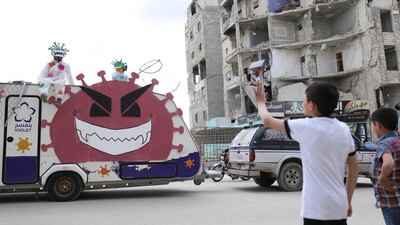
epa08392436 A truck for prevention against the COVID-19 coronavirus disease, operated by local NGO 'Violet Organization', drives through the streets of Idlib, Syria, 29 April 2020. EPA/YAHYA NEMAH -
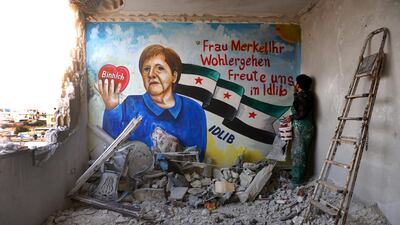
Artist Aziz al-Asmar paints a mural wishing for the well-being of German Chancellor Angela Merkel, who is in quarantine after being treated by a doctor who tested positive for coronavirus (COVID-19), inside a damaged building in the town of Binnish in Syria's northwestern Idlib province on March 24, 2020. (Photo by Muhammad HAJ KADOUR / AFP) -
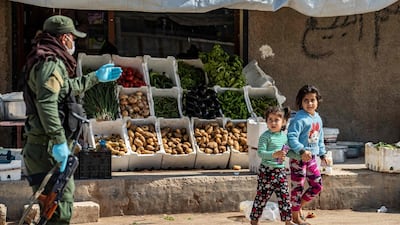
A member of the Kurdish Internal Security Forces of Asayesh urges children to return home, in Syria's northeastern city of Hasakeh on April 30, 2020, following measures taken by the Kurdish-led local authorities there, to limit the spread of the novel coronavirus. / AFP / DELIL SOULEIMAN -
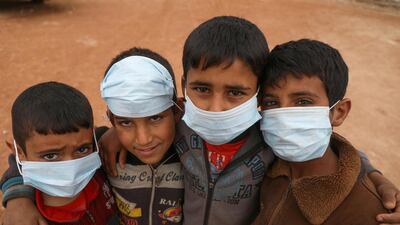
Syrian boys pose for a picture during an awareness workshop on Coronavirus (COVID-19) held by Doctor Ali Ghazal at a camp for displaced people in Atme town in Syria's northwestern Idlib province, near the border with Turkey, on March 14, 2020. (Photo by AAREF WATAD / AFP) -
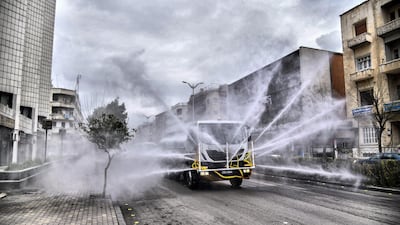
A handout picture released by the official Syrian Arab News Agency (SANA) on March 20, 2020 shows Syrian Red Crescent vehicles spraying disinfectant along a street in the capital Damascus, as part of measures against the spread of COVID-19 coronavirus disease. (Photo by - / SANA / AFP) / == RESTRICTED TO EDITORIAL USE - MANDATORY CREDIT "AFP PHOTO / HO / SANA" - NO MARKETING NO ADVERTISING CAMPAIGNS - DISTRIBUTED AS A SERVICE TO CLIENTS == -
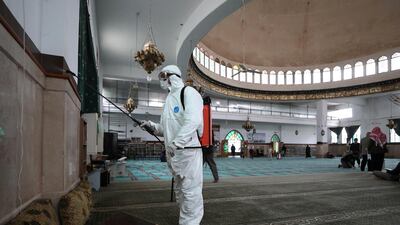
A volunteer from the Violet organisation disinfects a mosque in Syria's northwestern city of Idlib on April 25, 2020, from coronavirus (COVID-19) during the Muslim holy fasting month of Ramadan. (Photo by OMAR HAJ KADOUR / AFP) -
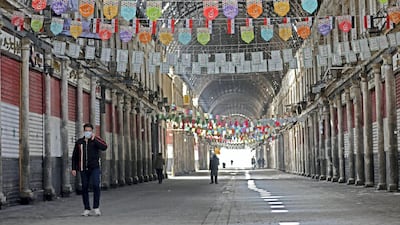
Only a few people walk in the century-old covered bazaar of Hamidiya in Syria's capital Damascus on March 24, 2020, after measures were taken by the authorities to fight the novel coronavirus pandemic. - Across much of the Syrian capital, with squares and markets once thronging with people even during the war, are now almost entirely empty. Five cases of COVID-19 have been reported in the country since Sunday, and the authorities have ordered all non-essential businesses closed. (Photo by LOUAI BESHARA / AFP) -
Researchers are examining the possibility of using inhalers to introduce stem cells into a patients lungs. AFP -
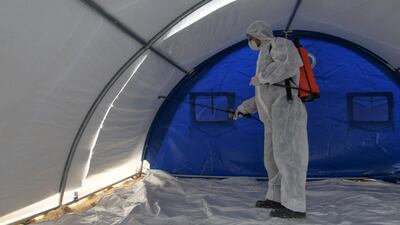
A member of the Syrian Violet NGO disinfects a triage tent erected for suspected coronavirus patients outside the Ibn Sina Hospital in Syria's northwestern Idlib city on March 19, 2020. - Syrian authorities on March 13 announced measures aimed at preventing coronavirus from reaching the war-torn country, including school closures and a ban on smoking shisha in cafes, state media reported. (Photo by Abdulaziz KETAZ / AFP) -
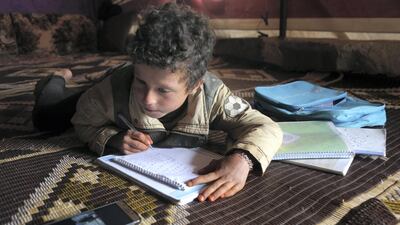
A young pupil follows a lesson on a mobile telephone inside a tent, in a camp for displaced Syrians in the village of Kafr Yahmoul in the northwestern Idlib province, amid the coronavirus pandemic on April 3, 2020. - Like in much of the world, educators in Syria are taking classes online after the country's various regions sent pupils home hoping to stem the COVID-19 pandemic. But distance learning is no small feat in a country battered by nine years of war, where fighting has displaced millions and the electricity supply is sporadic at best. (Photo by Aref TAMMAWI / AFP)


A policy briefing by the United Nations Economic and Social Commission for Western Asia and UN Women estimates that women could lose 700,000 jobs in the Middle East due to the pandemic, leading more of them to fall into poverty, particularly since women form a majority of the informal labour sector in the region. Covid-19 will also further restrict women’s access to various health services including during pregnancy, childbirth and postpartum, as well as services for victims of domestic abuse, who will find themselves increasingly forced to live with the abusers.
This is evident in the findings of Arab Barometer, a non-partisan research network. Surveys by the organisation found that citizens in several Arab countries perceived a rise in violence against women since the start of the pandemic, including a shocking 63 per cent perceived increase in Tunisia, 41 per cent in Morocco and Algeria, 27 per cent in Jordan and 20 per cent in Lebanon.
Bereft of support and services, many of these women have turned to the only source of succour that has not been denied to them – religion. The survey found that Arabs were praying more frequently since the start of the pandemic, with women seeking refuge in prayer in far greater numbers. In Algeria, the number of women praying more was higher by 21 per cent than men. In Jordan, that figure is 13 per cent.

Winning the battle against gender inequality, made more difficult by the pandemic, begins by recognising the issue. That means surveying women and gathering data on important markers of gender inequality, like domestic abuse, the division of household labour and workplace discrimination. But it also means enacting policies that protect women and highlight their contributions, including as leaders and frontline and essential workers in the fight against the coronavirus, devising new ways to reach out to and protect victims of domestic and gender-based violence, providing economic protections to women and finding ways to keep schools open or, at least, to provide equitable and comprehensive distance learning options to children during the pandemic.
As the battle for gender equality continues, many long-held norms will need to be shattered. That job is hard enough. We cannot allow the heartbreaking backsliding caused by the pandemic to become a permanent feature of our families, homes and workplaces.
Kareem Shaheen is a veteran Middle East correspondent in Canada and a columnist for The National

