• A satellite image taken over Galwan Valley in Ladakh, India, parts of which are contested with China, June 16, 2020, in this handout obtained from Planet Labs Inc. REUTERS
    A satellite image taken over Galwan Valley in Ladakh, India, parts of which are contested with China, June 16, 2020, in this handout obtained from Planet Labs Inc. REUTERS
  • An Indian army convoy makes way towards Leh, bordering China, in Gagangir. Twenty Indian soldiers were killed during "hand-to-hand' fighting with Chinese troops in a disputed Himalayan region, India's military said, the first deadly clash between the nuclear powers in decades. AFP
    An Indian army convoy makes way towards Leh, bordering China, in Gagangir. Twenty Indian soldiers were killed during "hand-to-hand' fighting with Chinese troops in a disputed Himalayan region, India's military said, the first deadly clash between the nuclear powers in decades. AFP
  • In this May 5, 2013 photo, Chinese troops hold a banner which reads: "You've crossed the border, please go back" in Ladakh, India. China on Tuesday, June 16, 2020 accused Indian forces along their Himalayan border of carrying out "provocative attacks" on its troops, leading to "serious physical conflicts" between the sides. AP Photo
    In this May 5, 2013 photo, Chinese troops hold a banner which reads: "You've crossed the border, please go back" in Ladakh, India. China on Tuesday, June 16, 2020 accused Indian forces along their Himalayan border of carrying out "provocative attacks" on its troops, leading to "serious physical conflicts" between the sides. AP Photo
  • Indian Border Security Force (BSF) soldiers guard a highway leading towards Leh, bordering China, in Gagangir. The long-running border dispute between Asian nuclear powers India and China turned deadly for the first time in nearly half a century after at least 20 Indian soldiers were killed in a "violent face-off", the army said. AFP
    Indian Border Security Force (BSF) soldiers guard a highway leading towards Leh, bordering China, in Gagangir. The long-running border dispute between Asian nuclear powers India and China turned deadly for the first time in nearly half a century after at least 20 Indian soldiers were killed in a "violent face-off", the army said. AFP
  • The father and mother of Colonel Santosh Babu, who was killed in border clashes with Chinese troops, sit next to his portrait, in Suryapet,Telangana state, India. REUTERS
    The father and mother of Colonel Santosh Babu, who was killed in border clashes with Chinese troops, sit next to his portrait, in Suryapet,Telangana state, India. REUTERS
  • Police set up barricades outside the Chinese embassy in New Delhi. The long-running border dispute between Asian nuclear powers India and China turned deadly for the first time in nearly half a century after at least 20 Indian soldiers were killed in a "violent face-off", the army said on June 16. AFP
    Police set up barricades outside the Chinese embassy in New Delhi. The long-running border dispute between Asian nuclear powers India and China turned deadly for the first time in nearly half a century after at least 20 Indian soldiers were killed in a "violent face-off", the army said on June 16. AFP
  • Indian Border Security Force (BSF) soldiers guard a highway leading towards Leh, bordering China, in Gagangir. The long-running border dispute between Asian nuclear powers India and China turned deadly for the first time in nearly half a century after at least 20 Indian soldiers were killed in a "violent face-off", the army said on June 16. AFP
    Indian Border Security Force (BSF) soldiers guard a highway leading towards Leh, bordering China, in Gagangir. The long-running border dispute between Asian nuclear powers India and China turned deadly for the first time in nearly half a century after at least 20 Indian soldiers were killed in a "violent face-off", the army said on June 16. AFP
  • Supporters of India's ruling Bharatiya Jayanta Party (BJP) attempt to burn a sheet resembling the Chinese national flag during a protest against China, in Kochi, India. REUTERS
    Supporters of India's ruling Bharatiya Jayanta Party (BJP) attempt to burn a sheet resembling the Chinese national flag during a protest against China, in Kochi, India. REUTERS
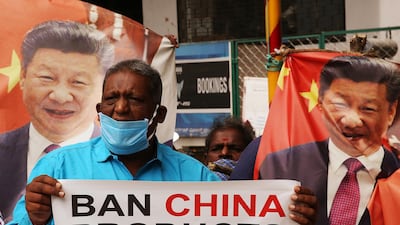
  • Anti-China protesters display placards urging citizens to boycott Chinese goods at a market in New Delhi. Twenty Indian soldiers were killed during "hand-to-hand' fighting with Chinese troops in a disputed Himalayan region, India's military said, the first deadly clash between the nuclear powers in decades. AFP
    Anti-China protesters display placards urging citizens to boycott Chinese goods at a market in New Delhi. Twenty Indian soldiers were killed during "hand-to-hand' fighting with Chinese troops in a disputed Himalayan region, India's military said, the first deadly clash between the nuclear powers in decades. AFP
  • Chinese police and security personnel stand outside the Indian embassy in Beijing. Beijing's state media on June 17 played down a deadly border confrontation between Chinese and Indian troops and did not reveal casualties on its side even as social media users urged retaliation. The Indian army said Tuesday that 20 of its soldiers were killed in a "violent face-off" along the Himalayan frontier on June 16, which resulted in "casualties on both sides". AFP
    Chinese police and security personnel stand outside the Indian embassy in Beijing. Beijing's state media on June 17 played down a deadly border confrontation between Chinese and Indian troops and did not reveal casualties on its side even as social media users urged retaliation. The Indian army said Tuesday that 20 of its soldiers were killed in a "violent face-off" along the Himalayan frontier on June 16, which resulted in "casualties on both sides". AFP

The 'Asian Century' depends on China and India working together


  • English
  • Arabic

The renewed tensions between China and India, two Asian giants, along the contested Line of Actual Control (LAC) in the Himalayan region of Ladakh in early May crossed the 100-day mark on Thursday.

For the first time since the Agreement on the Maintenance of Peace and Tranquility was signed by the two nations in 1993 – apropos the management of the 4,000-kilometre loose demarcation line that separates Indian and Chinese-controlled territories – there was a breakdown in the protocols carefully crafted over 27 years.

In the middle of June, 20 Indian soldiers including a colonel lost their lives in the Galwan River following a brawl with troops belonging to the People's Liberation Army of China. Beijing has yet to announce any casualties on its side, although Chinese media reports indicate that the PLA did lose personnel. In what was an anomalous development, no ordnance was used by either military at Galwan, even though both nuclear nations are militarily well-equipped. Soldiers on both sides, instead, resorted to sticks, stones and nail-studded clubs.

China and India are two Asian giants with a combined population of 2.8 billion people. AP Photo

India has held China responsible for "pre-meditated" transgressions in various locations along the LAC, while Beijing has accused Delhi of being the "aggressor".

In their August 15 Independence Day speeches, the Indian President Ram Nath Kovind and Prime Minister Narendra Modi referred to the challenge of "expansionism" in the neighbourhood but did not explicitly name China. It was added that India would not be deterred by any kind of "aggression" and was capable of giving a "befitting reply".

An uneasy stalemate prevails despite several rounds of talks at the diplomatic and military command levels. The Indian assessment is that its military will have to prepare for the long haul along the LAC through the winter months.

In the run-up to the 100th day, however, some signals seem to suggest that diplomacy may yet allow for a modus vivendi of a complex and tangled territorial dispute between the world’s two most populous nations with a combined strength of 2.8 billion people.

On Friday, the Indian ambassador in Beijing Vikram Misri met with senior officials of the Chinese Military Commission to reiterate Delhi’s position on the LAC. Earlier on Wednesday, Mr Misri had met with Liu Jianchao, a senior member of the Central Committee of the Chinese Communist Party. Media reports suggest that another round of talks could be on the cards.

Also on Wednesday, the Chinese embassy in Delhi expressed hope through a tweet that the “Indian side can meet the Chinese side half-way” and not act in any manner that would further "complicate" the border tensions. The tweet also said that China hoped India would create “favourable conditions” for maintaining peace and stability in the border areas and the healthy development of bilateral relations.

However, this was also accompanied by the Chinese ambassador to India Sun Weidong asserting in a signed article that the onus for resolving the border stand-off in the Ladakh sector of the LAC was “not on China". In short, the picture that emerges is unclear and has elements of a tentative intent to negotiate – but the article suggests it would be on terms set by Beijing. This will not be acceptable to Delhi, which seeks a return to the status quo positions along the LAC as they existed before the PLA intrusions.

The bilateral relationship between China and India has now entered a post-Galwan phase and both nations are aware that what is at stake is not just contested territoriality – but the texture and tenor of the emerging Asian strategic framework with larger global implications.

This was outlined by the Indian Foreign Minister Subrahmanyam Jaishankar, who earlier in the month noted: “We are seeing the parallel but differential rise of the two countries. To my mind, what it does is it puts a huge premium on reaching some kind of equilibrium or understanding between the two.” Highlighting the point that this equilibrium would have to be in the interests of both countries, he added: “How to do that is one of the big challenges that we face.”

While the Covid-19 pandemic has led to considerable uncertainty about the global economic recovery, it is expected that over the next decade, the world will see the emergence of three major single-state economies: China, the US and India, with the European Union being the fourth node.

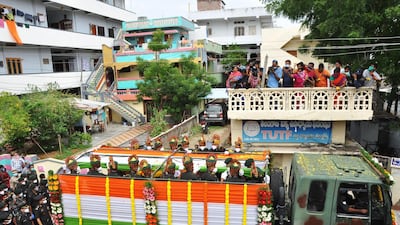
  • Indian Army personnel carry the body of Col Santosh Babu through Suryapet, a town near the southern Indian city of Hyderabad, on Thursday. Col Babu was among the 20 Indian troops killed in Monday's clash with Chinese soldiers in the Himalayan district of Ladakh. AFP
    Indian Army personnel carry the body of Col Santosh Babu through Suryapet, a town near the southern Indian city of Hyderabad, on Thursday. Col Babu was among the 20 Indian troops killed in Monday's clash with Chinese soldiers in the Himalayan district of Ladakh. AFP
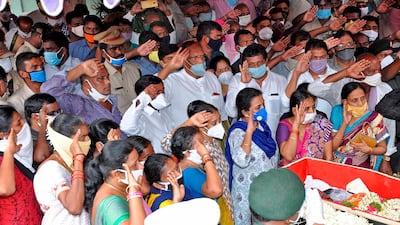
  • Indian Army personnel, family members and relatives salute next to the body of Col Santosh Babu before his funeral at Suryapet. AFP
    Indian Army personnel, family members and relatives salute next to the body of Col Santosh Babu before his funeral at Suryapet. AFP
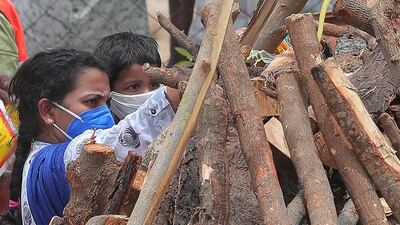
  • B Upender performs the final rites of his son Col Santosh Babu in Suryapet. AP Photo
    B Upender performs the final rites of his son Col Santosh Babu in Suryapet. AP Photo
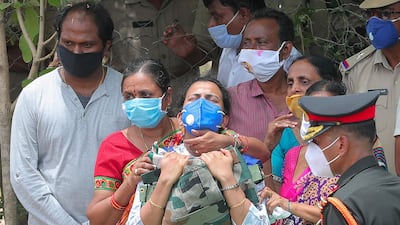
  • Santoshi mourns after receiving her husband Col Santosh Babu's uniform and the National flag during the last rites ceremony in Suryapet. AP Photo
    Santoshi mourns after receiving her husband Col Santosh Babu's uniform and the National flag during the last rites ceremony in Suryapet. AP Photo
  • Santoshi performs rituals during the last rites in Suryapet. AP Photo
    Santoshi performs rituals during the last rites in Suryapet. AP Photo
  • Santoshi and her son salute during the last rites of her husband in Suryapet. AP Photo
    Santoshi and her son salute during the last rites of her husband in Suryapet. AP Photo
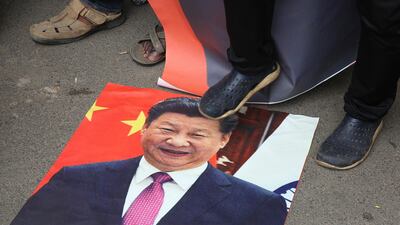
  • Activists hold photos of Chinese President Xi Jinping and shout slogans against China during a protest in the southern Indian city of Bangalore. EPA
    Activists hold photos of Chinese President Xi Jinping and shout slogans against China during a protest in the southern Indian city of Bangalore. EPA
  • Activists hold photos of Chinese President Xi Jinping and shouts slogans against China in Bangalore. EPA
    Activists hold photos of Chinese President Xi Jinping and shouts slogans against China in Bangalore. EPA
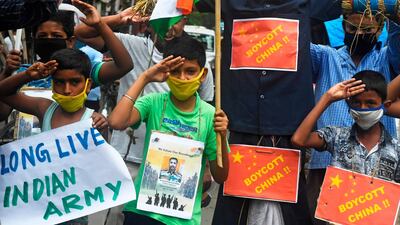
  • Children take part in an anti-China demonstration in the eastern Indian city of Kolkata. AFP
    Children take part in an anti-China demonstration in the eastern Indian city of Kolkata. AFP
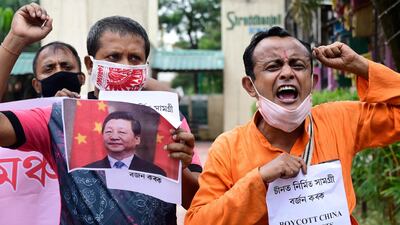
  • Men shout slogans and call for boycott of Chinese products during a demonstration in the north-eastern Indian city of Guwahati. AP Photo
    Men shout slogans and call for boycott of Chinese products during a demonstration in the north-eastern Indian city of Guwahati. AP Photo
  • Activists throughout India hold candles as a tribute to Indian soldiers killed in clash with Chinese troops in the Himalayan district of Ladakh. EPA
    Activists throughout India hold candles as a tribute to Indian soldiers killed in clash with Chinese troops in the Himalayan district of Ladakh. EPA
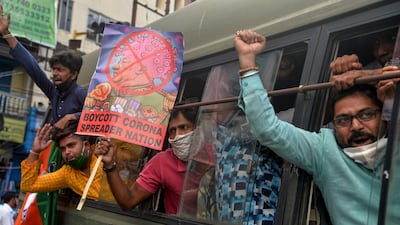
  • Activists belonging to the Bharatiya Janata Party shout slogans while holding posters as they sit in a police van during an anti-China protest in the eastern Indian city of Siliguri. AFP
    Activists belonging to the Bharatiya Janata Party shout slogans while holding posters as they sit in a police van during an anti-China protest in the eastern Indian city of Siliguri. AFP

In an earlier formulation, there was optimism about the resurgence of Asia, led by China’s economic growth followed by that of India, in addition to the sustained economic vitality of countries in the continent's north-east, south-east and west. It was envisioned that global prosperity and power would shift to the East, with the critical strategic triangle represented by China, the US and India.

This assumption, however, was predicated on a robust degree of co-operation among the major powers and a commitment to equitable globalisation in all the development sectors ranging from the economy, energy, infrastructure, investments, financial flows, trade, commerce and the sharing of technology. The past four years have turned out to be more turbulent and discordant across many tracks, and these include the souring of US-China, US-Russia and now China-India relations.

While the orientation of the US-China equation will largely be shaped by the outcome of the US presidential election in November, one factor will remain abiding – that of the swing-state relevance of India in the critical strategic triangle. How Beijing engages with Delhi in the post-Galwan era will have long-term implications for Asian equipoise and harmony – or the lack thereof.

C Uday Bhaskar is director of the New Delhi-based think tank Society for Policy Studies

Super Saturday race card

4pm: Mahab Al Shimaal Group 3 | US$350,000 | (Dirt) | 1,200m
4.35pm: Al Bastakiya Listed | $300,000 | (D) | 1,900m
5.10pm: Nad Al Sheba Turf Group 3 | $350,000 | (Turf) | 1,200m
5.45pm: Burj Nahaar Group 3 | $350,000 | (D) | 1,600m
6.20pm: Dubai City of Gold Group 2 | $300,000 | (T) | 2,410m
6.55pm: Al Maktoum Challenge Round 3 Group 1 | $600,000 | (D) | 2,000m
7.30pm: Jebel Hatta Group 1 | $400,000 | (T) | 1,800m

HIJRA

Starring: Lamar Faden, Khairiah Nathmy, Nawaf Al-Dhufairy

Director: Shahad Ameen

Rating: 3/5

UAE currency: the story behind the money in your pockets
Wicked: For Good

Director: Jon M Chu

Starring: Ariana Grande, Cynthia Erivo, Jonathan Bailey, Jeff Goldblum, Michelle Yeoh, Ethan Slater

Rating: 4/5

The specs: 2018 Ducati SuperSport S

Price, base / as tested: Dh74,900 / Dh85,900

Engine: 937cc

Transmission: Six-speed gearbox

Power: 110hp @ 9,000rpm

Torque: 93Nm @ 6,500rpm

Fuel economy, combined: 5.9L / 100km

'Unrivaled: Why America Will Remain the World’s Sole Superpower'
Michael Beckley, Cornell Press

Who was Alfred Nobel?

The Nobel Prize was created by wealthy Swedish chemist and entrepreneur Alfred Nobel.

  • In his will he dictated that the bulk of his estate should be used to fund "prizes to those who, during the preceding year, have conferred the greatest benefit to humankind".
  • Nobel is best known as the inventor of dynamite, but also wrote poetry and drama and could speak Russian, French, English and German by the age of 17. The five original prize categories reflect the interests closest to his heart.
  • Nobel died in 1896 but it took until 1901, following a legal battle over his will, before the first prizes were awarded.

Sui Dhaaga: Made in India

Director: Sharat Katariya

Starring: Varun Dhawan, Anushka Sharma, Raghubir Yadav

3.5/5

World Cricket League Division 2

In Windhoek, Namibia - Top two teams qualify for the World Cup Qualifier in Zimbabwe, which starts on March 4.

UAE fixtures

Thursday February 8, v Kenya; Friday February 9, v Canada; Sunday February 11, v Nepal; Monday February 12, v Oman; Wednesday February 14, v Namibia; Thursday February 15, final

ENGLAND SQUAD

Goalkeepers: Jack Butland, Jordan Pickford, Nick Pope 
Defenders: John Stones, Harry Maguire, Phil Jones, Kyle Walker, Kieran Trippier, Gary Cahill, Ashley Young, Danny Rose, Trent Alexander-Arnold 
Midfielders: Eric Dier, Jordan Henderson, Dele Alli, Jesse Lingard, Raheem Sterling, Ruben Loftus-Cheek, Fabian Delph 
Forwards: Harry Kane, Jamie Vardy, Marcus Rashford, Danny Welbeck


The Transfiguration

Director: Michael O’Shea

Starring: Eric Ruffin, Chloe Levine

Three stars

Benefits of first-time home buyers' scheme
  • Priority access to new homes from participating developers
  • Discounts on sales price of off-plan units
  • Flexible payment plans from developers
  • Mortgages with better interest rates, faster approval times and reduced fees
  • DLD registration fee can be paid through banks or credit cards at zero interest rates
Mubadala World Tennis Championship 2018 schedule

Thursday December 27

Men's quarter-finals

Kevin Anderson v Hyeon Chung 4pm

Dominic Thiem v Karen Khachanov 6pm

Women's exhibition

Serena Williams v Venus Williams 8pm

Friday December 28

5th place play-off 3pm

Men's semi-finals

Rafael Nadal v Anderson/Chung 5pm

Novak Djokovic v Thiem/Khachanov 7pm

Saturday December 29

3rd place play-off 5pm

Men's final 7pm

Day 1, Abu Dhabi Test: At a glance

Moment of the day Dimuth Karunaratne had batted with plenty of pluck, and no little skill, in getting to within seven runs of a first-day century. Then, while he ran what he thought was a comfortable single to mid-on, his batting partner Dinesh Chandimal opted to stay at home. The opener was run out by the length of the pitch.

Stat of the day - 1 One six was hit on Day 1. The boundary was only breached 18 times in total over the course of the 90 overs. When it did arrive, the lone six was a thing of beauty, as Niroshan Dickwella effortlessly clipped Mohammed Amir over the square-leg boundary.

The verdict Three wickets down at lunch, on a featherbed wicket having won the toss, and Sri Lanka’s fragile confidence must have been waning. Then Karunaratne and Chandimal's alliance of precisely 100 gave them a foothold in the match. Dickwella’s free-spirited strokeplay meant the Sri Lankans were handily placed at 227 for four at the close.