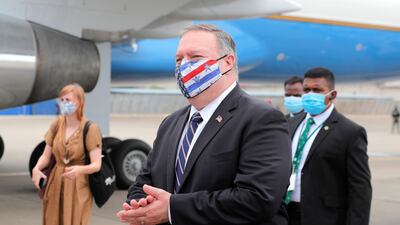

It has been a busy month for the Maldives. The US Secretary of State, Mike Pompeo, paid a visit and announced that America is finally opening an embassy in the country after over a half-century of diplomatic ties. Shortly after, the Indian Foreign Secretary, Harsh Shringla, visited to sign a $100 million top-up grant for a $500m infrastructure project to link the capital to surrounding islands. The close timing of these trips is not a coincidence.
It reflects a shared Indian and American determination to compete with China’s deep pockets as it tries to establish firm footholds across the Indian Ocean. For a country like the Maldives, with limited resources and vulnerable to climate change, peaceful attention from the great powers is potentially advantageous. But it can also bring pitfalls. There are no signs of existing US and Indian military tensions with China abating, from the Himalayas to the Taiwan Straits and the South China Sea. The Maldives is only likely to remain grateful as long as this competition remains confined to aid and investment.
The high stakes make sense as soon as you look at the sea lanes. The Indian Ocean has always been the maritime equivalent of the Silk Road, connecting East and West, with its many legacies of trade and travel. Historically, this has made it strategically vital for the West.

Trincomalee in Sri Lanka became the Royal Navy’s East Indies headquarters in 1813, guarding the passage between Suez and Singapore for 150 years. As independent Sri Lanka’s politics grew more non-aligned, Britain shifted to RAF Gan in the Maldives and later to Diego Garcia in the disputed Chagos Archipelago, just south of the Maldives. Britain remained the pre-eminent power in the region until its withdrawal in 1971, leaving a vacuum filled by the US, and by the 1980s, India.
The seamless transition meant that the Maldives was largely untroubled by the Cold War, leaving it a free hand to manage its difficult but remarkably rapid economic and social change. At the time of its independence in 1965 it was a scattered grouping of traditional fishing villages. It is now an upper-middle-income economy driven by high-end international tourism. It has also evolved from a sultanate, to an authoritarian republic, to a now flourishing democracy. Altogether, it is one of the unsung success stories of South Asia and the Muslim world.
The last decade has, however, been a time of profound geopolitical change that this time around refuses to bypass the region. China's ambitious Belt and Road Initiative seeks to integrate the economies of nations across the Eurasian land-mass and Indian Ocean with its own in order to realise the "Chinese Dream". The result, especially during the 2013-2018 rule of the Maldives' former president, Abdulla Yameen, was an influx of billions of dollars in loans and investment. During the Yameen years, unfortunately, negotiations on many of these deals were largely opaque. Critics say the results were not always in the public interest.
The same period also saw a more assertive Chinese foreign policy, intended to definitively end a period that China calls the “Century of Humiliation” at the hands of colonial powers. The key objective of this policy is restoring China to what it sees as its rightful place in the global order.
It is fair to say that the US has reacted strongly, perceiving this as a direct threat to its economic, technological and military dominance in the world. Former president Barack Obama’s toughening stance saw a doubling down under his successor, Donald Trump. All signs point to this continuing under the incoming Biden administration.
India, although initially keen to develop its economy in tandem with China's, now also shares American concerns, as do traditional US allies in the region, such as Australia and Japan. One of the uppermost priorities for this bloc is working together to keep as many Indian Ocean states aligned with them as possible. An unmistakable signal for this policy is the renaming of the US military's Pacific Command to "Indo-Pacific Command" in May 2018.

The Maldives, with its strategic location and heavy Chinese investments, is naturally at the top of the list of countries that the US and India want to keep on their side. Relations with India have always been good, but New Delhi's generosity is now reaching new heights. This could not have come at a better time. The Maldives' tourism-driven economy has shrunk by 30 per cent due to the coronavirus pandemic. Even though India is itself struggling with the economic consequences of Covid-19, it has agreed to give $250m in economic support to the Maldives. Meanwhile the $500m Greater Male Connectivity Project will provide much-needed jobs in the short term and, more importantly, ease serious land shortages in the capital where most of the Maldives' population lives.
These investments boost both the political stability of the Maldives and the goodwill of the Maldivian public. It is not at all clear that this kind of assistance would have been offered if the strategic stakes had not been raised. But the benefit to the Maldives from great-power rivalry hinges on two factors.
One is the continuing health of the country's governance. If this were to deteriorate, the enormous quantities of aid given to the country could actually prove politically and financially destabilising. Second, the worrying possibility that the region becomes the site of a military build-up. Not only would this damage tourism, but with such high stakes, the impulse for great powers to interfere in Maldivian politics is likely to sharply increase.
All this would distract from the Maldives’ existential enemy, climate change. The country helped found the Alliance of Small Island States in 1990 to co-ordinate action and Mohammed Nasheed, who served as president from 2008-2012 and who currently heads the ruling Maldivian Democratic Party, famously held a 2009 cabinet meeting underwater in scuba gear to raise awareness of the threat from rising sea levels.
However Sino-American competition in the region might play out, the Maldives must hold its course in the oncoming storm.
Johann Chacko is a writer and South Asia analyst

