


Live updates: Follow the latest on Israel-Gaza
Former Israeli ambassador Alon Liel is a campaigner for peace who views the past year through the lens of the failure of diplomacy amid the spread of a conflict engulfing the Middle East region.
Like many diplomats, he warns that Israel has suffered multiple reverses in its international relationships over the months since it decided on its response to the October 7 Hamas attacks from Gaza. From a position of relative strength, it has seen not only adverse international court judgements but increasing recognition of Palestine, arms export bans and sanctions against West Bank settlers – all against its wishes.
"These made Israel more vulnerable diplomatically," Mr Liel told The National. "What happened to us internationally during the last year is affected by two elements. One, our massive reaction, killing around us probably close to 45,000 people and the massive destruction not only in Gaza also in Lebanon and the West Bank and even in Yemen.
"Once we became more vulnerable, countries felt more comfortable to punch against us here and there and the same became true about the international organisations and it's accumulating.
"So much shooting all around with no talking whatsoever, as if diplomacy was not invented yet," he added. "So sad and so worrying."
The international correspondents working for The National in countries around the Middle East and across the globe have tracked these developments. Here, they give their insights into how key countries have reacted to the events of the past year.
Lizzie Porter, Istanbul:
One of the definitive moments came when Turkey suspended its economic relations with Israel.
Recep Tayyip Erdogan was relatively measured in the immediate aftermath of October 7, as Turkey called for calm. By the end of October, the Turkish president had likened the killings in the Palestinian enclave to the Holocaust and described Hamas as “a liberation group.” Israeli officials also started to fiercely criticise Mr Erdogan.
A complete halt of exports to and imports from Israel followed in an unprecedented move. Previous breakdowns had not hit trade between the two nations, which had continued to grow. In August, in another step that strained things further, Turkey applied to join South Africa’s genocide case against Israel at the International Court of Justice.
“I think, unfortunately, we are witnessing an unprecedented low in the relations,” said Hay Eytan Cohen Yanarocak, a Turkey expert at Tel Aviv University. “Traditionally, Israel could understand that Turkey might have a sensitivity regarding the Palestinian cause,” he told The National. “You can be pro-Palestinian, but when you are becoming pro-Hamas, this is something else.”

Domestic political considerations have weighed heavily with the leadership. Palestine has support across the political spectrum in Turkey, although Mr Erdogan’s Justice and Development Party (AKP) and Islamist groups show more overt support for Hamas than secular Turks, who favour less conservative Palestinian representation.
The AKP suffered its largest blow in decades, losing control of municipalities across the country in local elections in March.
“Of course, Turkey understood that the only factor that will contain Israel is the US position, and unless there is a change in that regard, the Turkish efforts will fail,” Oytun Orhan, Levant studies co-ordinator at the Ankara-based Centre for Middle Eastern Studies, told The National.
Sinan Mahmoud, Baghdad
Iran-backed Shiite militias in Iraq, which already wield significant influence in the country, have seized on the conflict to galvanise support for their anti-US platform. Last October saw drone and missile attacks by the militias on US troops stationed in Iraq and Syria.
The instigators framed their actions as part of a broader Iran-backed “Axis of Resistance” in the region, but their operations dragged Iraq deeper into the geopolitical struggle between Iran and the West. For Baghdad, the surge in militia activity has placed it in an uncomfortable position.
Tit-for-tat attacks between the US and militias strained the relations between Baghdad and Washington. Prime Minister Mohammed Shia Al Sudani heads a government that depends on US military aid and maintains its diplomatic relations with Washington.

Iraq's sovereignty was already fragile and is further compromised by getting deeper into regional conflicts. Hamas opened its first representative office in June in Baghdad creating a presence alongside the office for Yemen’s Houthi group that opened few years ago. The representatives of both militant groups, who operate under the protection of Iraqi militias, have been publicly meeting Iran-backed militants and political factions.
Hamza Hendawi, Cairo
For months President Abdel Fattah El Sisi has spearheaded Egypt's role as one of three Gaza war mediators – the other two are the United States and Qatar – in a manner that bolstered the country's international standing.
The successive rounds of mediation by Egypt and its partners the US and Qatar has not produced a ceasefire or secured the release of hostages held by Hamas for all the attention that has focused on the talks. In recent weeks the focus has shifted away from Gaza to Lebanon and the potential for a broader regional conflict.
Egypt's Rafah border crossing with Gaza functioned as the main route for humanitarian assistance for the Palestinians in the coastal enclave in the early months of the onslaught. However, Egypt angrily shut the crossing in May in response to Israel's capture of its Palestinian side of the facility.
Further afieldm Houthi attacks on Red Sea shipping reduced by half Egypt's Suez Canal revenue as more and more ships selected to take the longer and more costly route around Africa to Europe or Asia, rather than make the perilous journey through the strategic waterway linking the Red and Mediterranean seas. A bailout of about $60 billion was announced in February to spare Egypt from an economic meltdown that could have had disastrous consequences for the region and beyond.
Jamie Prentis, Beirut
Months of rising tensions and intermittent attacks between Hezbollah and Israel spilt over to the point Lebanon now finds itself progressively in all-out war.
lsraeli troops invaded Lebanon for the first time since 2006 as on Wednesday they engaged in direct combat with Hezbollah in southern Lebanon. The massive sharp rise in hostilities has seen civilian casualties in Lebanon soar across the country, while the government says around one million people have been displaced.
Many of those are now sleeping rough on the streets after being forced to flee their homes. Hospitals and medical personnel are overwhelmed in a country in the grips of devastating economic crisis.
The conflict had initially largely been confined to the southern border region, but it has firmly come to the Lebanese capital. For residents of Beirut the sound of Israeli drones are constant, while homes now shake on a regular basis as the country is attacked.

Sunniva Rose, Paris
Israel’s war on Gaza came before The Hague-based International Court of Justice in January and the repercussions of its decision reverberated around the world. The ICJ said that South Africa’s allegations of genocide were plausible, further ordering Israel to cease its military operations while it examined the case.
These provisional measures have so far been ignored by Israel with no consequences due to divisions over the matter at the UN Security Council. A few months later, another Hague-based intervention saw the International Criminal Court request arrest warrants for Israeli Prime Minister Benjamin Netanyahu and Defence Minister Yoav Gallant, as well as three Hamas leaders.
There has been no uniform European political reaction to the war but behind the scenes EU officials describe a quiet quitting of support for their ally. “Of the very staunch Israel supporters, only two remain: the Czech Republic and Hungary. No one else,” they said. “Israel is isolated. Relations are at a very low level. Everyone quietly hopes that there will be elections in Israel, that Netanyahu will lose, and that a new government will promise to investigate everything and then it can all be swept under the carpet.”
Capitals have issued statements criticising Israel’s indiscriminate killing of civilians yet have collectively drawn a line when Josep Borrell, the foreign affairs chief, has demanded sweeping sanctions or to stop weapons exports to Israel.
Pro-Palestinian sentiment has however rocketed among the youth, leading to clashes in universities. Overall, public expressions of support to Palestine have been suppressed, particularly in Germany, Israel’s strongest EU ally, and in France, where the government has avoided taking strong positions on the conflict in a turbulent election year.
Spain, Ireland, Slovenia and non-EU Norway’s decision to recognise Palestinian statehood may have given a moral boost to Palestinians. Yet commentator Erwin van Veen, a senior research fellow at Dutch think tank Clingendael, cautions there are still no indicators that these states have burnt bridges with Israel. "Apart from press releases, I see no tangible consequences of the fact that Israel is in this breach of most international conventions you can think of," he said.
Lemma Shehadi, London
The Labour government made decisive shifts in the UKs position when it was elected in July, reversing key decisions taken by the Conservative predecessors. Foreign Secretary David Lammy restored funding withdrawn when dozens of countries blocked assistance through the UNRWA agency. The UK’s legal challenge to the ICC was also dropped and a few weeks later a partial ban on arms licences for weapons used in Gaza was adopted.
Yet Labour continues to face political challenges from its traditional support base. These stem from the party leadership’s refusal to immediately recognise a Palestinian state, their vocal support for Israel, and the UKs continued supply of components for F-35 fighter jets used by the Israeli military in Gaza.
If anything, the rift between Palestinian campaigners and Labour politicians appears to be growing. Labour MPs are still haunted by the loss of four seats to pro-Palestinian independents in July’s election.
Keir Starmer, an international lawyer and now UK Prime Minister, is privately concerned that an arrest warrant from the ICC for Mr Netanyahu could bring the UK into conflict with Israel and other allies.
Former minister and fellow barrister David Wolfson told The National that it remained true that Israel’s relations with the UK were strong, even accounting for the long-standing strains stemming from Mr Netanyahu's lack of commitment to a two-state solution.
“There’s always been an element of the relationship which is warm," he said. "Equally, there is a long-standing UK policy of a two-state solution. Nobody believes (Mr Netanyahu's) heart is in that direction.”
Willy Lowry, Washington DC
In the early months of Israel’s war in Gaza the US used its veto powers four times to block UN resolutions calling for a ceasefire and Washington has repeatedly attempted to shield its ally from international condemnation.
The US was vociferous in its rejection of Karim Khan's efforts as ICC head prosecutor to gain warrants against Israel. “There should be no equivalence between Israel and Hamas – none,” State Department spokesman Matthew Miller said at the time, adding that the “the ICC has no jurisdiction over this matter”.
Throughout the war, relations between the administration of President Joe Biden and Israel’s historically far-right government have clearly soured but despite repeated rebuffs by Prime Minister Netanyahu, the US has refused to use any leverage to push Israel in a direction of peace.
-
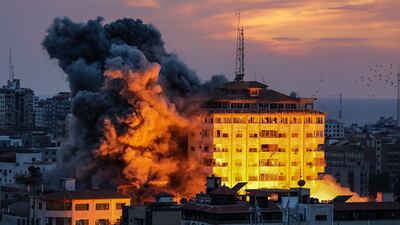
Smoke rises after Israeli air strikes targeted Palestine Tower in Gaza city on October 7, 2023. EPA -
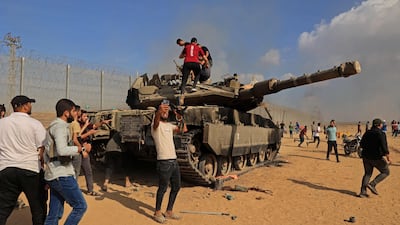
Palestinians take control of an Israeli Merkava battle tank after crossing the border fence with Israel from Khan Yunis in the southern Gaza Strip on October 7, 2023. AFP -
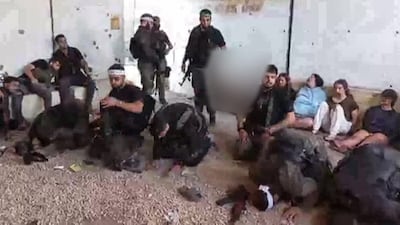
This video grab from footage released by the Israeli Hostage and Missing Families Forum campaign group on May 22 shows what the group described as Israeli female soldiers being captured by Palestinian Hamas militants during the October 7, 2023, attack on Israel. AFP -
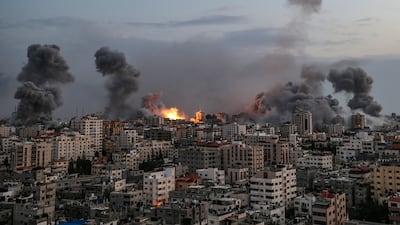
Smoke rises following an Israeli air strike in Gaza city on October 9, 2023. EPA -
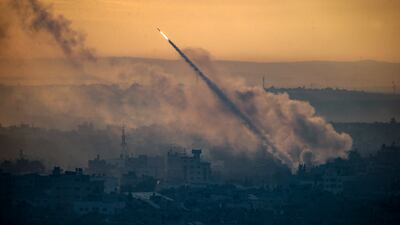
A rocket is launched from the coastal Gaza strip towards Israel by militants of the Ezz Al-Din Al Qassam militia, the military wing of Hamas movement, in Gaza city. EPA -

Israel's Iron Dome anti-missile system intercepts rockets launched from the Gaza Strip, as seen from the city of Ashkelon, Israel, on October 9, 2023. Reuters -

Lightning strikes as smoke billows following an Israeli air strike in Gaza city on October 9, 2023. AFP -
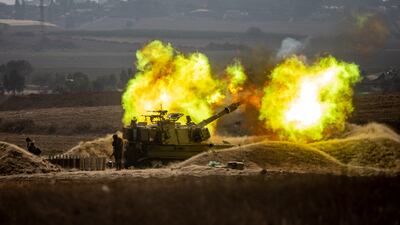
An Israeli artillery unit fires at an area along the border with Gaza, southern Israel, on October 11, 2023. EPA -

Ultra-Orthodox Jewish people carry their belongings before boarding a ship for US nationals and their immediate family members, as they leave Israel headed for Cyprus. Reuters -
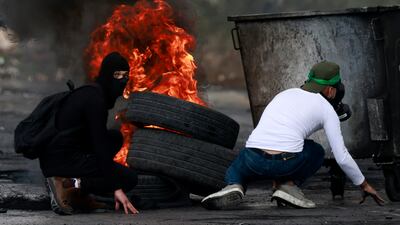
Palestinian youths take cover behind a rubbish container as they clash with Israeli forces at the northern entrance of the West Bank city of Ramallah near the Israeli settlement of Beit El on October 20, 2023. AFP -

A man mourns as he attends a funeral of Palestinians killed in Israeli strikes in Khan Younis in the southern Gaza Strip on October 24, 2023. Reuters -
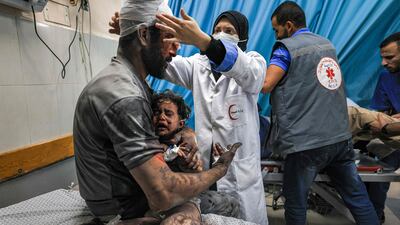
A man holds a child, survivors of Israeli bombardment, as they are treated at a trauma ward at Nasser hospital in Khan Yunis in the southern Gaza Strip on October 24, 2023. AFP -

People search for survivors and the bodies of victims through the rubble of buildings destroyed during Israeli bombardment in Khan Yunis in the southern Gaza Strip on October 26, 2023. AFP -

Anti-war protesters raise their 'bloody' hands behind US Secretary of State Antony Blinken during a Senate Appropriations Committee hearing on President Biden's $106 billion national security supplemental funding request to support Israel and Ukraine, as well as bolster border security, on Capitol Hill in Washington on October 31, 2023. Reuters -
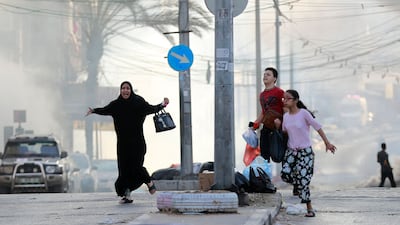
Palestinians run for cover after a strike near the Al Shifa hospital in Gaza city on November 1, 2023. AFP -
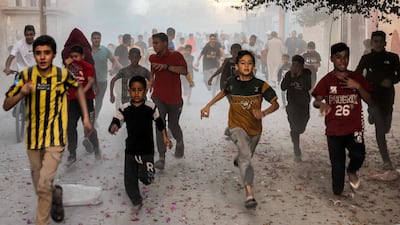
Palestinian children run as they flee from Israeli bombardment in Rafah in the southern Gaza Strip on November 6, 2023. AFP -
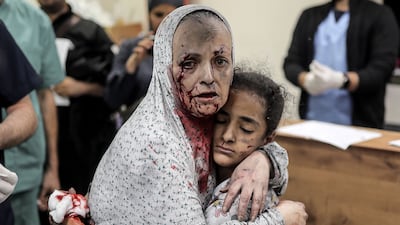
An injured Palestinian woman covered in dust and blood hugs an injured girl child at the hospital following the Israeli bombardment of Khan Yunis in the southern Gaza Strip on November 15, 2023. AFP -

Hostages released by Hamas Gal, left, and Tal Almog-Goldstein, second left, stand in a bus transporting them to an army base in Ofakim in southern Israel after they were released by the Palestinian militant group from the Gaza Strip on November 26, 2023. AFP -
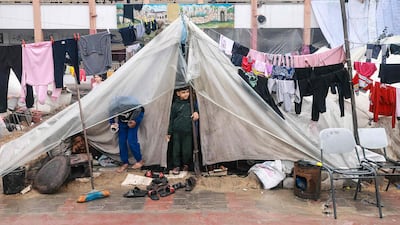
Palestinian boys stand in their makeshift tent at a camp set up on a schoolyard in Rafah in the southern Gaza Strip where most civilians have taken refuge, on December 13, 2023. AFP -
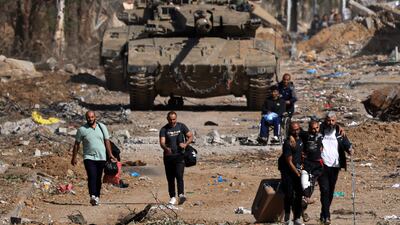
Palestinians fleeing the north through the Salaheddin road in the Zeitoun district on the southern outskirts of Gaza city, walk past Israeli army tanks on November 24, 2023. AFP -
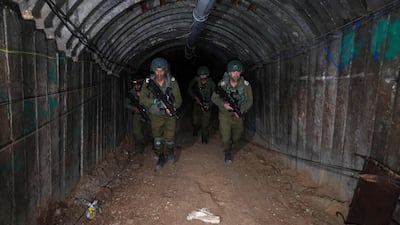
In this picture taken during a media tour organised by the Israeli military on December 15, 2023, soldiers visit a tunnel that Hamas reportedly used to attack Israel through the Erez border crossing on October 7. AFP -

Jewish protesters block the passage of aid trucks being sent to Gaza in Ashdod, Israel on February 1, 2024. Reuters -
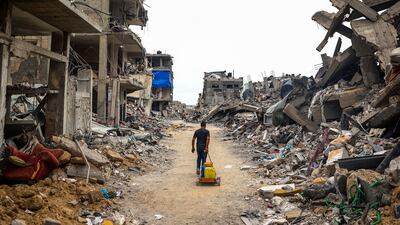
A man pulls water containers as he walks past destroyed buildings in Khan Younis on May 5, 2024. AFP -

Relatives of Hanan Yablonka, one of the Israeli hostages held in the Gaza Strip since the October 7, 2023 attack by Palestinian Hamas militants, mourn during his funeral in Tel Aviv on May 26. AFP -

Humanitarian aid packages land after being dropped from a plane in Al Mawasi district of Khan Younis, on May 30, 2024. Reuters -
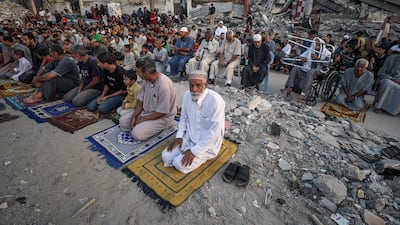
Palestinians attend Eid al-Adha prayer in Khan Younis town, southern Gaza strip, on June 16. EPA -
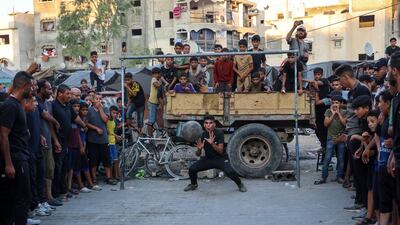
Displaced Palestinians play football in Jabalia on July 23, 2024. AFP -
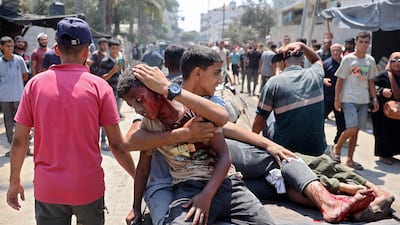
Palestinians injured in an Israeli strike on a school ride on the back of a cart in Deir Al Balah on July 27, 2024. AFP -
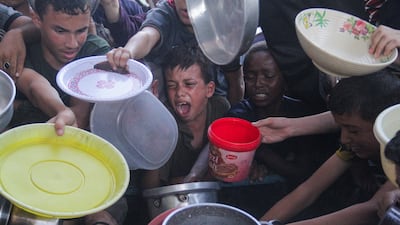
Palestinians gather to receive food cooked by a charity kitchen, amid the Israel-Hamas conflict, in the northern Gaza Strip, September 11. Reuters -

Palestinians survey the damage at the site of Israeli strikes on a displacement camp in Khan Younis on September 10, 2024. AFP -
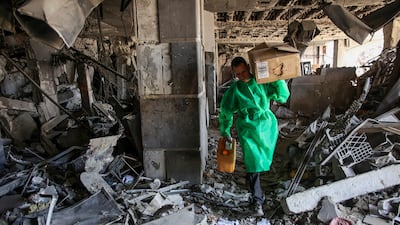
A medical staff member carries supplies through a destroyed section of Al Shifa hospital in Gaza city on September 17. AFP -
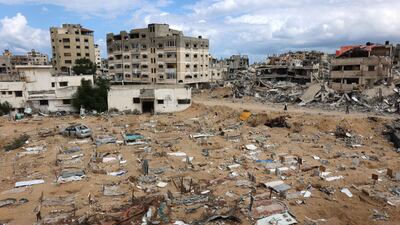
People walk past makeshift graves in Gaza city on September 17. AFP


While Washington was pushing for a ceasefire not only in Gaza but with Hezbollah, Israel shifted its attention north and killed its leader Hassan Nasrallah, followed by the launch of ground incursions.
The US now seems to be in tacit support of Israel’s actions in Lebanon and have essentially granted a green light on another Israeli strike on Iran following Tehran's retaliation for the killing of Nasrallah and Hamas’s political leader Ismail Haniyeh.
The succession of events has left the region on the brink of the full-scale war that the US has repeatedly said it hopes to avoid.

