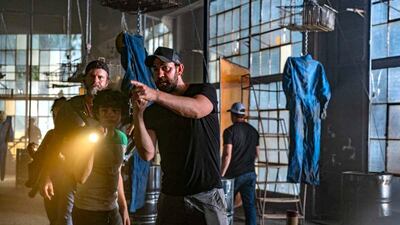
When John Krasinski's A Quiet Place hit cinemas in 2018, it felt like it came out of nowhere.
This innovative horror in which humanity has been ravaged by vicious alien creatures – reacting to the tiniest of sounds – was the sleeper hit of the year. Made on a modest budget of $17 million, it took $340m worldwide.
It also announced Krasinski – until then best known as Jim Halpert from popular US sitcom The Office – as a major director, adept at crafting a suspense narrative that'd make Alfred Hitchcock proud.
"A Quiet Place wasn't my first movie," says Krasinski, 41, "but it was certainly my first movie like that – on that scale and on that level." Working with an original script by Bryan Woods and Scott Beck, it set the tone for him.
“For me, the beauty of getting to direct the things I write is that I’m directing from the moment I start typing. Trying to find the story in every single page allows me to have a much easier job when I come on set, of just finding the story in every single shot. It was so exciting.”
The sequel arrives in the UAE next week: A Quiet Place Part II, delayed by a year due to the pandemic, finally hits cinemas to an avalanche of positive reviews.
"If you're vaccinated and feeling safe enough to step foot outside your home, Krasinski has crafted a follow-up that justifies the trip," raved trade paper Variety.
In America, the film enjoyed a $57m Memorial Day opening last weekend, a huge relief to cinema owners after more than 12 months of closures. For Krasinski, it was simply great to be behind the camera again. "A Quiet Place II was a thrill," he says.
Yet, it'd be wrong to suggest that Krasinski's success with both films is some sort of fluke. The hugely likeable star has been quietly prepping for this moment for years. Previously, before A Quiet Place, he'd made 2016's low-budget film The Hollars, in which he played an artist returning home on the eve of his mother's brain surgery. It hardly set the world alight, but it was another step in marking Krasinski out as more than just Jim from The Office.
While he also directed three episodes on The Office, Krasinski has used every job as preparation. Take his two seasons playing the title role on Jack Ryan, the TV drama based on the Tom Clancey character, which showed him how to orchestrate action.
"Being on Jack Ryan I definitely got to see more and more of how a lot of the action stuff works, and so any of the scenes in A Quiet Place – which were a lot smaller, stunt-wise! – you can see [the influence of this]." Likewise, he watched Transformers director Michael Bay close-up when Krasinski was cast in the 2016 military siege movie 13 Hours.
"Being on a Michael Bay set, that's a whole different thing ... that's trial by fire. As the nerdy writer-director who is always paying attention to the sets that I'm on, it's such a different language and a different skill set." Bay, crucially, would go on to produce A Quiet Place and its sequel.
From left, Noah Jupe, Millicent Simmonds and Emily Blunt in 'A Quiet Place Part II', which opened in US cinemas last week. AP
When Krasinski wasn't directing, he was producing via his company Sunday Night – something he felt essential to his career. He developed 2012's fracking drama Promised Land with co-star Matt Damon. He was also involved in making Manchester by the Sea, which won two Oscars. He and Damon brainstormed the story of an "emotionally crippled" handyman, taking it to playwright Kenneth Lonergan, who eventually directed the film.
It was through Damon that Krasinski met British actress Emily Blunt, who became his wife in 2010, is mother of their two daughters and also his co-star in A Quiet Place.
As I closed the door and before I called action, I thought: 'Did I just put my marriage on the line?'
“I was a fan of hers long before we met, so that was weird to be meeting someone that you thought was so incredibly talented,” he recalls. “Her whole thing is about storytelling; I just want to tell the best story. And so I get very excited to be around her and see her process.”
A Quiet Place Part II picks up immediately where the first film left off, with the Abbott family – led by Blunt's character Evelyn – desperately looking for shelter after their farmstead has been set on fire during an alien attack. Evelyn's husband Lee (played by Krasinski) sacrificed himself in the first movie to save their children, but we do get to see him in an exhilarating flashback on the first day of the alien attack – exactly the sort of controlled carnage he saw Bay craft on set.
As the film’s first trailer hinted, a bus travels down the street with one of the creature’s spidery tentacles protruding out of the broken windscreen. Evelyn’s car is just a hair’s breadth away, reversing frantically. Remarkably, it was a stunt Blunt did for real.
“Right as I closed the door and before I called action, I thought: ‘Did I just put my marriage on the line? This could go very badly for a lot of reasons,’” says Krasinski. Thankfully, it all went off without a hitch.
With Krasinski taking sole writing credit this time, Part II does not simply retread old ground but expands on the first movie, introducing new characters such as Cillian Murphy's loner Emmett.
"I felt it on set – I felt this vibe of: 'This is going to be a really cool movie,'" says Noah Jupe, who plays the Abbotts' young son Marcus, who together with his deaf sister Regan (Millicent Simmonds) are thrown into even more terrifying situations. Jupe says the sequel feels earned. "I feel like it's very necessary; it adds on to this story."
Already Paramount, the studio behind the franchise, is planning further instalments. Jeff Nichols, who directed 2016's sci-fi Midnight Special, is working on A Quiet Place spin-off, based on an idea by Krasinski. The actor-director, meanwhile, is producing Apartment 7A, a new horror with Relic director Natalie Erika James.
“[It’s] something much more fulfilling than just showing up and punching in as an actor,” he says. Although it’s been a long time since Krasinski has done that.
'A Quiet Place Part II' will be out in UAE cinemas on June 9

Badr Organisation: Seen as the most militarily capable faction in the Hashd. Iraqi Shiite exiles opposed to Saddam Hussein set up the group in Tehran in the early 1980s as the Badr Corps under the supervision of the Iran Revolutionary Guards Corps (IRGC). The militia exalts Iran’s Supreme Leader Ali Khamenei but intermittently cooperated with the US military.
Saraya Al Salam (Peace Brigade): Comprised of former members of the officially defunct Mahdi Army, a militia that was commanded by Iraqi cleric Moqtada Al Sadr and fought US and Iraqi government and other forces between 2004 and 2008. As part of a political overhaul aimed as casting Mr Al Sadr as a more nationalist and less sectarian figure, the cleric formed Saraya Al Salam in 2014. The group’s relations with Iran has been volatile.
Kataeb Hezbollah: The group, which is fighting on behalf of the Bashar Al Assad government in Syria, traces its origins to attacks on US forces in Iraq in 2004 and adopts a tough stance against Washington, calling the United States “the enemy of humanity”.
Asaeb Ahl Al Haq: An offshoot of the Mahdi Army active in Syria. Asaeb Ahl Al Haq’s leader Qais al Khazali was a student of Mr Al Moqtada’s late father Mohammed Sadeq Al Sadr, a prominent Shiite cleric who was killed during Saddam Hussein’s rule.
Harakat Hezbollah Al Nujaba: Formed in 2013 to fight alongside Mr Al Assad’s loyalists in Syria before joining the Hashd. The group is seen as among the most ideological and sectarian-driven Hashd militias in Syria and is the major recruiter of foreign fighters to Syria.
Saraya Al Khorasani: The ICRG formed Saraya Al Khorasani in the mid-1990s and the group is seen as the most ideologically attached to Iran among Tehran’s satellites in Iraq.
(Source: The Wilson Centre, the International Centre for the Study of Radicalisation)
Ticket prices
General admission Dh295 (under-three free)
Buy a four-person Family & Friends ticket and pay for only three tickets, so the fourth family member is free
Jebel Akhdar is a two-hour drive from Muscat airport or a six-hour drive from Dubai. It’s impossible to visit by car unless you have a 4x4. Phone ahead to the hotel to arrange a transfer.
If you’re driving, make sure your insurance covers Oman.
By air: Budget airlines Air Arabia, Flydubai and SalamAir offer direct routes to Muscat from the UAE.
Tourists from the Emirates (UAE nationals not included) must apply for an Omani visa online before arrival at evisa.rop.gov.om. The process typically takes several days.
Flash floods are probable due to the terrain and a lack of drainage. Always check the weather before venturing into any canyons or other remote areas and identify a plan of escape that includes high ground, shelter and parking where your car won’t be overtaken by sudden downpours.
Houthis: Iran-backed rebels who occupy Sanaa and run unrecognised government
Yemeni government: Exiled government in Aden led by eight-member Presidential Leadership Council
Southern Transitional Council: Faction in Yemeni government that seeks autonomy for the south
Habrish 'rebels': Tribal-backed forces feuding with STC over control of oil in government territory
Who was Alfred Nobel?
The Nobel Prize was created by wealthy Swedish chemist and entrepreneur Alfred Nobel.
In his will he dictated that the bulk of his estate should be used to fund "prizes to those who, during the preceding year, have conferred the greatest benefit to humankind".
Nobel is best known as the inventor of dynamite, but also wrote poetry and drama and could speak Russian, French, English and German by the age of 17. The five original prize categories reflect the interests closest to his heart.
Nobel died in 1896 but it took until 1901, following a legal battle over his will, before the first prizes were awarded.
The UN General Assembly President in quotes:
YEMEN: “The developments we have seen are promising. We really hope that the parties are going to respect the agreed ceasefire. I think that the sense of really having the political will to have a peace process is vital. There is a little bit of hope and the role that the UN has played is very important.”
PALESTINE: “There is no easy fix. We need to find the political will and comply with the resolutions that we have agreed upon.”
OMAN: “It is a very important country in our system. They have a very important role to play in terms of the balance and peace process of that particular part of the world, in that their position is neutral. That is why it is very important to have a dialogue with the Omani authorities.”
REFORM OF THE SECURITY COUNCIL: “This is complicated and it requires time. It is dependent on the effort that members want to put into the process. It is a process that has been going on for 25 years. That process is slow but the issue is huge. I really hope we will see some progress during my tenure.”
Pupils to learn coding and other vocational skills from Grade 6
Exams to test critical thinking and application of knowledge
A new National Assessment Centre, PARAKH (Performance, Assessment, Review and Analysis for Holistic Development) will form the standard for schools
Schools to implement online system to encouraging transparency and accountability
MATCH INFO
Uefa Champions League semi-final, first leg
Bayern Munich v Real Madrid When: April 25, 10.45pm kick-off (UAE) Where: Allianz Arena, Munich Live: BeIN Sports HD Second leg: May 1, Santiago Bernabeu, Madrid
UAE currency: the story behind the money in your pockets
Men: Hamad Nawad and Khalid Al Balushi (56kg), Omar Al Fadhli and Saeed Al Mazroui (62kg), Taleb Al Kirbi and Humaid Al Kaabi (69kg), Mohammed Al Qubaisi and Saud Al Hammadi (70kg), Khalfan Belhol and Mohammad Haitham Radhi (85kg), Faisal Al Ketbi and Zayed Al Kaabi (94kg)
Women: Wadima Al Yafei and Mahra Al Hanaei (49kg), Bashayer Al Matrooshi and Hessa Al Shamsi (62kg)
Dubai Bling season three
Cast: Loujain Adada, Zeina Khoury, Farhana Bodi, Ebraheem Al Samadi, Mona Kattan, and couples Safa & Fahad Siddiqui and DJ Bliss & Danya Mohammed
Sunday, January 20
3pm: Jordan v Vietnam at Al Maktoum Stadium, Dubai
6pm: Thailand v China at Hazza bin Zayed Stadium, Al Ain
9pm: Iran v Oman at Mohamed bin Zayed Stadium, Abu Dhabi
Monday, January 21
3pm: Japan v Saudi Arabia at Sharjah Stadium
6pm: Australia v Uzbekistan at Khalifa bin Zayed Stadium, Al Ain
9pm: UAE v Kyrgyzstan at Zayed Sports City Stadium, Abu Dhabi
Tuesday, January 22
5pm: South Korea v Bahrain at Rashid Stadium, Dubai
8pm: Qatar v Iraq at Al Nahyan Stadium, Abu Dhabi
