

Last month, the French government released an updated version of its Strategic Review – the French equivalent of the US's National Security Strategy. It was last updated just three years ago, but Paris deemed it necessary to acknowledge the major disruptions brought about by the Covid-19 pandemic. And if defence and security reviews are usually sombre in both substance and tone, this report paints a dark picture of the world in 2021. It also reflects how France sees both itself and Europe in a world unsettled by rising US-China-Russia competition and the behaviour of two troublesome Middle East states.
It begins by highlighting major trends shaping French national security amid growing instability in its two areas of influence: the Sahel and the Middle East.
West Africa remains a key area of involvement for the French military. But eight years after its intervention in Mali to oust militant groups – and with more than 5,000 soldiers still deployed across sub-Saharan Africa – its presence is being questioned both in Paris and in some African capitals. Local states are still mostly incapable of containing terror attacks on a sustained basis, yet France's military footprint has become a source of popular anger. The review does not offer a new path. A few days before its release, however, President Emmanuel Macron announced that his government would "adjust its efforts" in the region – a euphemism for gradual troop withdrawal.
-
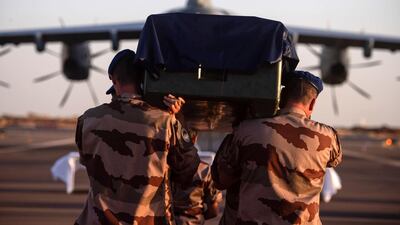
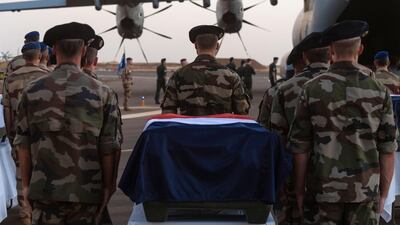
French soldiers of the Barkhane force carrying the coffin of a soldier who died when two French military helicopters collided in Mali. AFP -
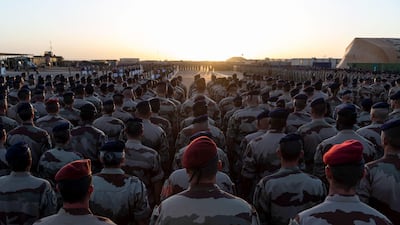
Troops at the French Army base in Gao, Mali, remember the 13 killed in the collision. AFP -
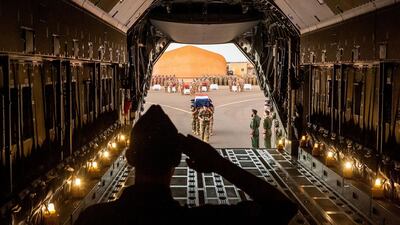
The crash occurred late on November 25, 2020, during an operation in the Liptako region, near the borders with Burkina Faso and Niger. AFP -

It was the heaviest single loss for the French military in nearly four decades. AFP -
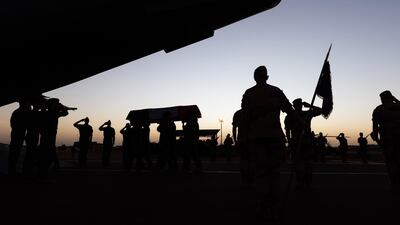
President Emmanuel Macron is considering reducing the number of French troops in the Sahel region. AFP -
President Macron is this week joining a Sahel G5 summit by video link. AFP


In the section devoted to the Middle East, the paper points to the assertiveness of Iran and Turkey as exacerbating factors in the various crises affecting the region. It states that the previous US administration's "maximum pressure" approach was ineffective in reining in Tehran's destabilising role in Syria, Iraq and Lebanon. It also underlines Iran's non-compliance with the 2015 nuclear deal – an assessment that will disappoint those hoping for a mere resumption of the agreement between the regime and the world's major powers.
Interestingly, although not surprisingly, the document dedicates a significant amount of ink to Ankara's role in the world. Even though Turkey is not explicitly portrayed as a hostile entity, it is put on a par with Iran. The ambitions of Turkey in the Middle East, particularly in Libya, are questioned, as is its impact on the regional security architecture. The review is no doubt a reflection of the deteriorating relations between France and Turkey over the past few years.
The paper also takes stock of the escalating competition between the US, China, and Russia and its negative consequences for Europe. Paris has trodden a delicate path in dealing with Washington, Moscow and Beijing. As part of its core strategy, France remains a key ally of the US and military co-operation remains strong both bilaterally and through the framework of Nato. In fact, Paris relies on US intelligence and logistical support in the Sahel – although this may not last given Washington's gradual shift in focus and redeployment of resources to Asia. It is no coincidence, therefore, that Florence Parly, France's Minister of the Armed Forces, called for a continuation of this arrangement on the day US President Joe Biden was inaugurated.

While acknowledging the benefits of the French-American alliance, Mr Macron also aimed to "reset" relations with Russia, which deteriorated after Moscow's annexation of Crimea in 2014. This renewal led to a strategic dialogue between Paris and Moscow that has so far proved inconclusive. Likewise, just as French officials often take a cue from Washington to criticise Beijing's strategic activities in the South-China Sea and elsewhere, Mr Macron has expressed support for the EU-China trade deal signed in December, an agreement now likely to complicate the US-EU dialogue on China.
Nearly four years after Mr Macron's election, the Strategic Review reflects the struggles of a middle power such as France to defend its interests on the world stage. Despite his age – Mr Macron is only 43 – he has embraced a view of international affairs that is deeply anchored in traditional French geopolitical thought. In interviews, he has often referred to former president Charles de Gaulle as a model. One of the most influential voices at the Elysee Palace is Hubert Vedrine, a former foreign minister and a proponent of "French realpolitik", who once described French-American relations as "allied but not aligned".

Mr Macron aims to position France as a country that continues to matter within the context of great-power competition. If France still sees its relationship with the US as vital to its interests, it has also been among the most active supporters of European "strategic autonomy". Mr Macron believes that heightened US-China competition and the erosion of multilateralism call for a stronger EU – a belief further cemented by America's transactional approach to foreign relations, especially with Europe, under the Trump administration.
That the Strategic Review was released only days after Mr Biden was sworn in also indicates that Paris does not consider the Trump presidency an anomaly. It believes that, despite the Biden presidency, American retrenchment from the world stage is a long-term trend.
The paper does not entertain any illusions on the challenges that lie ahead. It supports recent increases in defence spending, both in France and more broadly in Europe, while acknowledging that pandemic-related costs could force budget cuts in the immediate future. It this context, the summary is both clear and makes for a sobering read: that the risk of a "strategic downgrading of Europe and its disappearance from world affairs can no longer be dismissed".
Jean-Loup Samaan is an Abu Dhabi-based researcher in strategic affairs

