Paris will find it challenging to continue supporting the Malian army's counterrorism efforts while trying to nudge the junta to hand back power to the civilians
Nearly a month after a coup ousted Malian president Ibrahim Boubacar Keita from power, concerns remain within the country and in the international community about its democratic future – and the impact of the coup on counterterrorism operations under way in the region.
Last week, the country's military leaders launched public consultations with political parties as well as members of civil society, supposedly to accommodate the growing concerns of the political class in Bamako, as well as the country's allies, including France.
Even though the coup in mid-August was executed by a group of Malian officers, it followed months of civilian protests against the government of "IBK", given its struggles to tackle the socio-economic and security problems of the country.
Soon after this initial relief, however, uncertainties arose over the implications of the coup. Many of the civilian activists who participated in the demonstrations of the past few months felt ignored by the military junta. In particular, the leaders of the so-called "Movement of the June 5-Rally of Patriotic Forces" publicly shared their exasperation over the way the officers ignored their claims.
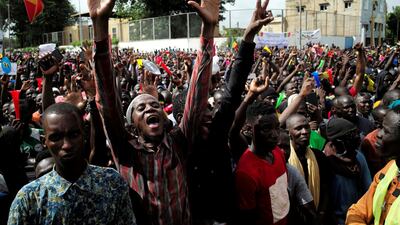
Supporters of Imam Mahmoud Dicko and other opposition political parties protest. Reuters
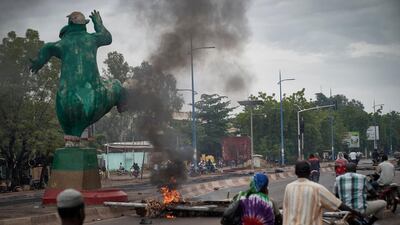
Protesters set barricades to block the circulation on the Martyrs bridge of Bamako. AFP
Anti-government protesters demonstrate in the capital Bamako, Mali. AP
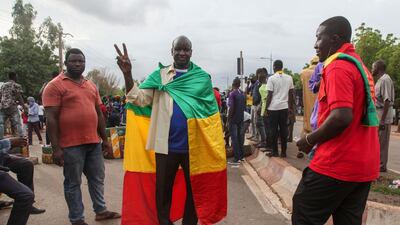
June 5 protesters gather last week in Mali. Reuters
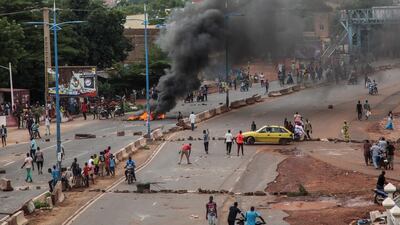
People run away at the arrival of the riot police as protesters set barricades to block the circulation on the Martyrs bridge of Bamako. AFP
Anti-government protesters burn tires and barricade roads in the capital Bamako, Mali. AP Photo
Anti-government protesters burn tires and barricade roads in the capital Bamako, Mali. Reuters
Anti-government protesters burn tires and barricade roads in the capital Bamako, Mali. AP Photo
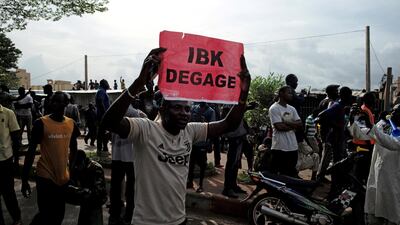
A protester holds a sign during a protest reading "Ibrahim Boubacar Keita get out". Reuters
Meanwhile, the international community expressed its consternation and promptly called for a transition back to civilian rule. During the latest political consultations, the junta announced a 18-month transitional period but this significant duration raised alarms both in foreign capitals and in Bamako where the opposition rejected the plan last Sunday.
As a result, the Economic Community of West African States – a regional bloc comprising 15 countries – imposed sanctions on the new rulers and urged them to designate a civilian leader while organising elections within the next 12 months. Likewise, the G5 Sahel Joint Force – a security organisation that includes Mali alongside Burkina Faso, Chad, Mauritania and Niger – also condemned the putsch. Maman Sidikou, executive secretary of the G5 Sahel, stated in an interview with German media that “the time of coups d’etat is over”. Similar statements were issued by the African Union, the charter for which explicitly rejects unconstitutional changes of government. It then suspended Mali from the 55-member grouping.
Beyond Africa, the coup also has major implications for the European Union, which not only called for a rapid return to the rule of law but suspended its training mission in the country. Since its inception in February 2013, this mission had trained about 10 battalions, with plans to ramp up the exercise after political pledges were made at an international summit in the French city of Pau last January.
It may be for France, the country most involved in Malian affairs since 2013, that IBK's exit and the establishment of the junta constitute the biggest setback. French diplomats and politicians had been somewhat critical of the former president's inability to address a number of critical security issues – in particular his reluctance to apply the Algiers Accords of 2015 that aimed to demobilise and reintegrate the former rebels. But the military takeover not only compromises past efforts to create good governance in Mali, it also reminds Paris of the very reasons it intervened militarily, back in 2013 with Operation Serval. At the time, the collapse of the state and the march of extremist forces towards Bamako were the consequences of a previous military coup, orchestrated eight years ago.
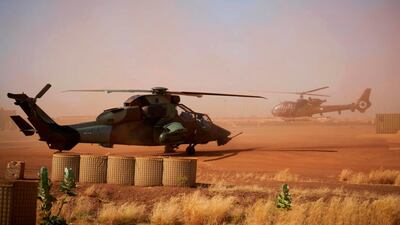
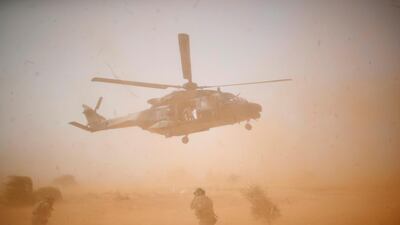
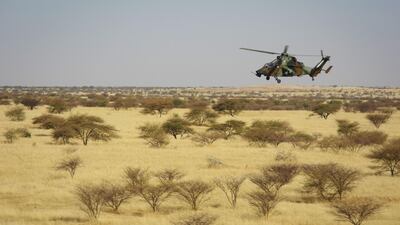
A Eurocopter Tiger at the French Military base in Gao in November 2019. Thirteen soldiers were killed after two helicopters collided during an operation. AFP
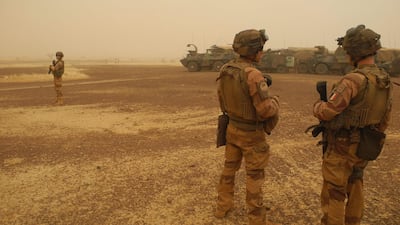
France has more than 4,500 troops in Africa's Sahel region. AP Photo
The helicopter crash was the deadliest attack since the French intervention began in 2013. AFP
In total, 38 French soldiers have been killed in the region. AFP
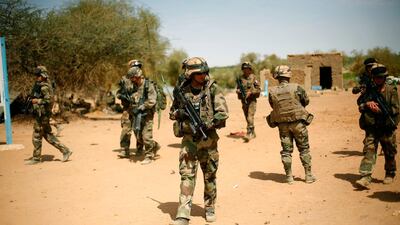
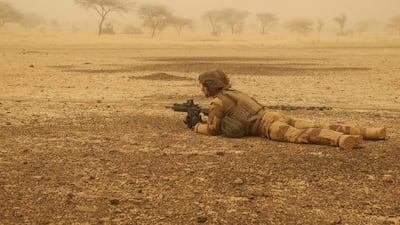
A French soldier secure a perimeter during a break in the military convoy's trip between Gossi and Hombori in March. AFP
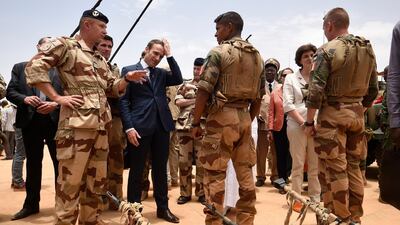
French President Emmanuel Macron visits soldiers of Operation Barkhane in Gao in 2017. He expressed his 'deep sadness' at the news. AP
UN Secretary General Antonio Guterres warned that terrorist groups have strengthened their foothold across the Sahel. Reuters
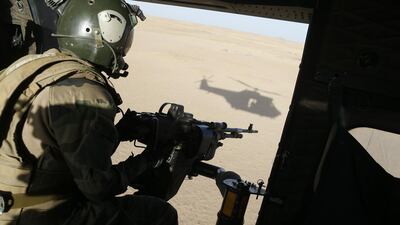
A French gunner sits in a Puma helicopter flying near Tessalit in 2013. AFP
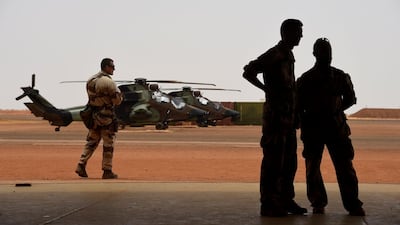
French soldiers of France's Barkhane are pictured next to a Eurocopter Tiger helicopter during the 2017 visit of the French President in Gao. AFP
France's Barkhane mission in central Mali in 2017. AFP
Today, as in 2012, Mali remains the centre of the fight against terrorism in the Sahel. Over the past seven years, France has dedicated its biggest deployment of armed forces overseas for this purpose. In early 2020, after witnessing an increase in terrorist attacks in the region, President Emmanuel Macron signed off on a troop surge, with 5,100 French personnel now engaged as part of Operation Barkhane.
Much like with the Americans in Iraq and Afghanistan, the French military strategy in Mali – and more broadly in the Sahel – has put an emphasis on strengthening local partners, either through joint counterterrorism operations or training missions. At the same time, French officials have repeatedly stressed that long-term security would be possible only if it is accompanied by socio-economic reforms. In fact, the two pillars of the G5 Sahel, founded in 2014, are security and development.
However, the military coup in Mali represents a rebuttal of this strategy. By ignoring the rule of law, it has compromised the aspirations for better governance. Moreover, by stirring up political instability in Bamako, it risks jeopardising national security against terrorist organisations.
Ibrahim Boubacar Keita had been Mali's president for seven years before he was removed from power in a coup last month. Reuters
On the one hand, the longer the uncertainty remains over a return to civilian rule and a democratic transition, the harder it will be for France to maintain its military efforts in the country without exacerbating anti-French sentiments among a population that already questions the presence of the former colonial power. On the other hand, the protracted political crisis may also complicate the ability of its security forces to address the immediate challenge posed by the extremist forces.
The recent suspension of the EU's training mission is an immediate example of the implications of the coup for international co-operation.
France has not gone as far as the EU. General Francois Lecointre, the French Chief of Joint Forces, stated that Paris was urging the Malian army to sustain its engagement against armed groups. For Paris, maintaining co-operation with Mali's armed forces in counterterrorism operations while forcing the junta to hand power back to the civilians could prove to be a delicate exercise. But right now it seems the only feasible option if it wants to prevent a return to the 2013 crisis.
Jean-Loup Samaan is an Abu Dhabi-based researcher in strategic affairs

Why it pays to compare
A comparison of sending Dh20,000 from the UAE using two different routes at the same time - the first direct from a UAE bank to a bank in Germany, and the second from the same UAE bank via an online platform to Germany - found key differences in cost and speed. The transfers were both initiated on January 30.
Route 1: bank transfer
The UAE bank charged Dh152.25 for the Dh20,000 transfer. On top of that, their exchange rate margin added a difference of around Dh415, compared with the mid-market rate.
Total cost: Dh567.25 - around 2.9 per cent of the total amount
Total received: €4,670.30
Route 2: online platform
The UAE bank’s charge for sending Dh20,000 to a UK dirham-denominated account was Dh2.10. The exchange rate margin cost was Dh60, plus a Dh12 fee.
Total cost: Dh74.10, around 0.4 per cent of the transaction
Total received: €4,756
The UAE bank transfer was far quicker – around two to three working days, while the online platform took around four to five days, but was considerably cheaper. In the online platform transfer, the funds were also exposed to currency risk during the period it took for them to arrive.
Mercer, the investment consulting arm of US services company Marsh & McLennan, expects its wealth division to at least double its assets under management (AUM) in the Middle East as wealth in the region continues to grow despite economic headwinds, a company official said.
Mercer Wealth, which globally has $160 billion in AUM, plans to boost its AUM in the region to $2-$3bn in the next 2-3 years from the present $1bn, said Yasir AbuShaban, a Dubai-based principal with Mercer Wealth.
“Within the next two to three years, we are looking at reaching $2 to $3 billion as a conservative estimate and we do see an opportunity to do so,” said Mr AbuShaban.
Mercer does not directly make investments, but allocates clients’ money they have discretion to, to professional asset managers. They also provide advice to clients.
“We have buying power. We can negotiate on their (client’s) behalf with asset managers to provide them lower fees than they otherwise would have to get on their own,” he added.
Mercer Wealth’s clients include sovereign wealth funds, family offices, and insurance companies among others.
From its office in Dubai, Mercer also looks after Africa, India and Turkey, where they also see opportunity for growth.
Wealth creation in Middle East and Africa (MEA) grew 8.5 per cent to $8.1 trillion last year from $7.5tn in 2015, higher than last year’s global average of 6 per cent and the second-highest growth in a region after Asia-Pacific which grew 9.9 per cent, according to consultancy Boston Consulting Group (BCG). In the region, where wealth grew just 1.9 per cent in 2015 compared with 2014, a pickup in oil prices has helped in wealth generation.
BCG is forecasting MEA wealth will rise to $12tn by 2021, growing at an annual average of 8 per cent.
Drivers of wealth generation in the region will be split evenly between new wealth creation and growth of performance of existing assets, according to BCG.
Another general trend in the region is clients’ looking for a comprehensive approach to investing, according to Mr AbuShaban.
“Institutional investors or some of the families are seeing a slowdown in the available capital they have to invest and in that sense they are looking at optimizing the way they manage their portfolios and making sure they are not investing haphazardly and different parts of their investment are working together,” said Mr AbuShaban.
Some clients also have a higher appetite for risk, given the low interest-rate environment that does not provide enough yield for some institutional investors. These clients are keen to invest in illiquid assets, such as private equity and infrastructure.
“What we have seen is a desire for higher returns in what has been a low-return environment specifically in various fixed income or bonds,” he said.
“In this environment, we have seen a de facto increase in the risk that clients are taking in things like illiquid investments, private equity investments, infrastructure and private debt, those kind of investments were higher illiquidity results in incrementally higher returns.”
The Abu Dhabi Investment Authority, one of the largest sovereign wealth funds, said in its 2016 report that has gradually increased its exposure in direct private equity and private credit transactions, mainly in Asian markets and especially in China and India. The authority’s private equity department focused on structured equities owing to “their defensive characteristics.”
Sector: Additive manufacturing, 3D printing technologies
Size: 15 full-time employees
Stage: Seed stage and seeking Series A round of financing
Investors: Oman Technology Fund from 2017 to 2019, exited through an agreement with a new investor to secure new funding that it under negotiation right now.
EPL's youngest
Ethan Nwaneri (Arsenal) 15 years, 181 days old
Max Dowman (Arsenal) 15 years, 235 days old
Jeremy Monga (Leicester) 15 years, 271 days old
Harvey Elliott (Fulham) 16 years, 30 days old
Matthew Briggs (Fulham) 16 years, 68 days old
Last-16 Europa League fixtures
Wednesday (Kick-offs UAE)
FC Copenhagen (0) v Istanbul Basaksehir (1) 8.55pm
Thursday, September 21
Al Dahfra v Sharjah (kick-off 5.35pm)
Al Wasl v Emirates (8.30pm)
Friday, September 22
Dibba v Al Jazira (5.25pm)
Al Nasr v Al Wahda (8.30pm)
Saturday, September 23
Hatta v Al Ain (5.25pm)
Ajman v Shabab Al Ahli (8.30pm)
How to wear a kandura
Dos
Wear the right fabric for the right season and occasion
Always ask for the dress code if you don’t know
Wear a white kandura, white ghutra / shemagh (headwear) and black shoes for work
Wear 100 per cent cotton under the kandura as most fabrics are polyester
Don’ts
Wear hamdania for work, always wear a ghutra and agal
Buy a kandura only based on how it feels; ask questions about the fabric and understand what you are buying
Cultural fiesta
What: The Al Burda Festival
When: November 14 (from 10am)
Where: Warehouse421, Abu Dhabi
The Al Burda Festival is a celebration of Islamic art and culture, featuring talks, performances and exhibitions. Organised by the Ministry of Culture and Knowledge Development, this one-day event opens with a session on the future of Islamic art. With this in mind, it is followed by a number of workshops and “masterclass” sessions in everything from calligraphy and typography to geometry and the origins of Islamic design. There will also be discussions on subjects including ‘Who is the Audience for Islamic Art?’ and ‘New Markets for Islamic Design.’ A live performance from Kuwaiti guitarist Yousif Yaseen should be one of the highlights of the day.
South Africa
Faf du Plessis (captain), Dean Elgar, Aiden Markram, Hashim Amla, AB de Villiers, Quinton de Kock (wkt), Vernon Philander, Keshav Maharaj, Kagiso Rabada, Morne Morkel, Lungi Ngidi.
Friday, February 18: 10am Oman v Nepal, Canada v Philippines; 2pm Ireland v UAE, Germany v Bahrain
Saturday, February 19: 10am Oman v Canada, Nepal v Philippines; 2pm UAE v Germany, Ireland v Bahrain
Monday, February 21: 10am Ireland v Germany, UAE v Bahrain; 2pm Nepal v Canada, Oman v Philippines
Tuesday, February 22: 2pm Semi-finals
Thursday, February 24: 2pm Final
UAE squad:Ahmed Raza(captain), Muhammad Waseem, Chirag Suri, Vriitya Aravind, Rohan Mustafa, Kashif Daud, Zahoor Khan, Alishan Sharafu, Raja Akifullah, Karthik Meiyappan, Junaid Siddique, Basil Hameed, Zafar Farid, Mohammed Boota, Mohammed Usman, Rahul Bhatia
Tips for job-seekers
Do not submit your application through the Easy Apply button on LinkedIn. Employers receive between 600 and 800 replies for each job advert on the platform. If you are the right fit for a job, connect to a relevant person in the company on LinkedIn and send them a direct message.
Make sure you are an exact fit for the job advertised. If you are an HR manager with five years’ experience in retail and the job requires a similar candidate with five years’ experience in consumer, you should apply. But if you have no experience in HR, do not apply for the job.
David Mackenzie, founder of recruitment agency Mackenzie Jones Middle East