People get exercise along the lakeshore path on Lake Ontario on a fall day during the coronavirus pandemic in Toronto, 29 September. Nathan Denette/The Canadian Press via AP

A second lockdown will be especially tough in cold countries


  • English
  • Arabic

Montreal, where I live, is going into lockdown again.

The pattern of rising coronavirus cases is by now familiar to people around the world. Countries that had beaten the virus earlier this spring and "flattened the curve" are now struggling with a second wave. France and Spain, which were hit hard in March, are seeing a resurgence of cases rivalling those in the early days. Germany and the Netherlands are in the grip of a second wave. In countries like the US and India, there wasn't even that brief respite.

This week the Quebec government announced a second lockdown in Montreal and Quebec City, as well as some surrounding regions that are hard hit. Only a few countries have reimposed tough lockdown measures a second time, because lockdowns are extremely unpopular, despite the disaster that unfolds without them in place. Israel imposed one earlier this month.

Canada is no exception. Cases in the worst-hit provinces, Quebec and Ontario, are rising as the global death toll passes 1 million. It is a sombre moment, highlighting the relentlessness of this virus.

Quebec recently reported 896 new cases of Covid-19, a figure that competes with spring infections. Most of the new cases are driven by young people contracting and spreading the virus. So while hospitals are not yet overwhelmed by patients, it is only a matter of time before the more vulnerable are affected.

Doctors are worried that younger people will infect older relatives, and that they will take longer to recover when they go to hospital, tying up resources. There have already been a few cases of infections in nursing homes, which were hit particularly hard in March and April.

In total, Quebec, the province that includes Montreal, had over 73,000 infections earlier this week and more than 5,800 deaths. At the prospect of a second lockdown I am experiencing a condensed version of the various stages of grief, cycling between frustration, anger and resignation at various points of the day. But mostly just resignation brought on by exhaustion.

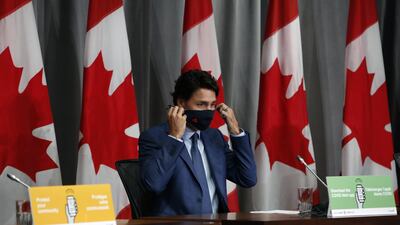
  • Justin Trudeau, Canada's Prime Minister, puts on a protective mask after a news conference in Ottawa, Ontario, Canada, on 25 September. David Kawai/Bloomberg
    Justin Trudeau, Canada's Prime Minister, puts on a protective mask after a news conference in Ottawa, Ontario, Canada, on 25 September. David Kawai/Bloomberg
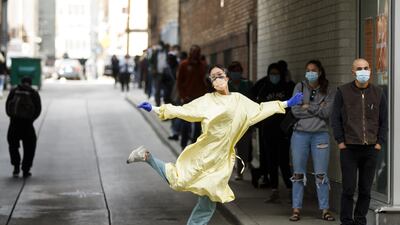
  • A healthcare worker poses for a photograph while walking towards a line of patients waiting outside a Covid-19 testing centre at St. Michael's Hospital in Toronto, Ontario, Canada on September 19. Cole Burston/Bloomberg
    A healthcare worker poses for a photograph while walking towards a line of patients waiting outside a Covid-19 testing centre at St. Michael's Hospital in Toronto, Ontario, Canada on September 19. Cole Burston/Bloomberg
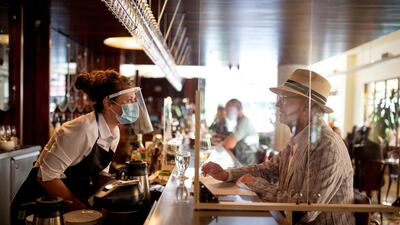
  • A bartender talks to a patron at Lemeac restaurant on the first day after the coronavirus restrictions were lifted to visit restaurants in Montreal, Quebec, Canada, on June 22. Christinne Muschi/ Reuters
    A bartender talks to a patron at Lemeac restaurant on the first day after the coronavirus restrictions were lifted to visit restaurants in Montreal, Quebec, Canada, on June 22. Christinne Muschi/ Reuters
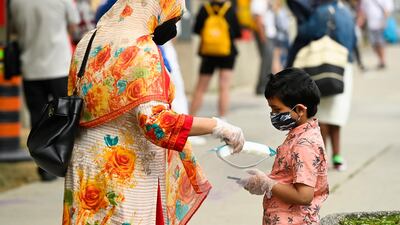
  • A boy plays on a phone as he waits in line for hours at a Covid-19 assessment centre at Mount Sinai Hospital during in Toronto on 24 September. Nathan Denette/The Canadian Press via AP
    A boy plays on a phone as he waits in line for hours at a Covid-19 assessment centre at Mount Sinai Hospital during in Toronto on 24 September. Nathan Denette/The Canadian Press via AP
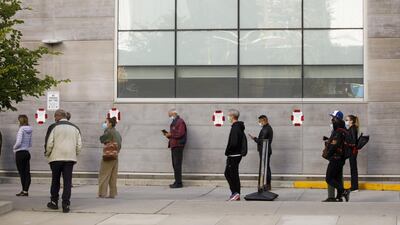
  • People queue up outside a Covid-19 testing centre at Women's College Hospital in Toronto, Ontario, Canada, on September 18. Cole Burston/Bloomberg
    People queue up outside a Covid-19 testing centre at Women's College Hospital in Toronto, Ontario, Canada, on September 18. Cole Burston/Bloomberg
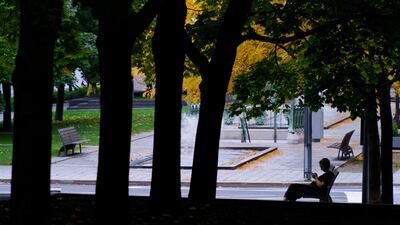
  • A woman at a park in the Montreal financial district on 28 September 28. Paul Chiasson/The Canadian Press via AP
    A woman at a park in the Montreal financial district on 28 September 28. Paul Chiasson/The Canadian Press via AP
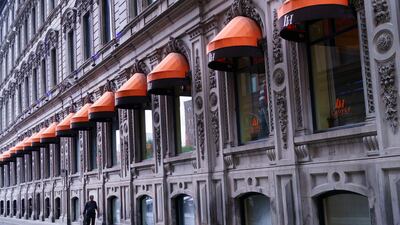
  • A pedestrian in Old Montreal, on 28 September. Paul Chiasson/The Canadian Press via AP
    A pedestrian in Old Montreal, on 28 September. Paul Chiasson/The Canadian Press via AP
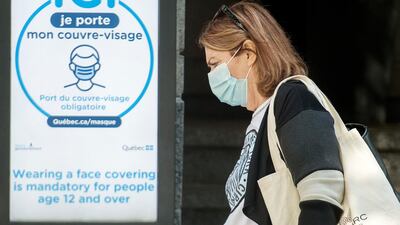
  • A woman wears a face mask as she walks by a sign advising of the mandatory wearing of masks and face coverings in Montreal, on 21 September. Graham Hughes/The Canadian Press via AP
    A woman wears a face mask as she walks by a sign advising of the mandatory wearing of masks and face coverings in Montreal, on 21 September. Graham Hughes/The Canadian Press via AP
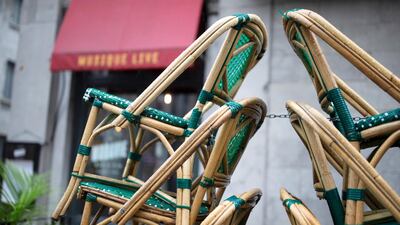
  • Chairs stacked outside a bistro as the Quebec government has ordered all restaurants, bars and casinos to close for 28 days effective midnight September 30 as Covid-19 numbers continue to rise in Montreal, Quebec, Canada, 29 September. Christinne Muschi / Reuters
    Chairs stacked outside a bistro as the Quebec government has ordered all restaurants, bars and casinos to close for 28 days effective midnight September 30 as Covid-19 numbers continue to rise in Montreal, Quebec, Canada, 29 September. Christinne Muschi / Reuters

To be sure, the lockdown is less harsh than the measures earlier in spring. Restaurants and bars will be closed, though the former can still offer takeout meals. Museums and libraries will be closed too. But businesses like gyms and hair salons will remain open. In-house gatherings are banned. Schools and day-cares will remain open, even at the highest alert level. There appears to be a government consensus that the social and economic cost of a full lockdown, even one that may arrest this wave in a shorter time, is too great to bear.

Still, it is frustrating. We are barrelling towards winter, which in Canada can be brutal, and without a vaccine candidate that is widely available in the autumn, an impossible feat, I am having a hard time imagining what life is supposed to look like in the coming months.

At least in the summer and fall, there was the panacea of walks in the park, an evening reading on the balcony, socially-distanced meetings with friends, strolls down the city’s boulevards or up the Mont Royal. It is harder to keep that up in sub-zero temperatures, especially with a baby.

I know I am lucky to be here in a country with a functioning healthcare system...

I am also frustrated because crowded bars were allowed to continue operating for much of the summer, despite quickly emerging as hotspots for the virus to spread. Closing these establishments may have allowed for a milder second wave, particularly one that is being driven by younger residents of the city.

I am worried about the next few months. Current infection rates are lagging indicators – they show a snapshot today, but the deaths and further infections that have already happened will show up only in a couple of weeks. As the premier of neighbouring Ontario, the most populous province in Canada, said, the second wave may end up becoming a tsunami.

I know I am lucky to be here in a country with a functioning healthcare system, a pandemic that did not spiral out of control as it did south of the border and where the government's focus has been on tiding people over financially as they struggle with job loss. The cost of health care is not even an issue. And we are spared political and security instability.

But I cannot help but feel sad at the prospect of yet another season without friends, without the laughter and conversation over a warm meal with family, meetings of minds with strangers or a hot cup of coffee while browsing in my favourite bookstore, smiles unhindered by masks, hugs unhindered by fear.

As our reserves are depleted, we will just have to carry on for a while longer, and perhaps we will eventually see ourselves through this whole mess. As Justin Trudeau, Canada’s Prime Minister, said in a recent speech: “It’s all too likely we won’t be gathering for Thanksgiving, but we still have a shot at Christmas.”

Here’s hoping.

Kareem Shaheen is a veteran Middle East correspondent in Canada

The specs: 2018 Kia Picanto

Price: From Dh39,500

Engine: 1.2L inline four-cylinder

Transmission: Four-speed auto

Power: 86hp @ 6,000rpm

Torque: 122Nm @ 4,000rpm

Fuel economy, combined: 6.0L / 100km

Groom and Two Brides

Director: Elie Semaan

Starring: Abdullah Boushehri, Laila Abdallah, Lulwa Almulla

Rating: 3/5

UAE currency: the story behind the money in your pockets
Other acts on the Jazz Garden bill

Sharrie Williams
The American singer is hugely respected in blues circles due to her passionate vocals and songwriting. Born and raised in Michigan, Williams began recording and touring as a teenage gospel singer. Her career took off with the blues band The Wiseguys. Such was the acclaim of their live shows that they toured throughout Europe and in Africa. As a solo artist, Williams has also collaborated with the likes of the late Dizzy Gillespie, Van Morrison and Mavis Staples.
Lin Rountree
An accomplished smooth jazz artist who blends his chilled approach with R‘n’B. Trained at the Duke Ellington School of the Arts in Washington, DC, Rountree formed his own band in 2004. He has also recorded with the likes of Kem, Dwele and Conya Doss. He comes to Dubai on the back of his new single Pass The Groove, from his forthcoming 2018 album Stronger Still, which may follow his five previous solo albums in cracking the top 10 of the US jazz charts.
Anita Williams
Dubai-based singer Anita Williams will open the night with a set of covers and swing, jazz and blues standards that made her an in-demand singer across the emirate. The Irish singer has been performing in Dubai since 2008 at venues such as MusicHall and Voda Bar. Her Jazz Garden appearance is career highlight as she will use the event to perform the original song Big Blue Eyes, the single from her debut solo album, due for release soon.

Key facilities
  • Olympic-size swimming pool with a split bulkhead for multi-use configurations, including water polo and 50m/25m training lanes
  • Premier League-standard football pitch
  • 400m Olympic running track
  • NBA-spec basketball court with auditorium
  • 600-seat auditorium
  • Spaces for historical and cultural exploration
  • An elevated football field that doubles as a helipad
  • Specialist robotics and science laboratories
  • AR and VR-enabled learning centres
  • Disruption Lab and Research Centre for developing entrepreneurial skills
Who was Alfred Nobel?

The Nobel Prize was created by wealthy Swedish chemist and entrepreneur Alfred Nobel.

  • In his will he dictated that the bulk of his estate should be used to fund "prizes to those who, during the preceding year, have conferred the greatest benefit to humankind".
  • Nobel is best known as the inventor of dynamite, but also wrote poetry and drama and could speak Russian, French, English and German by the age of 17. The five original prize categories reflect the interests closest to his heart.
  • Nobel died in 1896 but it took until 1901, following a legal battle over his will, before the first prizes were awarded.

Ordinary Virtues: Moral Order in a Divided World by Michael Ignatieff
Harvard University Press

Company Profile

Name: JustClean

Based: Kuwait with offices in other GCC countries

Launch year: 2016

Number of employees: 130

Sector: online laundry service

Funding: $12.9m from Kuwait-based Faith Capital Holding

Ten tax points to be aware of in 2026

1. Domestic VAT refund amendments: request your refund within five years

If a business does not apply for the refund on time, they lose their credit.

2. E-invoicing in the UAE

Businesses should continue preparing for the implementation of e-invoicing in the UAE, with 2026 a preparation and transition period ahead of phased mandatory adoption. 

3. More tax audits

Tax authorities are increasingly using data already available across multiple filings to identify audit risks. 

4. More beneficial VAT and excise tax penalty regime

Tax disputes are expected to become more frequent and more structured, with clearer administrative objection and appeal processes. The UAE has adopted a new penalty regime for VAT and excise disputes, which now mirrors the penalty regime for corporate tax.

5. Greater emphasis on statutory audit

There is a greater need for the accuracy of financial statements. The International Financial Reporting Standards standards need to be strictly adhered to and, as a result, the quality of the audits will need to increase.

6. Further transfer pricing enforcement

Transfer pricing enforcement, which refers to the practice of establishing prices for internal transactions between related entities, is expected to broaden in scope. The UAE will shortly open the possibility to negotiate advance pricing agreements, or essentially rulings for transfer pricing purposes. 

7. Limited time periods for audits

Recent amendments also introduce a default five-year limitation period for tax audits and assessments, subject to specific statutory exceptions. While the standard audit and assessment period is five years, this may be extended to up to 15 years in cases involving fraud or tax evasion. 

8. Pillar 2 implementation 

Many multinational groups will begin to feel the practical effect of the Domestic Minimum Top-Up Tax (DMTT), the UAE's implementation of the OECD’s global minimum tax under Pillar 2. While the rules apply for financial years starting on or after January 1, 2025, it is 2026 that marks the transition to an operational phase.

9. Reduced compliance obligations for imported goods and services

Businesses that apply the reverse-charge mechanism for VAT purposes in the UAE may benefit from reduced compliance obligations. 

10. Substance and CbC reporting focus

Tax authorities are expected to continue strengthening the enforcement of economic substance and Country-by-Country (CbC) reporting frameworks. In the UAE, these regimes are increasingly being used as risk-assessment tools, providing tax authorities with a comprehensive view of multinational groups’ global footprints and enabling them to assess whether profits are aligned with real economic activity. 

Contributed by Thomas Vanhee and Hend Rashwan, Aurifer

The Settlers

Director: Louis Theroux

Starring: Daniella Weiss, Ari Abramowitz

Rating: 5/5

WHAT ARE NFTs?


Non-fungible tokens (NFTs) are tokens that represent ownership of unique items. They allow the tokenisation of things such as art, collectibles and even real estate.


An NFT can have only one official owner at one time. And since they're minted and secured on the Ethereum blockchain, no one can modify the record of ownership, not even copy-paste it into a new one.


This means NFTs are not interchangeable and cannot be exchanged with other items. In contrast, fungible items, such as fiat currencies, can be exchanged because their value defines them rather than their unique properties.

 
Dubai works towards better air quality by 2021

Dubai is on a mission to record good air quality for 90 per cent of the year – up from 86 per cent annually today – by 2021.

The municipality plans to have seven mobile air-monitoring stations by 2020 to capture more accurate data in hourly and daily trends of pollution.

These will be on the Palm Jumeirah, Al Qusais, Muhaisnah, Rashidiyah, Al Wasl, Al Quoz and Dubai Investment Park.

“It will allow real-time responding for emergency cases,” said Khaldoon Al Daraji, first environment safety officer at the municipality.

“We’re in a good position except for the cases that are out of our hands, such as sandstorms.

“Sandstorms are our main concern because the UAE is just a receiver.

“The hotspots are Iran, Saudi Arabia and southern Iraq, but we’re working hard with the region to reduce the cycle of sandstorm generation.”

Mr Al Daraji said monitoring as it stood covered 47 per cent of Dubai.

There are 12 fixed stations in the emirate, but Dubai also receives information from monitors belonging to other entities.

“There are 25 stations in total,” Mr Al Daraji said.

“We added new technology and equipment used for the first time for the detection of heavy metals.

“A hundred parameters can be detected but we want to expand it to make sure that the data captured can allow a baseline study in some areas to ensure they are well positioned.”

What can victims do?

Always use only regulated platforms

Stop all transactions and communication on suspicion

Save all evidence (screenshots, chat logs, transaction IDs)

Report to local authorities

Warn others to prevent further harm

Courtesy: Crystal Intelligence

From Zero

Artist: Linkin Park

Label: Warner Records

Number of tracks: 11

Rating: 4/5

Company%20profile
%3Cp%3EName%3A%20Tabby%3Cbr%3EFounded%3A%20August%202019%3B%20platform%20went%20live%20in%20February%202020%3Cbr%3EFounder%2FCEO%3A%20Hosam%20Arab%2C%20co-founder%3A%20Daniil%20Barkalov%3Cbr%3EBased%3A%20Dubai%2C%20UAE%3Cbr%3ESector%3A%20Payments%3Cbr%3ESize%3A%2040-50%20employees%3Cbr%3EStage%3A%20Series%20A%3Cbr%3EInvestors%3A%20Arbor%20Ventures%2C%20Mubadala%20Capital%2C%20Wamda%20Capital%2C%20STV%2C%20Raed%20Ventures%2C%20Global%20Founders%20Capital%2C%20JIMCO%2C%20Global%20Ventures%2C%20Venture%20Souq%2C%20Outliers%20VC%2C%20MSA%20Capital%2C%20HOF%20and%20AB%20Accelerator.%3Cbr%3E%3C%2Fp%3E%0A