
Here on the US East Coast, it’s the traditional time for American football games, prepping for Halloween or Thanksgiving, or watching great maple trees turn red and orange.
But there is no tradition this year. Instead, most Americans find themselves caught in an increasingly dystopian world as elections grow nearer. Last week was the pinnacle, featuring the most startling presidential debate – or debacle as most see it – in history and then, a few days later, President Donald Trump and his wife Melania testing positive for Covid-19.
With Mr Trump, who is 74 and overweight, now hospitalised at Walter Reed Hospital, and more members of his circle testing positive, the 2020 election campaign has been turned upside down. There is also some confusion in the timeline of Mr Trump's illness. He didn't inform the public until 1am on Friday, but his doctors have made references to symptoms or treatments beginning while he was still attending large fundraisers and rallies.
-
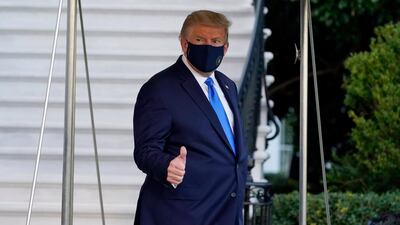
President Donald Trump gives a thumbs-up as he leaves the White House to go to Walter Reed National Military Medical Center. AP Photo -
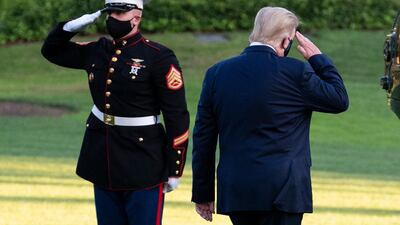
President Donald Trump salutes as he boards Marine One as he leaves the White House. AP Photo -
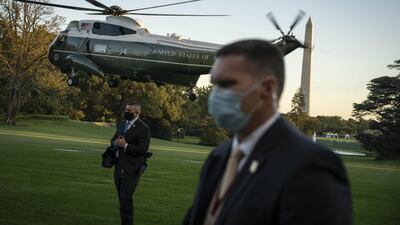
Members of the US Secret Service wear protective masks as Marine One, with U.S. President Donald Trump on board, departs the South Lawn of the White House. Bloomberg -
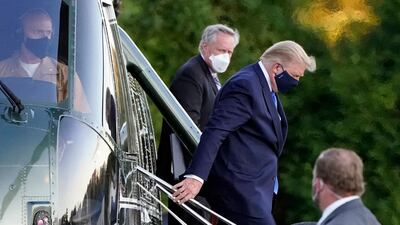
President Donald Trump arrives at Walter Reed National Military Medical Center. AP Photo -

US President Donald Trump waves from the presidential motorcade while arriving at the Walter Reed National Military Medical Center. Bloomberg -

President Donald Trump boards Marine One. AP Photo -
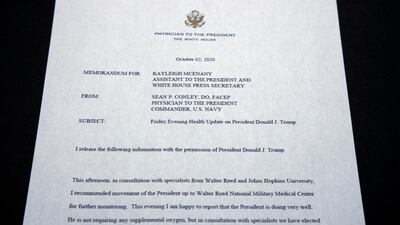
The memorandum from White House physician Sean Conley to White House press secretary Kayleigh McEnany with information about President Donald Trump being moved to Walter reed National Military Medical Center and the decision to initiate Remdesivir therapy. AP Photo -
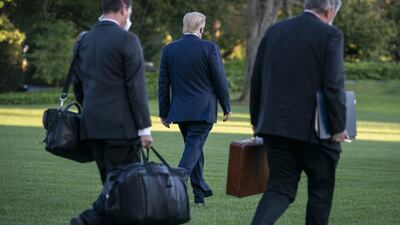
US President Donald Trump walks on the South Lawn of the White House before boarding Marine One. Bloomberg -
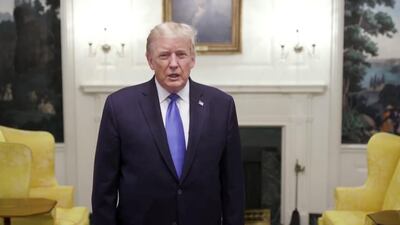
US President Donald Trump makes an announcement after he and First Lady Melania Trump tested positive for the coronavirus. Reuters -

Marine One helicopter, with President Donald Trump aboard, lifts off from the South Lawn of the White House. AP Photo -
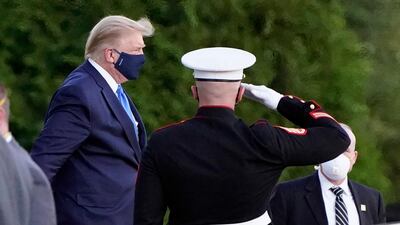
President Donald Trump arrives at Walter Reed National Military Medical Center. AP Photo -
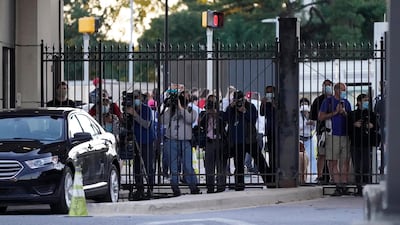
Members of the media and general public watch as President Donald Trump arrives at Walter Reed National Military Medical Center. AP Photo -
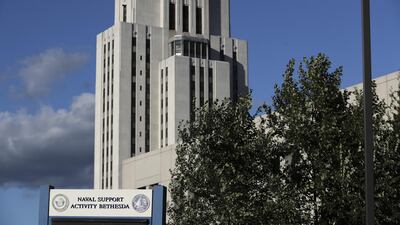
The Walter Reed National Military Medical Center in Bethesda, Maryland. Bloomberg


It would have been less bizarre had Mr Trump recognised that stopping the spread of the virus, by wearing masks and practising social distancing, is imperative. Instead, he encouraged his fan base to eschew masks. He called for large cities to be re-opened. He suggested that people drink bleach to combat the virus. Despite warnings, he has fixated on the release of a vaccine before the election – presumably to gain votes.
There might have been more sympathy for the Trumps had his wife not been caught on the “Melania tapes” earlier in the week. In a conversation with a former aide, the First Lady peppered her halting English with profanities to describe her White House Christmas duties, and her apparent disdain for the plight of immigrant children separated from their parents.
But it was the horror of the debate that left most Americans, even some of his supporters, reeling. Mr Biden stressed how the President had failed his country during the pandemic, leaving 200,000 dead. His "empty chair" image – symbolising how many families lost a loved one to the virus – went viral.
To counter, Trump went full-throttle bully. If it left anyone undecided about their vote after witnessing the spectacle, it is – in the words of the comedian David Sedaris – like being on an airplane and being offered chicken or a platter containing bits of broken glass, and then asking how the chicken is cooked.
Looking back historically at other debates, it is possible Mr Trump could climb out of this mess, if only because his Maga (Make American Great Again) voter base saw his performance as a victory.
There have been other unorthodox debates that changed American history.

In 1960, a young senator, John Kennedy, and vice president Richard Nixon, a tireless campaigner and a skilled politician, took to the stage. Nixon had been ill and refused to wear make-up because Kennedy goaded him into rejecting it. But the duplicitous Kennedy – who used television the way Mr Trump uses Twitter – had already applied his layer of foundation over tanned skin.
Nixon had still been leading the polls. Kennedy – the scion of a corrupt Irish-Catholic mafia – was an unknown. But while the former looked gaunt and pale from his illness, the latter appeared handsome – and played dirty. He prepped for weeks and broke a gentleman’s rule not to discuss foreign policy. Nixon was unprepared for Cold War conversation. Kennedy went on to win in one of the closest presidential elections, at that time, in history.
In 1980, a former Hollywood actor whose most famous co-star was a chimp debated against President Jimmy Carter. Mr Carter's presidency had not been successful. There were American hostages in Iran, and economic growth was stagnant. He used the debate to talk about a conversation with his 13-year-old daughter about nuclear weapons. Mr Carter had the lead in the polls. But Reagan used his refrain of "are you better off now then you were four years ago?" to help usher in a right-wing conservative shift in politics, Reaganomics and the Moral Majority movement.

In 1992, a relatively unknown governor from Arkansas, Bill Clinton, went up against the formidable, popular Gulf War president, George HW Bush. Bush’s detractors said he was an out-of-touch millionaire. Ross Perot, another Texas millionaire, entered the race and began taking Bush’s Republican votes. During the debate, Bush was asked how the national debt had affected the candidates personally. Bush – a privileged senator’s son – stumbled through the question. Mr Clinton knew how to connect with the audience; he had a natural warmth. Bush got caught staring at his watch while Mr Clinton spoke. A few weeks later, Mr Clinton won the election.
By November 3, we might not remember the debate if things get increasingly worse. There is talk already of Mr Trump's line of succession. There is increasing muttering about post-election violence and civil strife. There is speculation of a second wave of Covid-19.
His own diagnosis also imperils the Supreme Court installation of Amy Coney Barrett before Election Day. It would have been daunting for the confirmation to happen in steady times – but with the President in hospital, pulling off a complex operation that would need three branches of government involved in the next four weeks seems unlikely. Senior Republicans are adamant that they will move ahead with the hearings on her nomination.
We are only in October, and 2020 will go down as one of the most challenging and strange times in American history. I have no doubt we will recover, as a nation. Americans are historically resilient and Covid-19 will eventually lose its power. But whether or not Mr Trump will admit to losing his is another matter.
Janine di Giovanni is a Senior Fellow at Yale University’s Jackson Institute for Global Affairs

