Ursula von der Leyen, Charles Michel, Angela Merkel, Emmanuel Macron and Xi Jinping are seen on screen during the video conference. Reuters

Why a post-Brexit EU will be tougher to deal with


  • English
  • Arabic

At the end of what could be described as the "Year of Zoom", the leadership of the European Union fittingly sealed a landmark investment pact with China via video conference.

Something unusual occurred on Wednesday, when the call was joined by the Chancellor of Germany and the President of France. The imprimatur in-person of Angela Merkel and Emmanuel Macron, respectively, completed the continental bloc’s linkage with the Chinese economy. It was a moment that said that Germany and France really were in the driving seat for all 27 countries.

Henry Kissinger, the former US secretary of state, once asked who he should call if he wanted to talk to “Europe”. The answer now is a split line to Berlin and Paris.

On the same day the EU finished up the last bit of business from the old era: Charles Michel, President of the European Council, and Ursula von der Leyen, President of the European Commission, signed the free trade deal with the UK that should ensure a reasonably frictionless Brexit.

Power is about choices that demonstrate where it resides.

When UK Prime Minister Boris Johnson wanted to break the logjam of the Brexit talks earlier in December, he tried to reach over the head of Ms Von der Leyen. He wanted to engage directly with Mrs Merkel and Mr Macron.

Unlike the Chinese set-up, Mr Johnson’s call for direct talks was rebuffed. The common line ran through the EU offices in Brussels.

Because of its collective nature, the EU is often an opaque actor on the global stage. This is not a failure of communications. The countries of Europe have extremely able diplomats and plenty of resources available for communications.

The completion of the investment pact with Beijing concluded a long process of negotiations.

For Mrs Merkel, who is likely to step down in 2021, it was a cherished goal of her own endgame as a stateswoman. In her New Year message, Mrs Merkel spoke about how difficult this last period in office has been. She even said that it was the hardest of her 15 years in power.

German Chancellor Angela Merkel, right, will effectively hand over the leadership role of Europe to French President Emmanuel Macron, centre, when she retires this year. AP Photo

Despite the arduous times, she can depart in triumph. Mr Macron is thereby well positioned to take over as de facto leader of the union, with the new German chancellor likely to give him the role of a senior statesman until the next French presidential election in 2022.

That means that Mr Macron has an opportunity in particular to shape European defence and foreign policy around French priorities. In policy terms, the implications are that a more decisive, better-resourced European framework will be built up in the coming years.

For US President-elect Joe Biden, these trends will shape how he rebuilds American diplomacy. Washington can no longer take the Europeans for granted – and there is no disguising this fact. The EU's investment deal with China was signed even though Jake Sullivan, Mr Biden's nominee for the position of national security adviser, went public with a plea for a rethink.

The Europeans, instead, rushed ahead to ensure that the agreement was completed during the transition period between the Trump and Biden administrations.

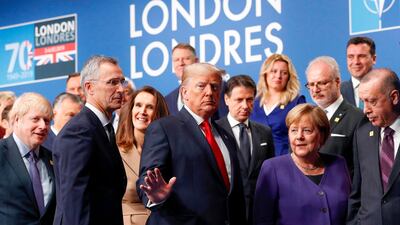
  • Britain's Prime Minister Boris Johnson (left), US President Donald Trump (centre), German Chancellor Angela Merkel (second right), Turkey's President Recep Tayyip Erdogan (right) and other Nato leaders leave the stage after the family photo to head to the plenary session at the NATO summit at the Grove hotel in Watford. AFP
    Britain's Prime Minister Boris Johnson (left), US President Donald Trump (centre), German Chancellor Angela Merkel (second right), Turkey's President Recep Tayyip Erdogan (right) and other Nato leaders leave the stage after the family photo to head to the plenary session at the NATO summit at the Grove hotel in Watford. AFP
  • Emmanuel Macron, France's president, gestures while speaking during a news conference. Bloomberg
    Emmanuel Macron, France's president, gestures while speaking during a news conference. Bloomberg
  • Britain's Princess Anne, right, talks to Nato delegates from left, Canadian Prime Minister Justin Trudeau and Britain's Prime Minister Boris Johnson. AP
    Britain's Princess Anne, right, talks to Nato delegates from left, Canadian Prime Minister Justin Trudeau and Britain's Prime Minister Boris Johnson. AP
  • US President Donald Trump speaks during a bilateral meeting with Italy's Prime Minister Giuseppe Conte (unseen) at the Nato summit at the Grove hotel in Watford. AFP
    US President Donald Trump speaks during a bilateral meeting with Italy's Prime Minister Giuseppe Conte (unseen) at the Nato summit at the Grove hotel in Watford. AFP
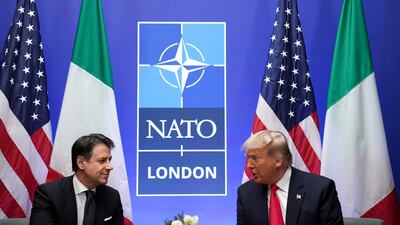
  • Donald Trump and Italian Prime Minister Giuseppe Conte meet on the sidelines of the Nato summit in Watford. Reuters
    Donald Trump and Italian Prime Minister Giuseppe Conte meet on the sidelines of the Nato summit in Watford. Reuters
  • France's President Emmanuel Macron (right) greets Poland's President Andrzej Duda (left) during a meeting at the Nato summit at the Grove hotel in Watford. AFP
    France's President Emmanuel Macron (right) greets Poland's President Andrzej Duda (left) during a meeting at the Nato summit at the Grove hotel in Watford. AFP
  • France's President Emmanuel Macron gives a press conference. AFP
    France's President Emmanuel Macron gives a press conference. AFP
  • US President Donald Trump speaks during a bilateral meeting with Italy's Prime Minister Giuseppe Conte. AFP
    US President Donald Trump speaks during a bilateral meeting with Italy's Prime Minister Giuseppe Conte. AFP

Joint action on climate change and a “Green Deal” will give the US and EU powerful synergies. But there are limitations ahead, not least because the Europeans will not always be able to – or want to – follow the US lead.

Internal tensions among the European states have been suppressed by the Covid-19 pandemic. And Washington is likely to find that there is a minefield to traverse as it engages with the bloc.

Open rifts will not be healed just by the shift from Donald Trump to Mr Biden. Neither side has a clear idea of how to patch up the divisions over Iran. The European expectations that the 2015 nuclear deal can be restored could be too optimistic.

The Biden administration is also unlikely to find it easy to rebuild the pre-eminent role for the Nato alliance in European security. Turkey took up the key command of Nato's rapid reaction force at the turn of the year. However, not only is Paris in an open feud with Ankara, but the French agenda of boosting the EU's defence capabilities points a sidelining of Nato over time.

This leaves the puzzle of where Britain will position itself. It is no longer in the EU so it cannot act as a firewall to protect Nato. Through Brexit, London risks slipping well down this priority list for whom the US president calls first in a crisis.

On the other hand, Britain aligns well with the new president. Its clear embrace of a green “build back better” agenda, globalist outlook and rising scepticism about the advantages of working in lockstep with Beijing are all in its favour.

Kissinger once asked who he should call if he wanted to talk to 'Europe'. The answer was a split line to Berlin and Paris. It still is

With a more nimble foreign policy – London promises to remain an ally for Europe – Washington could find more momentum through co-operation with the British government.

For Mr Johnson, the challenge is to navigate Britain back to its traditional role alongside Europe – and not within it. With much depending on the trade-deal diplomacy that London engages post-Brexit, there is a potential foreign policy dividend for 10 Downing Street.

France and Germany have stepped to the plate of European leadership. For the outside world, especially the US but also Japan and Australia, the EU orientation’s may not be as useful as London’s positioning.

It would be a mistake to say that outright competition will dictate these relationships over the rest of the decade. At the same time, it is not a foregone conclusion that France and Germany will ensure that the EU is a go-to partner in the years ahead.

Damien McElroy is London bureau chief at The National

Mercer, the investment consulting arm of US services company Marsh & McLennan, expects its wealth division to at least double its assets under management (AUM) in the Middle East as wealth in the region continues to grow despite economic headwinds, a company official said.

Mercer Wealth, which globally has $160 billion in AUM, plans to boost its AUM in the region to $2-$3bn in the next 2-3 years from the present $1bn, said Yasir AbuShaban, a Dubai-based principal with Mercer Wealth.

Within the next two to three years, we are looking at reaching $2 to $3 billion as a conservative estimate and we do see an opportunity to do so,” said Mr AbuShaban.

Mercer does not directly make investments, but allocates clients’ money they have discretion to, to professional asset managers. They also provide advice to clients.

“We have buying power. We can negotiate on their (client’s) behalf with asset managers to provide them lower fees than they otherwise would have to get on their own,” he added.

Mercer Wealth’s clients include sovereign wealth funds, family offices, and insurance companies among others.

From its office in Dubai, Mercer also looks after Africa, India and Turkey, where they also see opportunity for growth.

Wealth creation in Middle East and Africa (MEA) grew 8.5 per cent to $8.1 trillion last year from $7.5tn in 2015, higher than last year’s global average of 6 per cent and the second-highest growth in a region after Asia-Pacific which grew 9.9 per cent, according to consultancy Boston Consulting Group (BCG). In the region, where wealth grew just 1.9 per cent in 2015 compared with 2014, a pickup in oil prices has helped in wealth generation.

BCG is forecasting MEA wealth will rise to $12tn by 2021, growing at an annual average of 8 per cent.

Drivers of wealth generation in the region will be split evenly between new wealth creation and growth of performance of existing assets, according to BCG.

Another general trend in the region is clients’ looking for a comprehensive approach to investing, according to Mr AbuShaban.

“Institutional investors or some of the families are seeing a slowdown in the available capital they have to invest and in that sense they are looking at optimizing the way they manage their portfolios and making sure they are not investing haphazardly and different parts of their investment are working together,” said Mr AbuShaban.

Some clients also have a higher appetite for risk, given the low interest-rate environment that does not provide enough yield for some institutional investors. These clients are keen to invest in illiquid assets, such as private equity and infrastructure.

“What we have seen is a desire for higher returns in what has been a low-return environment specifically in various fixed income or bonds,” he said.

“In this environment, we have seen a de facto increase in the risk that clients are taking in things like illiquid investments, private equity investments, infrastructure and private debt, those kind of investments were higher illiquidity results in incrementally higher returns.”

The Abu Dhabi Investment Authority, one of the largest sovereign wealth funds, said in its 2016 report that has gradually increased its exposure in direct private equity and private credit transactions, mainly in Asian markets and especially in China and India. The authority’s private equity department focused on structured equities owing to “their defensive characteristics.”

Pharaoh's curse

British aristocrat Lord Carnarvon, who funded the expedition to find the Tutankhamun tomb, died in a Cairo hotel four months after the crypt was opened.
He had been in poor health for many years after a car crash, and a mosquito bite made worse by a shaving cut led to blood poisoning and pneumonia.
Reports at the time said Lord Carnarvon suffered from “pain as the inflammation affected the nasal passages and eyes”.
Decades later, scientists contended he had died of aspergillosis after inhaling spores of the fungus aspergillus in the tomb, which can lie dormant for months. The fact several others who entered were also found dead withiin a short time led to the myth of the curse.

Specs

Engine: 51.5kW electric motor

Range: 400km

Power: 134bhp

Torque: 175Nm

Price: From Dh98,800

Available: Now

THE%20HOLDOVERS
%3Cp%3E%3Cstrong%3EDirector%3A%20%3C%2Fstrong%3EAlexander%20Payne%3C%2Fp%3E%0A%3Cp%3E%3Cstrong%3EStarring%3A%3C%2Fstrong%3E%20Paul%20Giamatti%2C%20Da'Vine%20Joy%20Randolph%2C%20Dominic%20Sessa%3C%2Fp%3E%0A%3Cp%3E%3Cstrong%3ERating%3A%3C%2Fstrong%3E%204.5%2F5%3C%2Fp%3E%0A
Fifa%20World%20Cup%20Qatar%202022%20
%3Cp%3E%3Cstrong%3EFirst%20match%3A%20%3C%2Fstrong%3ENovember%2020%0D%3Cbr%3E%3Cstrong%3EFinal%2016%20round%3A%20%3C%2Fstrong%3EDecember%203%20to%206%0D%3Cbr%3E%3Cstrong%3EQuarter-finals%3A%20%3C%2Fstrong%3EDecember%209%20and%2010%0D%3Cbr%3E%3Cstrong%3ESemi-finals%3A%20%3C%2Fstrong%3EDecember%2013%20and%2014%0D%3Cbr%3E%3Cstrong%3EFinal%3A%20%3C%2Fstrong%3EDecember%2018%3C%2Fp%3E%0A
Ten tax points to be aware of in 2026

1. Domestic VAT refund amendments: request your refund within five years

If a business does not apply for the refund on time, they lose their credit.

2. E-invoicing in the UAE

Businesses should continue preparing for the implementation of e-invoicing in the UAE, with 2026 a preparation and transition period ahead of phased mandatory adoption. 

3. More tax audits

Tax authorities are increasingly using data already available across multiple filings to identify audit risks. 

4. More beneficial VAT and excise tax penalty regime

Tax disputes are expected to become more frequent and more structured, with clearer administrative objection and appeal processes. The UAE has adopted a new penalty regime for VAT and excise disputes, which now mirrors the penalty regime for corporate tax.

5. Greater emphasis on statutory audit

There is a greater need for the accuracy of financial statements. The International Financial Reporting Standards standards need to be strictly adhered to and, as a result, the quality of the audits will need to increase.

6. Further transfer pricing enforcement

Transfer pricing enforcement, which refers to the practice of establishing prices for internal transactions between related entities, is expected to broaden in scope. The UAE will shortly open the possibility to negotiate advance pricing agreements, or essentially rulings for transfer pricing purposes. 

7. Limited time periods for audits

Recent amendments also introduce a default five-year limitation period for tax audits and assessments, subject to specific statutory exceptions. While the standard audit and assessment period is five years, this may be extended to up to 15 years in cases involving fraud or tax evasion. 

8. Pillar 2 implementation 

Many multinational groups will begin to feel the practical effect of the Domestic Minimum Top-Up Tax (DMTT), the UAE's implementation of the OECD’s global minimum tax under Pillar 2. While the rules apply for financial years starting on or after January 1, 2025, it is 2026 that marks the transition to an operational phase.

9. Reduced compliance obligations for imported goods and services

Businesses that apply the reverse-charge mechanism for VAT purposes in the UAE may benefit from reduced compliance obligations. 

10. Substance and CbC reporting focus

Tax authorities are expected to continue strengthening the enforcement of economic substance and Country-by-Country (CbC) reporting frameworks. In the UAE, these regimes are increasingly being used as risk-assessment tools, providing tax authorities with a comprehensive view of multinational groups’ global footprints and enabling them to assess whether profits are aligned with real economic activity. 

Contributed by Thomas Vanhee and Hend Rashwan, Aurifer

MATCH INFO

Manchester United 1 (Fernandes pen 2') Tottenham Hotspur 6 (Ndombele 4', Son 7' & 37' Kane (30' & pen 79, Aurier 51')

Man of the match Son Heung-min (Tottenham)

Meatless Days
Sara Suleri, with an introduction by Kamila Shamsie
​​​​​​​Penguin 

Scoreline

Syria 1-1 Australia

Syria Al Somah 85'

Australia Kruse 40'

The specs

Engine: 2-litre 4-cylinder and 3.6-litre 6-cylinder

Power: 220 and 280 horsepower

Torque: 350 and 360Nm

Transmission: eight-speed automatic

Price: from Dh136,521 VAT and Dh166,464 VAT 

On sale: now

How to get exposure to gold

Although you can buy gold easily on the Dubai markets, the problem with buying physical bars, coins or jewellery is that you then have storage, security and insurance issues.

A far easier option is to invest in a low-cost exchange traded fund (ETF) that invests in the precious metal instead, for example, ETFS Physical Gold (PHAU) and iShares Physical Gold (SGLN) both track physical gold. The VanEck Vectors Gold Miners ETF invests directly in mining companies.

Alternatively, BlackRock Gold & General seeks to achieve long-term capital growth primarily through an actively managed portfolio of gold mining, commodity and precious-metal related shares. Its largest portfolio holdings include gold miners Newcrest Mining, Barrick Gold Corp, Agnico Eagle Mines and the NewMont Goldcorp.

Brave investors could take on the added risk of buying individual gold mining stocks, many of which have performed wonderfully well lately.

London-listed Centamin is up more than 70 per cent in just three months, although in a sign of its volatility, it is down 5 per cent on two years ago. Trans-Siberian Gold, listed on London's alternative investment market (AIM) for small stocks, has seen its share price almost quadruple from 34p to 124p over the same period, but do not assume this kind of runaway growth can continue for long

However, buying individual equities like these is highly risky, as their share prices can crash just as quickly, which isn't what what you want from a supposedly safe haven.

The 15 players selected

Muzzamil Afridi, Rahman Gul, Rizwan Haider (Dezo Devils); Shahbaz Ahmed, Suneth Sampath (Glory Gladiators); Waqas Gohar, Jamshaid Butt, Shadab Ahamed (Ganga Fighters); Ali Abid, Ayaz Butt, Ghulam Farid, JD Mahesh Kumara (Hiranni Heros); Inam Faried, Mausif Khan, Ashok Kumar (Texas Titans

A%20QUIET%20PLACE
%3Cp%3E%3Cstrong%3EStarring%3A%3C%2Fstrong%3E%20Lupita%20Nyong'o%2C%20Joseph%20Quinn%2C%20Djimon%20Hounsou%3C%2Fp%3E%0A%3Cp%3E%3Cstrong%3EDirector%3A%20%3C%2Fstrong%3EMichael%20Sarnoski%3C%2Fp%3E%0A%3Cp%3E%3Cstrong%3ERating%3A%3C%2Fstrong%3E%204%2F5%3C%2Fp%3E%0A
Results

5pm: Maiden (PA) Dh80,000 (Turf) 1,600m; Winner: Rawat Al Reef, Adrie de Vries (jockey), Abdallah Al Hammadi (trainer)

5.30pm: Wathba Stallions Cup Handicap (PA) Dh70,000 (T) 1,400m; Winner: Noof KB, Richard Mullen, Ernst Oertel

6pm: Handicap (PA) Dh80,000 (T) 1,200m; Winner: AF Seven Skies, Bernardo Pinheiro, Qaiss Aboud

6.30pm: Handicap (PA) Dh80,000 (T) 2,200m; Winner: Jabalini, Szczepan Mazur, Ibrahim Al Hadhrami

7pm: UAE Arabian Derby – Prestige (PA) Dh150,000 (T) 2,200m; Winner: Dergham Athbah, Richard Mullen, Mohamed Daggash

7.30pm: Emirates Championship – Group 1 (PA) Dh1,000,000 (T) 2,200m; Winner: Somoud, Richard Mullen, Jean de Roualle

8pm: Abu Dhabi Championship – Group 3 (TB) Dh380,000 (T) 2,200m; Winner: Irish Freedom, Antonio Fresu, Satish Seemar