Saudi Arabia revised its social security system to allow children of Saudi women married to foreigners to benefit from their mother’s pension if she is widowed or divorced.
State payments to women who have retired from their jobs can be accessed by their children even if they don't carry the Saudi passport.
The mother must provide proof of marriage and must be a permanent resident in the kingdom, and should not have spent more than three months outside the kingdom in the year prior to her retirement.
The state will also allow benefits to people with disabilities who have Saudi mothers, and children whose Saudi mothers have passed away, providing they hold a valid travel document.
Applicants for state support must receive a decision within 20 days from the Ministry of Human Resources and Social Development, along with reasons in case the application is rejected.
In case there is no response, decision or reasons for rejection, the applicant can issue an official complaint against the committee over a period of one month.
Under Saudi Arabia’s marriage law, a woman will not lose her nationality if she marries a non-Saudi, unless she opts to adopt another citizenship.
However, she has the right to reclaim her Saudi nationality if she is divorced and wants to live in the kingdom.
A Saudi woman married to a foreigner can't pass on her nationality to her children, nor can a non-Saudi woman who is married to a Saudi national. According to Saudi Nationality Law, children acquire their father's citizenship and can therefore avail and access all benefits.
However, Saudi women married to non-Saudis can help sponsor and secure jobs for their husbands in the kingdom.
Children born to Saudi mothers and foreign fathers are placed under a sponsorship system.
Saudi mothers have the right to bring their children to live in the kingdom if they are abroad, in which case the state bears their residency fees
These children can also work in the private sector with equal access to opportunities as Saudi nationals, “in respect of entitlement to education and medical treatment, and taking them into account in the calculation of the rate of Saudisation of jobs in the private sector”, according to Saudi Nationality Law.
-

Hanadi Hindi from Saudi Arabia gives the thumbs up as she sits in the cockpit of the American Piper Archor 2000 plane before take off at Marka airport in Amman April 30, 2003. The first ever Saudi woman pilot Hanadi Hindi currently training in Jordan, said flying had given her freedom from conservative traditions and she hopes that women from Saudi Arabia would enjoy one day. Reuters -
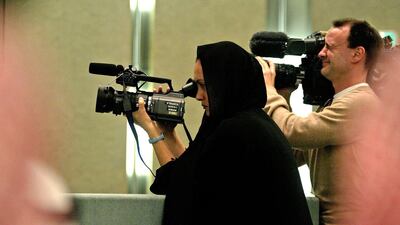
A woman journalist films the announcement of election results 11 February 2005 for the Riyadh Municipal Council in Saudi Arabia where pro-Islamists candidates emerged a the triumphant block in the landmark elections. EPA -
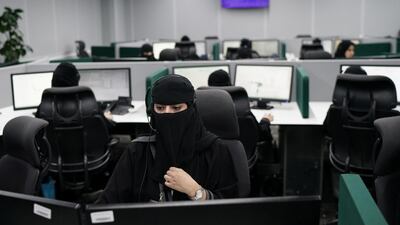
Saudi women work at National Center for Security Operations 911 headquarters in the holy city of Mecca, Saudi Arabia August 6, 2019. Reuters -

Saudi Rodina Maamoun, who employed 19 young women almost entirely replacing the men, sells jewellery at a retail store in Riyadh's Hayat mall on February 19, 2020. For decades, straitlaced Saudi society offered limited opportunities for paid work to women. The few who found jobs were mostly restricted to the health and education sectors. An oppressive "guardianship" system also gave male relatives the right to object to women' professional aspirations. But change came in mid-2016 when Crown Prince Mohammed bin Salman unveiled his "Vision 2030" plan aimed at diversifying the kingdom's economy and ending its addiction to oil. AFP -

Enaam Gazi al-Aswad, 43, one of the first female drivers hired by the ride sharing company Careem but waiting for Saudi license to be issued by the government, applies lipstick inside her car at a company's office in Jeddah, Saudi Arabia June 24, 2018. Reuters -
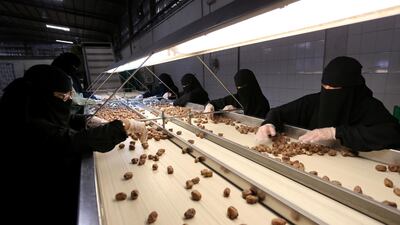
Saudi women work at a dates packaging factory in Al-Ahsa, Saudi Arabia, September 10, 2020. Reuters -
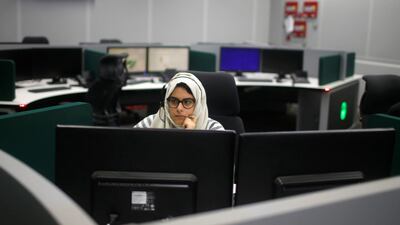
A Saudi woman works inside the first all-female call centre in the kingdom's security sector, in the holy city of Mecca, Saudi Arabia August 29, 2017. Reuters -
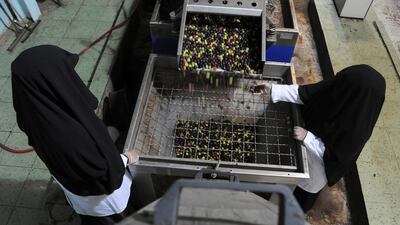
Veil-clad female workers process olives at a factory for pickling olives in the Saudi city of Tabuk October 23, 2013. Reuters -

Dr Samira al-Ghamdi, a practicing psychologist, drives her car out in her neighborhood while going to work, in Jeddah, Saudi Arabia June 24, 2018. Reuters -

A Saudi female employee adds price tags to murchandise at a hypermarket, newly launched by the operator LuLu and run by a team of women, in the Saudi Arabian port city of Jeddah, on February 21, 2021. AFP


Earlier this month, Shura council members pushed for the children of Saudi women married to non-Saudis to get permanent residency permits (Iqamas) without paying any fee, a proposal that has been rejected twice by the Shura Council’s Security Affairs Committee already.
No decision has been made yet as the council members continue to discuss the issue.

