

More Saudi Arabian women are joining the workforce than ever before as wide-sweeping reforms bear fruit, leading to higher employment, leveraging untapped talent, boosting household incomes and reducing the economy's reliance on oil revenues.
Female participation in the kingdom's workforce rose to 33 per cent at the end of 2020, from 19 per cent in 2016, according to data from the General Authority for Statistics (GASTAT). The rapid rise in women joining the workforce in the Arab world's largest economy has helped the kingdom sail past its target of increasing the female labour force participation a decade earlier.
The unprecedented influx of Saudi women into the job market is largely the result of various reforms, combined with Saudisation rules in sectors such as retail and the private sector hiring more women in line with government initiatives for gender inclusion, Taher Safieddine, executive director in the JP Morgan Mena Equity Research team, said.
For decades, Saudi Arabia had one of the lowest female labour force participation rates in the world. But female employment has received a boost under Crown Prince Mohammed bin Salman's Vision 2030 economic diversification plan. Over the past few years, the kingdom implemented a flurry of economic and social reforms that made it easier for women to get jobs. These ranged from allowing women to drive (that made it easier to commute to work) to changes in guardianship, labour and family laws.
Saudi Arabia made the biggest improvement globally on women's rights at work since 2017 in the World Bank's Women, Business, and Law (WBL) 2020 report. It enacted reforms that impacted women's mobility, pensions and retirement age. It criminalised sexual harassment in public and private sector employment. Legal amendments now protect women from discrimination in employment and encouraged women's entrepreneurship by prohibiting gender-based discrimination in accessing financial services.
The recent surge in the number of women joining the workforce is also essential for the world’s largest exporter of crude as it seeks to develop non-oil sectors, create jobs for its citizens and stimulate economic growth.
"In today's Saudi Arabia, keeping women at home is a luxury, which the kingdom can no longer afford in a non-oil economic diversification era," Kholoud Mousa, partner and head of Inclusion & Diversity at KPMG Saudi Arabia, told The National. "The country's leadership has set out a very ambitious programme for expanding the economy and creating jobs."
In addition, the higher university enrollment of women compared to men – 57 per cent of college graduates in the kingdom are female – means there is "pent-up demand" from qualified Saudi women to find work, Ms Mousa said.
The increase in Saudi Arabia's female employment in 2020 is a result of structural reforms that reflect a cultural shift rather than cyclical changes, Mazen Alsudairi, head of research at Al Rajhi Capital, said.
"Going forward, we expect the number of female participants to continue to improve," he said.
In stark contrast to the rest of the world where the Covid-19 pandemic has set back gains in workplace equality and female employment, the shift to remote working has given Saudi women more opportunities and flexibility, Ms Mousa said. This has also helped boost the talent pool for companies emerging from the crisis to accelerate their diversification away from oil and gas, she added.
"With remote and hybrid working schemes defining the future of employment, future gender diversity gains could be promising," she said.
The government has also supported the private sector with a programme to cover 60 per cent of Saudi employees' salaries during the pandemic, helping to sustain female employment, Mr Safieddine of JP Morgan said.

While the social impact of increasing women's workforce participation is abundantly obvious, the move also has clear benefits for transforming Saudi Arabia's economy.
The higher proportion of Saudi Arabian women working will spur productivity, incomes and economic growth, analysts say.
"Consumer discretionary spending could increase by an additional five per annum, over and above its normal growth rate," Mr Safieddine said.
An anticipated shortage of skilled professionals in the next decade in Saudi Arabia could be tackled by leveraging the relatively untapped pool of female professionals, bringing more gender diversity into leadership roles and company boards, Ms Mousa said.
Sectors including automotive, entertainment, aviation, banking and retail have benefited as more women began working.
Female employment in labour-intensive sectors such as construction, manufacturing and accommodation and food grew by 9, 14 and 40 per cent respectively between the beginning of 2019 and the end of 2020, GASTAT data shows.
Ride-hailing company Uber recorded a 48 per cent year-on-year increase on average in the number of weekly active Saudi female drivers in the kingdom since 2018, Mohammad Gazzaz, general manager of Uber Saudi Arabia, told The National. That's when it launched Masaruky (meaning "your path" in Arabic), a programme that gives women access to flexible, part-time work.
"The events of 2020 have restored a sense of urgency to renew and expand our commitment to diversity, equity and inclusion," Mr Gazzaz said. "This certainly applies to Saudi as well."
Saudi Arabia-based airline flynas, which first started accepting women to join its airline crew in 2018, said it received nearly 1,000 applications for co-pilot positions within days of the announcement. The airline welcomed its first batch of flight attendants in 2019 and said it is rolling out various initiatives to attract more women workers.
"Flynas also launched two new initiatives to empower women in the sector, through enabling them to work in the maintenance department, and allowing married couples to work together within shared roles that suit their work schedules," the airline told The National.
Seera, Saudi Arabia's largest travel company, is considering lifting the number of its female employees to 50 per cent from 26 per cent currently, Rola Fattal, HR director at Seera Group, told The National. It also started talks to hire female Saudi drivers for its car rental business unit Lumi and will offer roles for female tour guides through its destination management company Discover Saudi.
"We are looking at hiring more women across all positions, alongside growing our own female leaders within the organisation, by further investing in mentorship programmes to advance their capabilities," Ms Fattal said. "Eventually as we lose headcount, we will look to replace people based on merit, which will mean 50 per cent opportunity to males and females."
-

Hanadi Hindi from Saudi Arabia gives the thumbs up as she sits in the cockpit of the American Piper Archor 2000 plane before take off at Marka airport in Amman April 30, 2003. The first ever Saudi woman pilot Hanadi Hindi currently training in Jordan, said flying had given her freedom from conservative traditions and she hopes that women from Saudi Arabia would enjoy one day. Reuters -
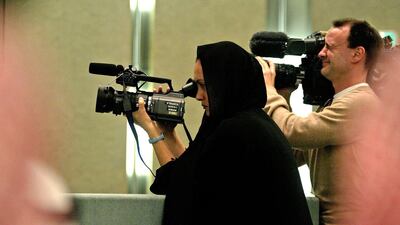
A woman journalist films the announcement of election results 11 February 2005 for the Riyadh Municipal Council in Saudi Arabia where pro-Islamists candidates emerged a the triumphant block in the landmark elections. EPA -
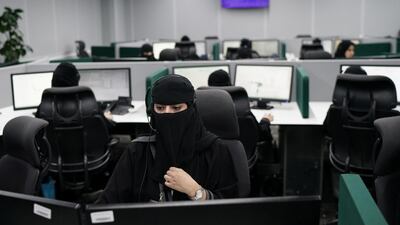
Saudi women work at National Center for Security Operations 911 headquarters in the holy city of Mecca, Saudi Arabia August 6, 2019. Reuters -

Saudi Rodina Maamoun, who employed 19 young women almost entirely replacing the men, sells jewellery at a retail store in Riyadh's Hayat mall on February 19, 2020. For decades, straitlaced Saudi society offered limited opportunities for paid work to women. The few who found jobs were mostly restricted to the health and education sectors. An oppressive "guardianship" system also gave male relatives the right to object to women' professional aspirations. But change came in mid-2016 when Crown Prince Mohammed bin Salman unveiled his "Vision 2030" plan aimed at diversifying the kingdom's economy and ending its addiction to oil. AFP -
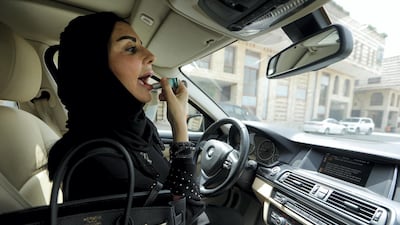
Enaam Gazi al-Aswad, 43, one of the first female drivers hired by the ride sharing company Careem but waiting for Saudi license to be issued by the government, applies lipstick inside her car at a company's office in Jeddah, Saudi Arabia June 24, 2018. Reuters -
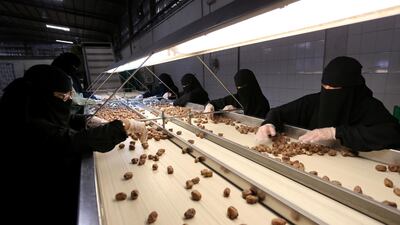
Saudi women work at a dates packaging factory in Al-Ahsa, Saudi Arabia, September 10, 2020. Reuters -
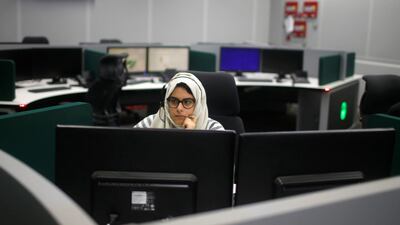
A Saudi woman works inside the first all-female call centre in the kingdom's security sector, in the holy city of Mecca, Saudi Arabia August 29, 2017. Reuters -
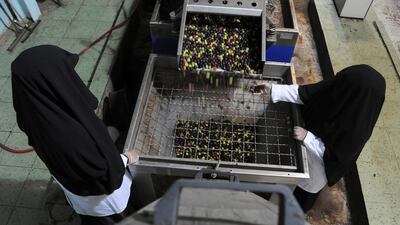
Veil-clad female workers process olives at a factory for pickling olives in the Saudi city of Tabuk October 23, 2013. Reuters -
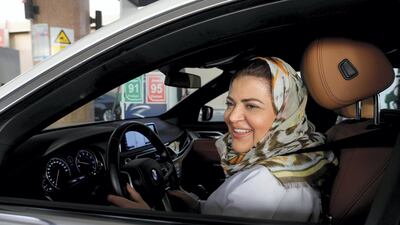
Dr Samira al-Ghamdi, a practicing psychologist, drives her car out in her neighborhood while going to work, in Jeddah, Saudi Arabia June 24, 2018. Reuters -
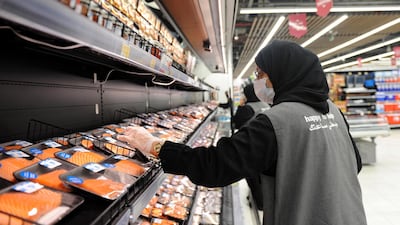
A Saudi female employee adds price tags to murchandise at a hypermarket, newly launched by the operator LuLu and run by a team of women, in the Saudi Arabian port city of Jeddah, on February 21, 2021. AFP


Hanan Bahamdan, the first female Saudi artist to sell a painting at Sotheby's auction house in 2007, said the Vision 2030 plan recognises the importance of art to the Saudi economy.
The strategy has ensured that women played a "primary role" alongside men, while removing restrictions on art, leading to a "boom in creativity" and a "new era" for Saudi art on the global scene.
"This aided in the creation of a new market locally and internationally, which is noticeable by the increase of art galleries run by Saudi women and the interest in establishing art museums, which can attract cultural tourism," she told The National. "There is a boom in new opportunities and jobs such as curators, managers, art teachers."
Regional luxury retailer Chalhoub Group set out sustainability targets for its Saudi Arabian operations, including increasing the number of women in senior management positions to 50 per cent by 2023 from 20 per cent, it said this week.
Jordan's Fine Hygienic Holding is starting a new programme in Saudi Arabia aimed at increasing its current female representation by diversifying its leadership team and offering training for women to prepare them for future leadership roles, it said this week.
The social and economic reforms in the kingdom are changing Saudi Arabian women's lives. Gender segregation rules are easing, dress codes are loosening and many spaces – such as offices, concerts and conferences – are now mixed.
"New technology and innovation will be the driver for growth," Ms Mousa said. "Hence, it is a good time for female leaders to become involved and shape the future.”

