


No coronavirus vaccine has been approved for use yet, but governments across the globe have already bought up hundreds of millions of doses of several of those under development.
Authorities that have struck deals are typically from countries or regions that also have the manufacturing capacity to produce the vast quantities needed to inoculate whole populations.
Before any vaccine has been given the green light, it would appear that developing countries already face lengthy delays in accessing vital supplies.
“I think it was a concern, now it’s simply become a reality,” said Dr Manuel Martin, a policy advisor at Médecins Sans Frontières.
“It’s unfortunately a reality that high-income countries will secure the first batches of doses, should one of the vaccines be successful.
“Rich countries will be able to vaccinate their key populations, while low and middle-income countries, some of which are heavily affected by Covid, will struggle.”
A look at the agreements already signed suggests fears may not be overblown. A deal for 400 million doses of a vaccine, developed by the University of Oxford, was struck in June by the Inclusive Vaccine Alliance, an initiative of France, Germany, Italy and the Netherlands.
The UK has spread its risk across four vaccines in its agreements for 250m doses, while the US government has bought 100m shots in a $1.95bn (Dh7.16bn) deal, with an option for a further 500m.
Governments in Europe and North America have also been investing heavily in vaccine research, which is likely to put them first in line to receive supplies following approval.
“There’s nothing stopping countries from buying up supplies of vaccine from companies,” said Prof Beate Kampmann, of the London School of Hygiene and Tropical Medicine, who directs vaccine research and trials in The Gambia for the UK’s Medical Research Council.
“It’s only going to be an ethical obligation not to plunder the market. Whether we can entice governments to make available at least a tranche of their supply to low and middle-income countries remains to be seen.”
The UAE too has strong links with vaccine programmes, with late-stage clinical trials for Chinese and Russian vaccines set to take place here, something that could lead to local manufacturing.
-
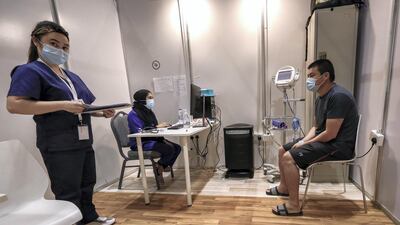
A volunteer undergoes a check-up before being accepted to the Covid-19 vaccine trial at Adnec. Victor Besa / The National -
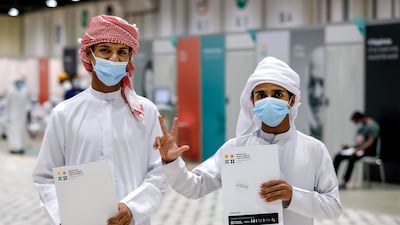
Vaccine volunteers at the Adnec volunteer facility. Victor Besa / The National -
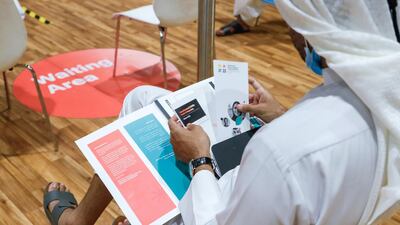
Volunteers read information about the Covid-19 vaccine trial at Abu Dhabi National Exhibition Centre. Victor Besa / The National -
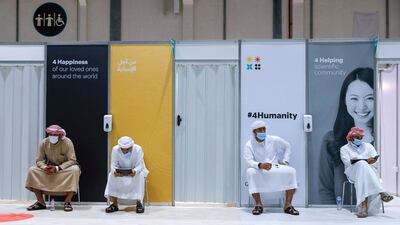
Vaccine volunteers wait to be screened at the Adnec facility. Victor Besa / The National -
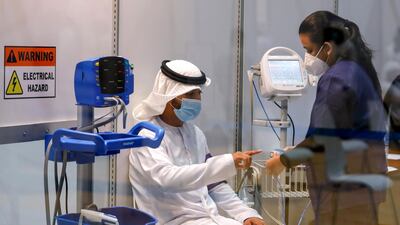
A volunteer has his heart rate checked after registering to take part in the Covid-19 clinical trial in Abu Dhabi. Victor Besa / The National -
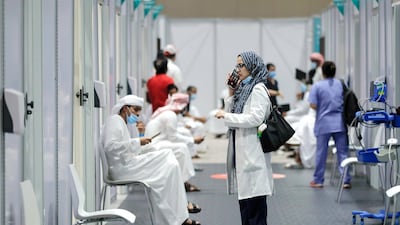
Volunteers wait to be screened and injected with the Covid-19 vaccine at Adnec. Victor Besa / The National -
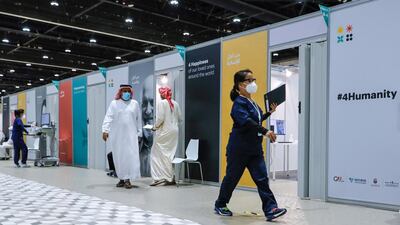
Volunteers are led to a stall where they are screened and vaccinated as part of the Covid-19 vaccine trial in Abu Dhabi. Victor Besa / The National -
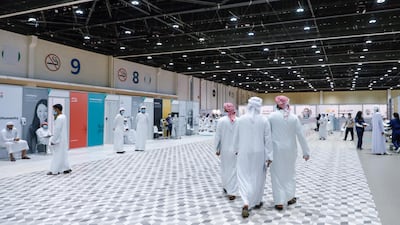
Volunteers wait to be screened and injected with the Covid-19 vaccine at Adnec. Victor Besa / The National -
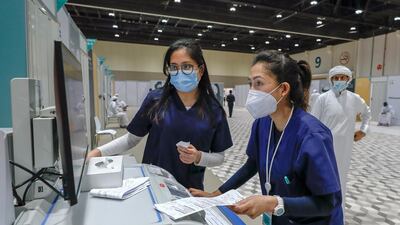
Nurses update medical records as part of the Covid-19 vaccine trial in Abu Dhabi. Victor Besa / The National -
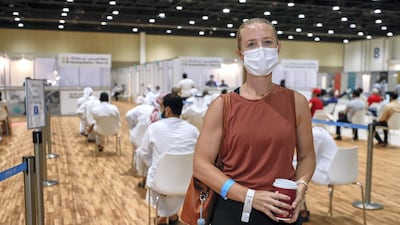
A mother-of-three, 41, has volunteered as part of the Covid-19 vaccine trial because her husband is in the aviation industry, which has been among the hardest hit by the pandemic. Victor Besa / The National -
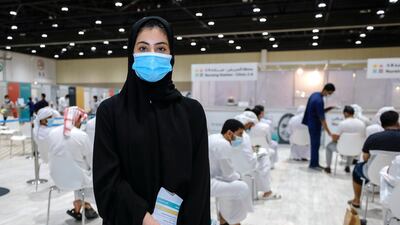
A volunteer, 26, takes part in the Covid-19 vaccine trial to give back and support the UAE. Victor Besa / The National -
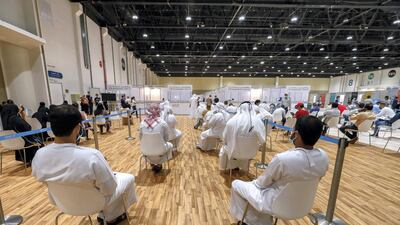
Volunteers wait their turn to be screened and inoculated with the first of two Covid-19 vaccines. Victor Besa / The National -
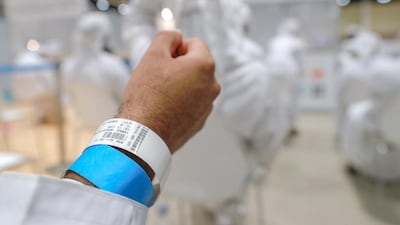
Volunteers wait their turn to be inoculated with the first of two Covid-19 vaccines. Victor Besa / The National -
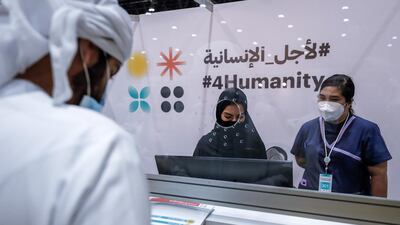
Volunteers register to take part in the Covid-19 vaccine trial in Abu Dhabi. Victor Besa / The National -
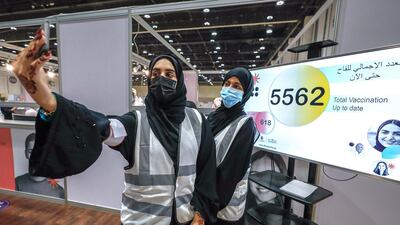
Staff take a selfie in front of the monitor that displays the number of volunteers who have been vaccinated since the start if the trial. Victor Besa / The National -
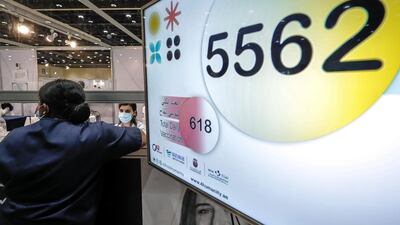
A monitor displays the number of volunteers who have received their first vaccine since the trial began. Victor Besa / The National -

A volunteer waits her turn to get a medical check up at the Covid-19 vaccine trial facility in Abu Dhabi. Victor Besa / The National -
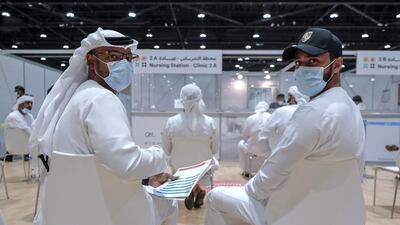
Volunteers read information about the Covid-19 vaccine trial at Abu Dhabi National Exhibition Centre. Victor Besa / The National -
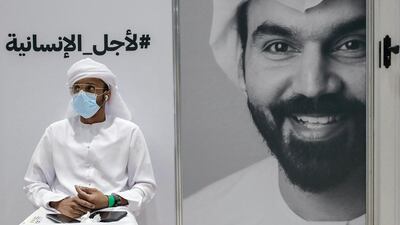
Volunteers for the Covid-19 vaccine trial wait to be screened at Abu Dhabi National Exhibition Centre. Victor Besa / The National


For all the concerns, there are initiatives to help poorer nations gain access to supplies, including Covax, which is led by the World Health Organisation, the Coalition for Epidemic Preparedness (Cepi), and Gavi, formerly the Global Alliance for Vaccines and Immunisation.
Covax aims to deliver 2 billion doses of vaccine by the end of next year, with the focus on the most vulnerable 20 per cent of the population in the 165 countries linked to the scheme. Of these countries, 75 are wealthier nations, among them the UAE, that have expressed interest in the scheme; these “self-financing” countries could subsidise vaccinations in lower-income recipient states.
Question marks have been raised, notably by MSF, about whether Gavi, which typically delivers vaccine programmes in poorer countries, is an appropriate organisation to run a truly global scheme that also involves negotiations with middle and high-income countries.
Another key issue is whether the necessary finance will be available.
“Although everybody would work to achieve equity, it’s going to be hard to achieve because the money has to be there and the supplies have to be there,” said Prof David Salisbury, who previously chaired the WHO’s Strategic Advisory Group of Experts on immunisation and is a former director of immunisation at the UK Department of Health.
“Quite a few countries have signed expressions of interest … [but] Covax has to have money to be able to commit to contracts with supplies. There will be a commitment required from those that are interested in terms of putting their money down.”
The hope is that early sponsors could encourage other nations to get on board as donors. Philanthropists engaged in impact investing could also look to support vaccine work.
Healthcare workers might be able to strongarm governments into ensuring their counterparts in other nations are vaccinated, suggested Prof Kampmann, but the same may not apply to other key groups who need vaccination, such as the elderly, who lack advocacy.
As well as moral pressure, self-interest may make governments keen to ensure other nations receive supplies, especially if they are important trading partners.
A particular concern may be middle-income nations that are too well off to receive support from Gavi, yet, still lack the resources to buy supplies in what will be a highly competitive market, said Prof Kaupmann.
“They often have large populations – Brazil, India, Pakistan. Given the scale, they may not be able to provide adequately,” she said.
Logistical factors may also come into play, with certain nations potentially finding it harder to identify at-risk individuals than will countries that already have well-developed annual influenza vaccination programmes, which typically target the elderly.
“They may have childhood vaccination, but they don’t know where their adults over 65 are [or] with multiple risks,” said Prof Salisbury.
“Your distribution of the vaccine that you have becomes even more challenging. The questions countries have to ask are: can we access it; can we afford to pay for it; if we have it, do we have the infrastructure in place.
“Gulf countries can afford it and could be able to make contracts if they haven’t already, but they would have to think carefully about their implementation if they don’t have any established adult vaccination programmes.”
Whether the vaccine or vaccines that are rolled out prevent the virus’s spread or have the more limited ability to simply stop people falling ill will also determine how global vaccination progresses.
If a vaccine can prevent only illness, governments may focus on inoculating their most vulnerable groups rather than their whole populations, potentially allowing a faster, more equitable, global rollout. The problem would then be “much smaller than we currently think,” said Prof Kampmann.
Despite the widespread concerns, some observers are broadly optimistic about the roll-out of coronavirus vaccines.

Prof David Taylor, who researches pharmaceutical and public health policy at University College London, said it is much easier to roll out vaccination programmes in developing countries than it is to deliver high quality care for cancer or diabetes, for example.
“The record on vaccines themselves isn’t that bad,” he said. “During the 21st century we’ve progressed a long way in protecting global populations, where we can, through vaccines.
“Drugs are relatively easy to distribute … It’s in the interests of the rich world to make sure the whole world is protected.”
China, with its strong links to Africa, may be keen to provide supplies of its vaccines to the continent, which lacks significant manufacturing capacity apart from in South Africa.
Prof Taylor is not under any illusions that the distribution of any coronavirus vaccines will be totally equitable; the developed world will, he said, have access earlier.
But, given the age structure of the populations – developed countries typically have older populations due to lower birth rates in recent decades – this may not be inappropriate.
He also sees a silver lining in the way that governments in richer nations are buying up hundreds of millions of doses of vaccines even before clinical trials are completed: this could attract investment that speeds up vaccine development by offering security to investors.
Yet Dr Manuel at MSF said people should not expect that a significant proportion of vaccine production will be given to low and middle-income countries, given the actions so far of high-income nations.
“Unfortunately we’ve seen a lot of high-income countries go off and do their own thing,” he said.

