The US elections are upon us again. Regardless of whether Joe Biden or Donald Trump wins, there is a looming danger. This ideological monster is precipitated by the rise of far-left politicians and activists in the West, many of whom come from Muslim backgrounds and exploit that identity for their leftist cause. These individuals and the movement they have helped build seek radical changes in Washington DC, London and Middle Eastern capitals, too.
I have nothing personal against the mainstream left. I was a member of the UK Labour Party, and for three years I was an adviser to former Labour prime minister Tony Blair. I believe societies need a robust political centre-left and centre-right in order to produce the creative friction that propels us forward.
On the left and right, there are examples of political actors who have leveraged their Muslim backgrounds constructively to foster peaceful co-operation. Former US secretary of state Hillary Clinton’s adviser, Huma Abedeen, a Democrat, was one such person. On the conservative side, American activist Suhail A Khan was a staffer in Republican president George W Bush’s White House. He was instrumental in organising Mr Bush’s visit to a mosque right after the 9/11 attacks. But that centrist, sensible influence is giving way to a new idea of Muslim political engagement, from university campuses to Congressional caucuses.
In the November 2000 US presidential elections, 70 per cent of American Muslims surveyed voted for President George W Bush. Muslim support for President Trump has doubled in 2020 compared with a year ago, but still only 30 per cent of Muslims are willing to vote for him. With 3.5 million Muslims in America, concentrated in swing states of Florida, Pennsylvania, Michigan, Ohio and Texas, they can swing the election result. Little wonder, then, that Mr Biden has been busy campaigning among Muslim Americans.
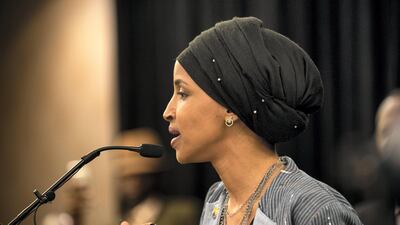
Prominent Muslim Congresswoman Ilhan Omar has endorsed Joe Biden. That Mr Biden said “inshallah” in a televised debate had some activist Muslims in outbreaks of joy online. But he knows that Ms Omar’s support, as a supposed role model for young American Muslims, is not unconditional.
Ms Omar is part of the "Squad” – a group of Congresswomen that also includes Palestinian-American Rashida Tlaib, African-American Ayanna Pressley and Latin-American Alexandria Ocasio-Cortez (popularly known as “AOC”).
What unites the Squad? These American lawmakers represent three trends.
First, they are an intersection of interests and opinions that seeks to undo the intellectual scaffolding of the modern West and the civilisational alliances it has with its allies in the Middle East.
America is an idea. It is about the free individual, powered by human reason, and citizenship based on the content of one’s character, and not the colour of one’s skin, as Martin Luther King, Jr beautifully encapsulated it. No religion or collectivist interest is paramount above the nation state and its laws.
This settlement that makes America so special is being slowly uprooted by poisonous identity politics, some of which the Squad represent. When they are under fire for their policy positions on the economy or immigration, rather than engage in reasoned debate, they will often hide behind protest politics of being “women of colour”. To question Ilhan Omar is to be accused of “Islamophobia”. Labels trump logic.
Second, the Squad are the tip of an iceberg that has been building among the far left on campuses and communities across America and Europe since 9/11. A strategic alliance between supporters of political Islam has found common cause with the political far left. This intersection has put aside their deep divergences on God, religion, family, homosexuality and the role of women and united their activist base on campuses and community hubs in their shared hatred for Western history and capitalism.
This counterintuitive union, which I have called the “Red-Green Alliance”, is similar to the revolutionary mindset that saw Iranian left-Islamists come together before 1979 with the encouragement of the French philosopher Michel Foucault. In Britain, Jeremy Corbyn, the former Labour party leader, had a similar Red-Green alliance last year with a view to winning the general election with 30 Muslim-influenced constituencies – only to lose disastrously.
But when push comes to shove, Islamism and “wokeness” do not mix. Iran’s Islamists killed thousands and exiled leftists. In Gaza, Hamas hanged leftists from tall buildings. Ask Egyptian feminists how the Islamists in Egypt treated them after the 2011 uprisings. Islamists debated in Parliament to reduce the age of consent for marriage for women from 18 to nine.
When push comes to shove, Islamism and 'wokeness' do not mix
Third, the Red-Green Alliance wants to tear down the alliances of safety and stability that America and the West have supported in the Middle East. Ms Omar has repeatedly attacked Egypt and the Gulf states. Yet the real risks of a Muslim Brotherhood-led sexist, homophobic and anti-Semitic government in Libya or Sudan have not seemed to trouble her and her allies.
Occasionally, however, the mask slips. Ms Omar has been forced to apologise by Nancy Pelosi for using anti-Semitic references in comments about the pro-Israel lobby. Her laughter at Americans’ fears of Al Qaeda caused outrage. Ms Tlaib, for her part, has been an outspoken proponent of boycotts and sanctions against Israel.
No country is perfect, of course. But for a movement that appears to have such a deep interest in the Middle East, why is the Red-Green Alliance silent on Iran’s fascist government? Where is its condemnation of Tehran’s support for terrorism in Syria, Bahrain, Yemen, Lebanon and Saudi Arabia? What has it said of assassination attempts by the Iranian regime in Europe and Washington? Not a word.
This strategy of putting community before country and ideology before national interests will cause a furious backlash. The Red-Green Alliance will continue to agitate in Washington and to grow on campuses. They will take over the Democratic party as their British comrades did Labour.
Ultimately, they will lose because, as Margaret Thatcher warned, “the facts of life are conservative”. But in the process of their defeat, this movement for identity-based communal politics will do immense damage.
The far right is rising, at least in part, in reaction to the far left. With this comes a higher risk of reactionary Islamophobia, and new challenges for Arab leaders looking to engage with the West. In its revolutionary fervour, the Red-Green Alliance will help the cause of regressive Islamist revolutionaries in the Middle East.
Will Joe Biden and his running mate Kamala Harris confront this psychosis? Former president Barack Obama, concerned by this new political culture, lashed out at the new activism in comments at his foundation’s annual summit last October. “That's enough,” he said. “If all you're doing is casting stones, you are probably not going to get that far.”
Ed Husain is author of The House of Islam: a Global History and a columnist at The National

Zayed Sustainability Prize
About%20My%20Father
%3Cp%3E%3Cstrong%3EDirector%3A%20%3C%2Fstrong%3ELaura%20Terruso%3C%2Fp%3E%0A%3Cp%3E%3Cstrong%3EStars%3A%20%3C%2Fstrong%3ERobert%20De%20Niro%2C%20Sebastian%20Maniscalco%2C%20Kim%20Cattrall%3C%2Fp%3E%0A%3Cp%3E%3Cstrong%3ERating%3A%3C%2Fstrong%3E%202%2F5%26nbsp%3B%3C%2Fp%3E%0A
Mercer, the investment consulting arm of US services company Marsh & McLennan, expects its wealth division to at least double its assets under management (AUM) in the Middle East as wealth in the region continues to grow despite economic headwinds, a company official said.
Mercer Wealth, which globally has $160 billion in AUM, plans to boost its AUM in the region to $2-$3bn in the next 2-3 years from the present $1bn, said Yasir AbuShaban, a Dubai-based principal with Mercer Wealth.
“Within the next two to three years, we are looking at reaching $2 to $3 billion as a conservative estimate and we do see an opportunity to do so,” said Mr AbuShaban.
Mercer does not directly make investments, but allocates clients’ money they have discretion to, to professional asset managers. They also provide advice to clients.
“We have buying power. We can negotiate on their (client’s) behalf with asset managers to provide them lower fees than they otherwise would have to get on their own,” he added.
Mercer Wealth’s clients include sovereign wealth funds, family offices, and insurance companies among others.
From its office in Dubai, Mercer also looks after Africa, India and Turkey, where they also see opportunity for growth.
Wealth creation in Middle East and Africa (MEA) grew 8.5 per cent to $8.1 trillion last year from $7.5tn in 2015, higher than last year’s global average of 6 per cent and the second-highest growth in a region after Asia-Pacific which grew 9.9 per cent, according to consultancy Boston Consulting Group (BCG). In the region, where wealth grew just 1.9 per cent in 2015 compared with 2014, a pickup in oil prices has helped in wealth generation.
BCG is forecasting MEA wealth will rise to $12tn by 2021, growing at an annual average of 8 per cent.
Drivers of wealth generation in the region will be split evenly between new wealth creation and growth of performance of existing assets, according to BCG.
Another general trend in the region is clients’ looking for a comprehensive approach to investing, according to Mr AbuShaban.
“Institutional investors or some of the families are seeing a slowdown in the available capital they have to invest and in that sense they are looking at optimizing the way they manage their portfolios and making sure they are not investing haphazardly and different parts of their investment are working together,” said Mr AbuShaban.
Some clients also have a higher appetite for risk, given the low interest-rate environment that does not provide enough yield for some institutional investors. These clients are keen to invest in illiquid assets, such as private equity and infrastructure.
“What we have seen is a desire for higher returns in what has been a low-return environment specifically in various fixed income or bonds,” he said.
“In this environment, we have seen a de facto increase in the risk that clients are taking in things like illiquid investments, private equity investments, infrastructure and private debt, those kind of investments were higher illiquidity results in incrementally higher returns.”
The Abu Dhabi Investment Authority, one of the largest sovereign wealth funds, said in its 2016 report that has gradually increased its exposure in direct private equity and private credit transactions, mainly in Asian markets and especially in China and India. The authority’s private equity department focused on structured equities owing to “their defensive characteristics.”
COMPANY PROFILE
Name: Lamsa
Founder: Badr Ward
Launched: 2014
Employees: 60
Based: Abu Dhabi
Sector: EdTech
Funding to date: $15 million
UAE squad
Ali Kashief, Salem Rashid, Khalifa Al Hammadi, Khalfan Mubarak, Ali Mabkhout, Omar Abdelrahman, Mohammed Al Attas (Al Jazira), Mohmmed Al Shamsi, Hamdan Al Kamali, Mohammad Barghash, Khalil Al Hammadi (Al Wahda), Khalid Eisa, Mohammed Shakir, Ahmed Barman, Bandar Al Ahbabi (Al Ain), Adel Al Hosani, Al Hassan Saleh, Majid Suroor (Sharjah), Waleed Abbas, Ismail Al Hammadi, Ahmed Khalil (Shabab Al Ahli Dubai) Habib Fardan, Tariq Ahmed, Mohammed Al Akbari (Al Nasr), Ali Saleh, Ali Salmeen (Al Wasl), Hassan Al Mahrami (Baniyas)
Captain Marvel
Director: Anna Boden, Ryan Fleck
Starring: Brie Larson, Samuel L Jackson, Jude Law, Ben Mendelsohn
4/5 stars
The%20specs
%3Cp%3E%3Cstrong%3EEngine%3A%20%3C%2Fstrong%3E2.0-litre%204-cyl%20turbo%3Cbr%3E%3Cstrong%3EPower%3A%20%3C%2Fstrong%3E190hp%20at%205%2C600rpm%3Cbr%3E%3Cstrong%3ETorque%3A%20%3C%2Fstrong%3E320Nm%20at%201%2C500-4%2C000rpm%3Cbr%3E%3Cstrong%3ETransmission%3A%20%3C%2Fstrong%3E7-speed%20dual-clutch%20auto%3Cbr%3E%3Cstrong%3EFuel%20consumption%3A%20%3C%2Fstrong%3E10.9L%2F100km%3Cbr%3E%3Cstrong%3EPrice%3A%20%3C%2Fstrong%3EFrom%20Dh119%2C900%3Cbr%3E%3Cstrong%3EOn%20sale%3A%20%3C%2Fstrong%3ENow%3C%2Fp%3E%0A
If you go
The flights Etihad (www.etihad.com) and Spice Jet (www.spicejet.com) fly direct from Abu Dhabi and Dubai to Pune respectively from Dh1,000 return including taxes. Pune airport is 90 minutes away by road.
The hotels A stay at Atmantan Wellness Resort (www.atmantan.com) costs from Rs24,000 (Dh1,235) per night, including taxes, consultations, meals and a treatment package.
Total eligible population
About 57.5 million people
51.1 million received a jab
6.4 million have not
Where are the unvaccinated?
England 11%
Scotland 9%
Wales 10%
Northern Ireland 14%
Top investing tips for UAE residents in 2021
Build an emergency fund: Make sure you have enough cash to cover six months of expenses as a buffer against unexpected problems before you begin investing, advises Steve Cronin, the founder of DeadSimpleSaving.com.
Think long-term: When you invest, you need to have a long-term mindset, so don’t worry about momentary ups and downs in the stock market.
Invest worldwide: Diversify your investments globally, ideally by way of a global stock index fund.
Is your money tied up: Avoid anything where you cannot get your money back in full within a month at any time without any penalty.
Skip past the promises: “If an investment product is offering more than 10 per cent return per year, it is either extremely risky or a scam,” Mr Cronin says.
Choose plans with low fees: Make sure that any funds you buy do not charge more than 1 per cent in fees, Mr Cronin says. “If you invest by yourself, you can easily stay below this figure.” Managed funds and commissionable investments often come with higher fees.
Be sceptical about recommendations: If someone suggests an investment to you, ask if they stand to gain, advises Mr Cronin. “If they are receiving commission, they are unlikely to recommend an investment that’s best for you.”
Get financially independent: Mr Cronin advises UAE residents to pursue financial independence. Start with a Google search and improve your knowledge via expat investing websites or Facebook groups such as SimplyFI.
Who's who in Yemen conflict
Houthis: Iran-backed rebels who occupy Sanaa and run unrecognised government
Yemeni government: Exiled government in Aden led by eight-member Presidential Leadership Council
Southern Transitional Council: Faction in Yemeni government that seeks autonomy for the south
Habrish 'rebels': Tribal-backed forces feuding with STC over control of oil in government territory
How to protect yourself when air quality drops
Install an air filter in your home.
Close your windows and turn on the AC.
Shower or bath after being outside.
Wear a face mask.
Stay indoors when conditions are particularly poor.
If driving, turn your engine off when stationary.
