


On Monday, Saudi Arabia's Crown Prince Mohammed bin Salman announced the establishment of the Green Initiative Foundation.
It was a commitment to two climate initiatives worth 39 billion riyals ($10.4bn), to which the kingdom would contribute 15 per cent.
Two days earlier, Saudi Arabia had announced that it would commit itself to net-zero carbon emissions by 2060 at the Saudi Green Initiative Summit in Riyadh.
The target represents a huge leap for the Saudi Green Initiative and Middle East Green Initiative, announced in March. They are part of the kingdom's Vision 2030 programme to reshape its economy, placing itself at the centre of regional efforts to meet international targets on environmental projects.
What is the Saudi Green Initiative?
Alongside the net zero plan — in which the kingdom will rapidly expand already substantial investment in renewable energy — Saudi Arabia will work to restore, conserve, and sustainably manage one billion hectares of land by 2040.
The Saudi Green initiative aims to plant 10 billion trees — the same as rehabilitating 200 million hectares of degraded land. The target also represents 4 per cent of the global drive to reverse land degradation and 1 per cent of the global effort to plant one trillion trees.
As part of the plan, 30 per cent of the kingdom — or 600,000 square kilometres — will be protected areas and efforts will be made to protect coastal environments.
The Middle East Green Initiative has a similar plan for the region. Saudi Arabia will work with countries to plant 50 billion trees across the Middle East.
The Saudi Green Initiative goals:
- Plant 10 billion trees in Saudi Arabia and 50 billion across the Middle East;
- Cut carbon dioxide emissions in the Middle East by 60 per cent;
- Renewables to produce 50 per cent of Saudi Arabia's electricity by 2030;
- Divert 94 per cent of rubbish now going to landfill;
- Increase protected areas to more than 30 per cent (including marine and coastal ecosystems);
- Eliminate more than 130 million tonnes of carbon emissions using clean hydrocarbon technology;
- Reach zero-net emissions by 2060;
- The Saudi Green Initiative programme aims to achieve more than 278 Mtpa in carbon emissions reduction by 2030;
- The kingdom will join the Global Methane Pledge to contribute to cutting global methane emissions by 30 per cent by 2030;
- To provide food for more than 750 million people in the world through an initiative.
Why are environmental projects important for the Middle East?
-
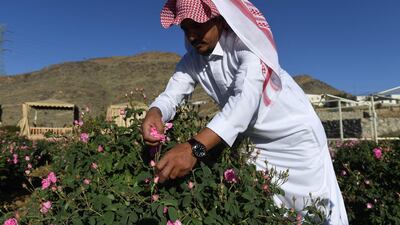
Salman, a member of the Bin Salman family, picks Taif roses ahead of the distillation process at the family's farm in the Saudi city of Taif. AFP -
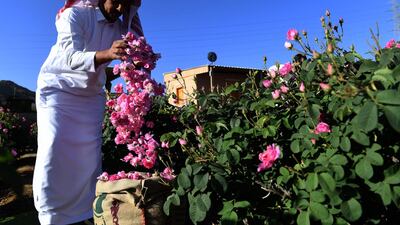
The family farm is open to visitors and offers a complete rural experience including the viewing of the time-honoured tradition of extracting rose water and oil from the Taif rose. AFP -
The Taif rose is a prized component in the cosmetic, culinary and other industries, becoming synonymous with the city itself. AFP -
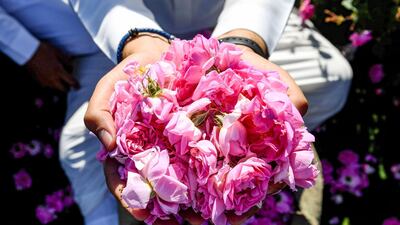
Taif is dubbed locally as the City of Roses. AFP -
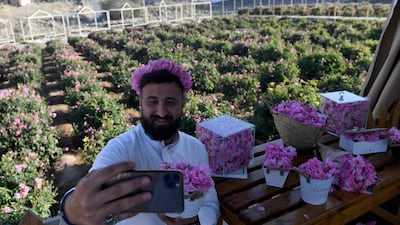
A tourist takes a photo with Taif roses at the Bin Salman Farm in the Saudi city of Taif. AFP -
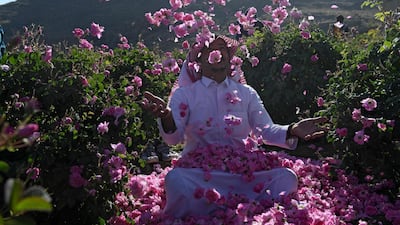
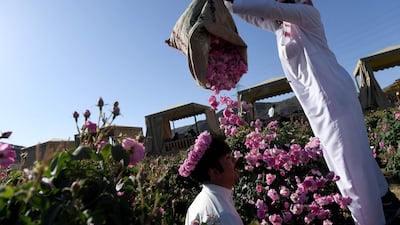
Salman throws roses into the air at the family's farm in the Saudi city of Taif. AFP -
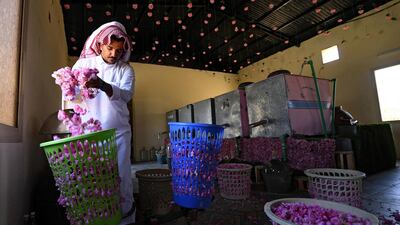
Salman weighs roses during the distillation process. AFP -
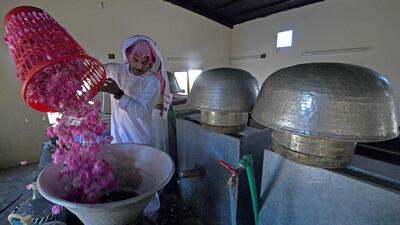
Salman pours weighed roses into a copper vat ahead of the distillation process. AFP -
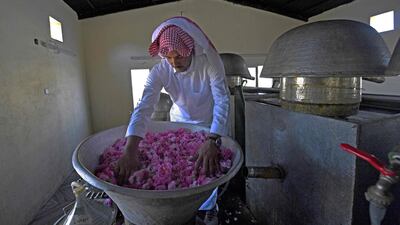
Salman pushes weighed roses into a copper vat ahead of the distillation process. AFP -
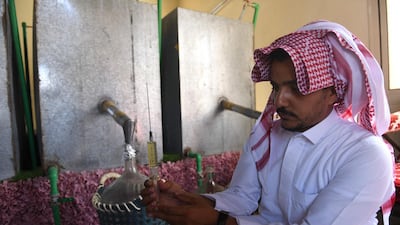
Salman displays a syringe of distilled Taif rose oil. AFP -
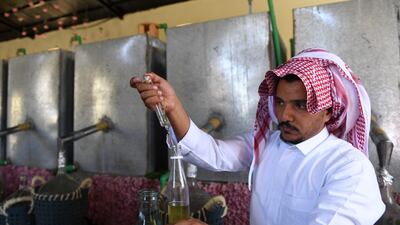
Salman fills a bottle with distilled Taif rose oil. AFP


Partly this is about the region's commitments to international climate change mitigation targets such as the 2015 Paris Accord.
The Crown Prince said the kingdom and the region face environmental challenges such as desertification, which pose an economic threat.
The Green Initiative aims to increase vegetation cover, reduce carbon emissions, combat pollution and preserve marine life.
Sandstorms alone, he said, cost the region $13 billion a year and air pollution is estimated to cut 18 months from life expectancy.
The ambitious programmes aim to reduce the region’s carbon emissions by 60 per cent.
About 50 billion trees are due to be planted in the world’s biggest forestation project, covering an area double the size of the Great Green Wall in the Sahel region and representing 5 per cent of the global tree planting target.
At the moment, only seven per cent of energy production in the Middle East is clean. The initiative aims to cut more than 130 million tonnes of carbon emissions, reducing global carbon emissions by more than 4 per cent.
The kingdom has ambitious targets for renewable energy, including the increased use of wind and solar, which will generate half of the country’s electricity by 2030 to further reduce greenhouse gas emissions.
What did the Crown Prince say about the plans?
“As a leading global producer of oil, we are fully aware of our share of the responsibility in advancing the fight against the climate crisis and as our pioneering role in stabilising energy markets during the oil and gas era, we will act to lead the next green era,” he said.
“The kingdom and the region are facing many environmental challenges, such as desertification, which poses an economic threat to the region, as it is estimated that $13 billion are drained by sandstorms in the region every year and air pollution from greenhouse gases is estimated to have reduced the average age of citizens by one and a half years.
“We will act through the Saudi Green Initiative to raise vegetation cover, reduce carbon emissions, combat pollution and land degradation, and preserve marine life.”
The Crown Prince announced plans to cut carbon emissions by more than 270 million tons a year as part of the Saudi Green Initiative, which would attract investments of more than 700 billion riyals ($186.63 billion).
“We will establish an investment fund for the circular carbon economy and an international economic initiative to provide food for more than 750 million people in the world through an initiative.”
During the Middle East Green Initiative Summit, he said: “We are meeting today at this summit to coordinate efforts towards protecting the environment and confronting climate change, and to develop a road map to reduce carbon emissions in the region by more than 10 per cent of the global contributions, and planting 50 billion trees in the region, according to a programme that is considered the largest tree-planting programme in the world.”
What was the reaction to the plan?
The Crown Prince spoke with the leaders of Qatar, Kuwait, Bahrain, Iraq and Sudan after the announcement.
Several states have celebrated the move. Kuwait state media on Tuesday said that the country’s Cabinet had “heaped praise” on the plan. It said the matter featured heavily in the recent conversation between the Crown Prince and Kuwait’s Emir Sheikh Nawaf Al Ahmed.
Pakistan offered to support the plan, with Prime Minister Imran Khan saying he was “delighted to learn” about it.
“We would be happy to share experiences, knowledge, and lessons from our nature-based approaches and initiatives,” he said in a letter to the Crown Prince.
The UN said it was following the news “with great interest”.
“We very much look forward to hearing more from the kingdom and other G20 members on April 22 at the meeting being organised by the US, and which will be the next milestone,” said Stephane Dujarric, spokesman for UN Secretary General Antonio Guterres.
The UK’s Prince Charles said that Saudi Arabia's green initiatives contribute to building a sustainable and productive future, indicating that the kingdom's global leadership in the “transition to renewable energy is essential”.
Why are these projects important to Saudi Arabia?
Saudi Arabia’s Vision 2030 programme is a massive national reform plan that aims to reduce the kingdom’s dependence on oil revenue. One aspect is environmental protection and climate targets that involve diversifying energy production from fossil fuels to renewable sources.
Saudi Arabia, as the region’s largest economy, has long sought to be a leading force in shaping the Middle East and coordinating regional responses to crises from conflict to hunger to climate change.
The initiatives will chart the country and region’s road map for protecting the environment.
How has Saudi Arabia protected the environment in the past?
The two green initiatives are based on the kingdom’s mission to help protect the planet that was at the heart of its 2020 presidency of the G20 group of nations.
But it has long supported the so-called circular carbon economy, a framework that places emphasis on reducing carbon output and finding ways to reuse and recycle emissions.
In 2012, the country launched the Saudi Energy Efficiency Programme, a cornerstone of its plan to reduce carbon emissions.
The kingdom is also planning a massive new hydrogen fuel plant in the futuristic megacity of Neom, as well as the world’s largest carbon dioxide purification plant, with a capacity of 500,000 tonnes a year.
The Circular Carbon Economy National Programme, or CCE, was officially announced in November last year by King Salman.
Speaking at the G20 leaders’ summit last year, Crown Prince Mohammed said the CCE “allows for the holistic management of emissions to mitigate the challenges of climate impact and advance cleaner and more sustainable energy systems, as well as advancing stable and secure energy markets and energy access”.
How do Saudis feel about it?
Saudis feel the country has been stepping up efforts to raise awareness about environmental issues and is serious about preserving nature and sustainable development.
Marine biologists have hailed the kingdom’s efforts to protect coastal and marine life in the past year.
Ghada Kamel, 27, a marine biology student and scuba-diving instructor from Saudi Arabia, said the initiatives have come at the right time to teach the younger generation the importance of climate change and preserving the planet.
“Since last year, the Shura Council has implemented new standards and penalties for violations in order to preserve marine life. I hope they continue to build more public awareness on all fronts from plastic pollution to marine biodiversity,” Ms Kamel told The National.
Maliha Alshareef, 34, a Saudi architect, said the kingdom’s young population was increasingly conscious of environmental issues.
“For those living in the kingdom, we have witnessed a radical change in the way we interact with nature in the last seven years,” she said.
“From recycling, reusing and pushing for sustainable means of consumption and production, we have had more awareness at a grassroots level over the last few years, starting with education in schools. This was unavailable at when we were growing up.
“This is sending the right message.”
Read more about climate change and sustainability in the Middle East: John Kerry in UAE: We face an enormous global climate challenge — and it's only growing
John Kerry visits world’s largest solar park in Abu Dhabi
Climate summit: five ways the UAE leads the way on sustainability
Comment: The Middle East can be a powerful ally against climate change

