The US presidential election is always a cause for consternation, and often alarm, around the world. The US is a global hegemon, with military and economic interests far beyond its borders. But the anxiety is even more pronounced in neighbouring countries, which will have to grapple with the outcome of one of the most divisive elections in generations.
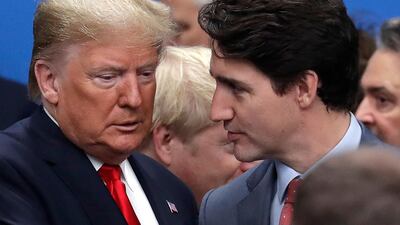
The worry is palpable here in Canada, which has endured a rocky relationship with its southern neighbour and one of its oldest allies. Tensions over the past four years took the form of undiplomatic asides and tweets by US President Donald Trump against Canadian Prime Minister Justin Trudeau accusing him of being a "phony", to more serious repercussions such as the fraying of the Nato alliance and the ethos of multilateralism, the acrimonious renegotiation of the Nafta trade deal and ongoing threats and impositions of tariffs and other economic weapons.
But the alarm here has taken on a different tone in recent months because of ongoing civil unrest in the US and the threat of violence in the aftermath of a contested election, given Mr Trump's repeated refusal to commit to a peaceful transfer of power if he loses and the looming threat of white nationalist groups. The election and the cacophony surrounding it such as the debates and latest controversies receive blow-by-blow coverage from the Canadian national broadcaster, drowning out by its incessant din important stories such as a recent charity group scandal involving the Prime Minister, ballooning coronavirus cases and failures in the response to them.
Prominent commentators and analysts say that Canada must plan for the possibility of serious instability in the US regardless of the outcome of the election, save perhaps for a landslide Joe Biden victory.
The existential angst is understandable, partly because of the damage that four years of Mr Trump has done to the Canada-US alliance and to the national and social fabric down south, and it can be easy to lose perspective amid the daily scandals. But Canadians can do little but watch with a sense of foreboding as election day draws closer, so near and yet so far when every day is an eternity lengthened by every outrage and the Covid-19 pandemic in the background.
That is why countries such as Canada should focus on areas where they can make a difference regardless of the occupant in the White House. Even if Mr Biden were to win, it will take a long time to undo some of the damage that the incumbent wreaked on issues such as environmental treaties, the rules-based international order, decades-old alliances that underwrite global security, and the defence of fundamental human rights.
Canada must assume leadership on the Paris climate agreement even though the US has withdrawn from it. AP Photo
Rebuilding alliances and defending causes through multilateralism will do more good than continuing to reel from the despondency and hysteria tearing through the US
They can do so by continuing to co-operate in fighting global challenges even as America emerges from or wallows in the throes of nationalist isolation – by continuing to work to develop a vaccine for the coronavirus and ensuring that it is widely available globally beyond the developed world, by continuing to push for adherence to the Paris climate agreement and to supporting other environmental initiatives, by continuing to advocate and mediate in persistent and intractable conflicts such as the ones in Syria and Palestine, by continuing to advocate for humane and sustainable solutions to the global refugee and migration crisis, and by continuing to stand up for the pivotal human rights issues of our times.
Rebuilding these alliances and defending these causes through multilateralism to strengthen the world more generally will do more good than continuing to reel from the despondency and hysteria tearing through the US. And that world will be there when America decides to rejoin it.
Kareem Shaheen is a veteran Middle East correspondent in Canada and a columnist for The National

Red flags
Promises of high, fixed or 'guaranteed' returns.
Unregulated structured products or complex investments often used to bypass traditional safeguards.
Lack of clear information, vague language, no access to audited financials.
Overseas companies targeting investors in other jurisdictions - this can make legal recovery difficult.
Micro-retirement is not a recognised concept or employment status under Federal Decree Law No. 33 of 2021 on the Regulation of Labour Relations (as amended) (UAE Labour Law). As such, it reflects a voluntary work-life balance practice, rather than a recognised legal employment category, according to Dilini Loku, senior associate for law firm Gateley Middle East.
“Some companies may offer formal sabbatical policies or career break programmes; however, beyond such arrangements, there is no automatic right or statutory entitlement to extended breaks,” she explains.
“Any leave taken beyond statutory entitlements, such as annual leave, is typically regarded as unpaid leave in accordance with Article 33 of the UAE Labour Law. While employees may legally take unpaid leave, such requests are subject to the employer’s discretion and require approval.”
If an employee resigns to pursue micro-retirement, the employment contract is terminated, and the employer is under no legal obligation to rehire the employee in the future unless specific contractual agreements are in place (such as return-to-work arrangements), which are generally uncommon, Ms Loku adds.
The Voice of Hind Rajab
Starring: Saja Kilani, Clara Khoury, Motaz Malhees
Director: Kaouther Ben Hania
Rating: 4/5
The Settlers
Director: Louis Theroux
Starring: Daniella Weiss, Ari Abramowitz
Rating: 5/5
Dark Souls: Remastered
Developer: From Software (remaster by QLOC)
Publisher: Namco Bandai
Price: Dh199
The bio
Job: Coder, website designer and chief executive, Trinet solutions
School: Year 8 pupil at Elite English School in Abu Hail, Deira
Role Models: Mark Zuckerberg and Elon Musk
Dream City: San Francisco
Hometown: Dubai
City of birth: Thiruvilla, Kerala
What is Diwali?
The Hindu festival is at once a celebration of the autumn harvest and the triumph of good over evil, as outlined in the Ramayana.
According to the Sanskrit epic, penned by the sage Valmiki, Diwali marks the time that the exiled king Rama – a mortal with superhuman powers – returned home to the city of Ayodhya with his wife Sita and brother Lakshman, after vanquishing the 10-headed demon Ravana and conquering his kingdom of Lanka. The people of Ayodhya are believed to have lit thousands of earthen lamps to illuminate the city and to guide the royal family home.
In its current iteration, Diwali is celebrated with a puja to welcome the goodness of prosperity Lakshmi (an incarnation of Sita) into the home, which is decorated with diyas (oil lamps) or fairy lights and rangoli designs with coloured powder. Fireworks light up the sky in some parts of the word, and sweetmeats are made (or bought) by most households. It is customary to get new clothes stitched, and visit friends and family to exchange gifts and greetings.
Position: legal consultant with Al Rowaad Advocates and Legal Consultants.
Building boom turning to bust as Turkey's economy slows
Deep in a provincial region of northwestern Turkey, it looks like a mirage - hundreds of luxury houses built in neat rows, their pointed towers somewhere between French chateau and Disney castle.
Meant to provide luxurious accommodations for foreign buyers, the houses are however standing empty in what is anything but a fairytale for their investors.
The ambitious development has been hit by regional turmoil as well as the slump in the Turkish construction industry - a key sector - as the country's economy heads towards what could be a hard landing in an intensifying downturn.
After a long period of solid growth, Turkey's economy contracted 1.1 per cent in the third quarter, and many economists expect it will enter into recession this year.
The country has been hit by high inflation and a currency crisis in August. The lira lost 28 per cent of its value against the dollar in 2018 and markets are still unconvinced by the readiness of the government under President Recep Tayyip Erdogan to tackle underlying economic issues.
The villas close to the town centre of Mudurnu in the Bolu region are intended to resemble European architecture and are part of the Sarot Group's Burj Al Babas project.
But the development of 732 villas and a shopping centre - which began in 2014 - is now in limbo as Sarot Group has sought bankruptcy protection.
It is one of hundreds of Turkish companies that have done so as they seek cover from creditors and to restructure their debts.
