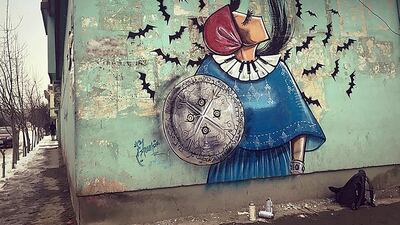
Shamsia Hassani''s art on a Kabul wall. Musical instruments are a common theme in her work, which signify women's need to use tools other than their voices to be heard. Courtesy of Shamsia Hassani

What we don't get about women in politics and war


  • English
  • Arabic

Shortly after the Taliban fell in Kabul in November 2001 following the US-led invasion of Afghanistan, I got a message from my then foreign editor back in London. “Go to a hairdresser that just opened,” he wrote in an email. “See what the women have to say. Get some stories of their miserable lives under the Taliban.”

I was furious. I had spent months travelling in Afghanistan with the opposition Northern Alliance – and living rough. I wanted to report about the new government, the American troops landing in the cave complex of Tora Bora, and the information available on hard disks that the Taliban had left behind. In my view, those were much more hard-hitting stories. I didn’t want to write about the women’s angle.

Fortunately, one of my male colleagues knew of our conversation and said: “I’ll go talk to the women.” He saw the "soft feature" as a novelty. As he trotted off in search of a hairdresser, I made my way to the Presidential Palace.

Armenian women make camouflage net to be sent to a frontline in Karabakh in Yerevan last week. AFP

In retrospect, it would have been interesting to sit for a few hours listening to women who were allowed out in public for the first time in years. Later, I did seek out women to hear their stories. But what annoyed me then was that I was the only female in a team of male correspondents, and the "soft angle" inevitably fell to me – although I was the only one who had toughed it out in northern Afghanistan for months and the one who had the most experience in war zones.

From the beginning of my career, I was always told to go to hospitals and schools, to refugee camps and places where I could find women to get the “human angle".

As journalists and storytellers, we can focus more on stories of empowerment

This angle typically involved a broken woman who was desperate to survive and protect her family. There were always tears involved, sometimes anger and fear. This was backed up by a dramatic photograph, and it usually made the front page of a newspaper.

I resented victimising women, which involved portraying a traumatised rape victim or a refugee mother struggling to feed her children. A few years ago, when I attended a memorial of the Srebrenica genocide, it hit me that we were doing a great disservice to women.

Afghan politician and women's rights activist Fawzia Koofi became the first woman deputy speaker of her country's parliament. EPA

We went to the Bosnian city of Zenica, which was the scene of terrible war crimes, including systematic rape. But the first person who was brought out to us to give testimony was not a woman, but a man. He wept as he talked about enduring rape while held prisoner. In my decades of reporting, it was the first time a man was shown as a victim of sexual violence. Why was it always a woman’s face then?

War reporting often distorts women’s role in peace and security. Mainstream journalists, including myself, tend to focus on the stories that the public would feel comfortable reading. When we read about the plight of Syrian refugees, it’s usually about women alone, struggling to take care of their children because their husbands are either fighting or dead.

According to a UN-backed global study on women, peace and security, only 13 per cent of stories in the news media on peace and security-related themes include women as the subject. Women are central to the story in only six per cent of the cases. Regardless of the topic, only four per cent of stories portray women as leaders in conflict and post-conflict countries and only two per cent highlight gender equality or inequality issues.

We can relate to a woman who has lost her power. A man who is powerless makes us uncomfortable; so does a woman who is too willful or strong. We don't read much about the brave women who fought in Aleppo or those who stood up to ISIS. What if we had amplified the voices of strong women recounting their experiences of war worldwide, such as the female commanders in Kurdistan or the Yazidi women who chose not to be broken by ISIS-imposed slavery but turned their trauma into a way of escalating women's position in society?

Iraqi human rights activist Nadia Murad and Congolese gynaecologist Denis Mukwege were jointly awarded the Nobel Peace Prize in 2018. AFP

Is there an alternative that would strengthen women's voices, a feminist media perspective on war reporting? One way to do so would be to look at women's efforts to build peace. Women are so often shunted from the negotiating table – unless they are assistants sitting in the back row taking notes behind men with power.

I have always argued for women to have a vital role to play in peacebuilding. They don't have to be just female commanders or military leaders, but wives of commanders who have influence, or community leaders, or faith-based leaders.

Even in patriarchal societies, women wield influence at their own tables. So why can't they use their leverage to bring about peace? This is essential in Track 2 and Track 3 diplomatic efforts, which include more people-to-people talks than discussions involving high-level political and military leaders focused on ceasefires and treaties.

What really matters after a war is the reconstruction of a country and the delivery of justice. Rwanda and Sierra Leone, two countries that witnessed horrible conflicts, are good examples of countries where women played an essential role in peacebuilding. In 1994, women were being slaughtered and raped during the genocide in Rwanda. Yet the country boasts of more women parliamentarians today than any other country in the world.

Stephanie Williams, the Acting Special Representative of the Secretary-General and Head of the United Nations Support Mission in Libya, has helped secure a permanent ceasefire in the North African country. AP

The United Nations, which plays an important role in preventing and ending wars, lacks enough women in senior positions. Yet studies prove that gender-equal participation contributes to longer, and lasting peace after conflict. UN Women, an entity for gender equality and the empowerment of women, demonstrated that, in UN-sponsored peace processes, women's participation in delegations involved in negotiations has not improved in recent years. In 2018, out of six active UN-led or co-led processes, women were included in just 14 out of 19 delegations.

According to the US-based think tank Council on Foreign Relations, between 1992 and 2018, women constituted 13 per cent of negotiators, three per cent of mediators and only four per cent of signatories in major peace processes.

So what can we do to reverse this? As journalists and storytellers, we can focus more on stories of empowerment. We can train more women in post-conflict countries to tell their own stories, rather than rely on foreign reporters. We can make a case for the allocation of more peacebuilding funds and bilateral aid to promote gender equality and women’s rights in fragile states. We can push the UN Security Council to pass more resolutions involving women and security.

The photograph and the storyline might not be as explicit. In the old days of British tabloids reporting the kind of stories that used to grab their readers used to be referred to by editors as the “Shock Horror”.

There is no "shock horror" in telling stories of powerful women during war. But we would be doing a huge favour to women everywhere if we stopped portraying them as victims and gave them back their agency.

Janine di Giovanni is a Senior Fellow at Yale University’s Jackson Institute for Global Affairs

Company%20profile
%3Cp%3E%3Cstrong%3EName%3A%3C%2Fstrong%3E%20WallyGPT%3Cbr%3E%3Cstrong%3EStarted%3A%20%3C%2Fstrong%3E2014%3Cbr%3E%3Cstrong%3EFounders%3A%20%3C%2Fstrong%3ESaeid%20and%20Sami%20Hejazi%3Cbr%3E%3Cstrong%3EBased%3A%3C%2Fstrong%3E%20Dubai%3Cbr%3E%3Cstrong%3ESector%3A%20%3C%2Fstrong%3EFinTech%3Cbr%3E%3Cstrong%3EInvestment%20raised%3A%20%3C%2Fstrong%3E%247.1%20million%3Cbr%3E%3Cstrong%3ENumber%20of%20staff%3A%3C%2Fstrong%3E%2020%3Cbr%3E%3Cstrong%3EInvestment%20stage%3A%20%3C%2Fstrong%3EPre-seed%20round%3C%2Fp%3E%0A
The specs: 2018 Nissan Altima


Price, base / as tested: Dh78,000 / Dh97,650

Engine: 2.5-litre in-line four-cylinder

Power: 182hp @ 6,000rpm

Torque: 244Nm @ 4,000rpm

Transmission: Continuously variable tranmission

Fuel consumption, combined: 7.6L / 100km

Results

5pm: Al Maha Stables – Maiden (PA) Dh80,000 (Turf) 1,600m; Winner: Reem Baynounah, Fernando Jara (jockey), Mohamed Daggash (trainer)

5.30pm: Wathba Stallions Cup – Maiden (PA) Dh70,000 (T) 1,600m; Winner: AF Afham, Tadhg O’Shea, Ernst Oertel

6pm: Emirates Fillies Classic – Prestige (PA) Dh100,000 (T) 1,600m; Winner: Ghallieah, Sebastien Martino, Jean-Claude Pecout

6.30pm: Emirates Colts Classic – Prestige (PA) Dh100,000 (T) 1,600m; Winner: Yas Xmnsor, Saif Al Balushi, Khalifa Al Neyadi

7pm: The President’s Cup – Group 1 (PA) Dh2,500,000 (T) 2,200m; Winner: Somoud, Adrie de Vries, Jean de Roualle

7.30pm: The President’s Cup – Listed (TB) Dh380,000 (T) 1,400m; Winner: Haqeeqy, Dane O’Neill, John Hyde.

David Haye record

Total fights: 32
Wins: 28
Wins by KO: 26
Losses: 4

The Baghdad Clock

Shahad Al Rawi, Oneworld

Avatar%20(2009)
%3Cp%3E%3Cstrong%3EDirector%3A%20%3C%2Fstrong%3EJames%20Cameron%3C%2Fp%3E%0A%3Cp%3E%3Cstrong%3EStars%3A%20%3C%2Fstrong%3ESam%20Worthington%2C%20Zoe%20Saldana%2C%20Sigourney%20Weaver%3C%2Fp%3E%0A%3Cp%3E%3Cstrong%3ERating%3A%20%3C%2Fstrong%3E3%2F5%3C%2Fp%3E%0A

Mercer, the investment consulting arm of US services company Marsh & McLennan, expects its wealth division to at least double its assets under management (AUM) in the Middle East as wealth in the region continues to grow despite economic headwinds, a company official said.

Mercer Wealth, which globally has $160 billion in AUM, plans to boost its AUM in the region to $2-$3bn in the next 2-3 years from the present $1bn, said Yasir AbuShaban, a Dubai-based principal with Mercer Wealth.

Within the next two to three years, we are looking at reaching $2 to $3 billion as a conservative estimate and we do see an opportunity to do so,” said Mr AbuShaban.

Mercer does not directly make investments, but allocates clients’ money they have discretion to, to professional asset managers. They also provide advice to clients.

“We have buying power. We can negotiate on their (client’s) behalf with asset managers to provide them lower fees than they otherwise would have to get on their own,” he added.

Mercer Wealth’s clients include sovereign wealth funds, family offices, and insurance companies among others.

From its office in Dubai, Mercer also looks after Africa, India and Turkey, where they also see opportunity for growth.

Wealth creation in Middle East and Africa (MEA) grew 8.5 per cent to $8.1 trillion last year from $7.5tn in 2015, higher than last year’s global average of 6 per cent and the second-highest growth in a region after Asia-Pacific which grew 9.9 per cent, according to consultancy Boston Consulting Group (BCG). In the region, where wealth grew just 1.9 per cent in 2015 compared with 2014, a pickup in oil prices has helped in wealth generation.

BCG is forecasting MEA wealth will rise to $12tn by 2021, growing at an annual average of 8 per cent.

Drivers of wealth generation in the region will be split evenly between new wealth creation and growth of performance of existing assets, according to BCG.

Another general trend in the region is clients’ looking for a comprehensive approach to investing, according to Mr AbuShaban.

“Institutional investors or some of the families are seeing a slowdown in the available capital they have to invest and in that sense they are looking at optimizing the way they manage their portfolios and making sure they are not investing haphazardly and different parts of their investment are working together,” said Mr AbuShaban.

Some clients also have a higher appetite for risk, given the low interest-rate environment that does not provide enough yield for some institutional investors. These clients are keen to invest in illiquid assets, such as private equity and infrastructure.

“What we have seen is a desire for higher returns in what has been a low-return environment specifically in various fixed income or bonds,” he said.

“In this environment, we have seen a de facto increase in the risk that clients are taking in things like illiquid investments, private equity investments, infrastructure and private debt, those kind of investments were higher illiquidity results in incrementally higher returns.”

The Abu Dhabi Investment Authority, one of the largest sovereign wealth funds, said in its 2016 report that has gradually increased its exposure in direct private equity and private credit transactions, mainly in Asian markets and especially in China and India. The authority’s private equity department focused on structured equities owing to “their defensive characteristics.”

'Ashkal'
%3Cp%3E%3Cstrong%3EDirector%3A%3C%2Fstrong%3E%20Youssef%20Chebbi%3C%2Fp%3E%0A%3Cp%3E%3Cstrong%3EStars%3A%3C%2Fstrong%3E%20Fatma%20Oussaifi%20and%20Mohamed%20Houcine%20Grayaa%3C%2Fp%3E%0A%3Cp%3E%3Cstrong%3ERating%3A%3C%2Fstrong%3E%204%2F5%3C%2Fp%3E%0A
F1 2020 calendar

March 15 - Australia, Melbourne; March 22 - Bahrain, Sakhir; April 5 - Vietnam, Hanoi; April 19 - China, Shanghai; May 3 - Netherlands, Zandvoort; May 20 - Spain, Barcelona; May 24 - Monaco, Monaco; June 7 - Azerbaijan, Baku; June 14 - Canada, Montreal; June 28 - France, Le Castellet; July 5 - Austria, Spielberg; July 19 - Great Britain, Silverstone; August 2 - Hungary, Budapest; August 30 - Belgium, Spa; September 6 - Italy, Monza; September 20 - Singapore, Singapore; September 27 - Russia, Sochi; October 11 - Japan, Suzuka; October 25 - United States, Austin; November 1 - Mexico City, Mexico City; November 15 - Brazil, Sao Paulo; November 29 - Abu Dhabi, Abu Dhabi.

500 People from Gaza enter France

115 Special programme for artists

25   Evacuation of injured and sick

UAE currency: the story behind the money in your pockets
The%20Color%20Purple
%3Cp%3E%3Cstrong%3EDirector%3A%20%3C%2Fstrong%3EBlitz%20Bazawule%3Cbr%3E%3Cstrong%3EStarring%3A%20%3C%2Fstrong%3EFantasia%20Barrino%2C%20Taraji%20P%20Henson%2C%20Danielle%20Brooks%2C%20Colman%20Domingo%3Cbr%3E%3Cstrong%3ERating%3A%3C%2Fstrong%3E%204%2F5%3C%2Fp%3E%0A
Tips for job-seekers
  • Do not submit your application through the Easy Apply button on LinkedIn. Employers receive between 600 and 800 replies for each job advert on the platform. If you are the right fit for a job, connect to a relevant person in the company on LinkedIn and send them a direct message.
  • Make sure you are an exact fit for the job advertised. If you are an HR manager with five years’ experience in retail and the job requires a similar candidate with five years’ experience in consumer, you should apply. But if you have no experience in HR, do not apply for the job.

David Mackenzie, founder of recruitment agency Mackenzie Jones Middle East

HOW TO WATCH

Facebook: TheNationalNews  

Twitter: @thenationalnews  

Instagram: @thenationalnews.com  

TikTok: @thenationalnews 

UAE currency: the story behind the money in your pockets
SERIE A FIXTURES

Saturday Spezia v Lazio (6pm), Juventus v Torino (9pm), Inter Milan v Bologna (7.45pm)

Sunday Verona v Cagliari (3.30pm), Parma v Benevento, AS Roma v Sassuolo, Udinese v Atalanta (all 6pm), Crotone v Napoli (9pm), Sampdoria v AC Milan (11.45pm)

Monday Fiorentina v Genoa (11.45pm)

While you're here
Our legal advisor

Rasmi Ragy is a senior counsel at Charles Russell Speechlys, a law firm headquartered in London with offices in Europe, the Middle East and Hong Kong.

Experience: Prosecutor in Egypt with more than 40 years experience across the GCC.

Education: Ain Shams University, Egypt, in 1978.
