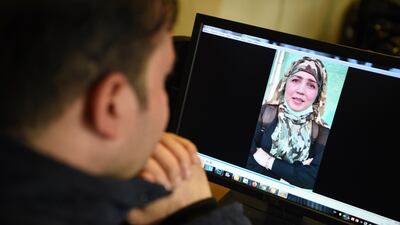
A man watches a video of Afghan woman Muzghan, who walked free from jail in September after confessing to being members of the Taliban's ultra-violent Haqqani network. AFP

Taliban's female assassins who lured men to their deaths released


  • English
  • Arabic

Female assassins who lured an Afghan security official to his death before shooting him and dumping his body at a cemetery are among thousands of Taliban criminals freed as part of a fragile peace plan.

While the ultraconservative religious militants ban women from many areas of life – often forcing them to stay home and barring them from most jobs – they are not above using them as killers.

Muzghan and her aunt Nasreen walked free from jail in September after confessing to being members of the Taliban's ultra-violent Haqqani network.

A man watches a video of Afghan woman Nasreen, who walked free from jail in September after confessing to being members of the Taliban's ultra-violent Haqqani network. AFP

The two women had been on death row after several killings, including the murder of an Afghan intelligence agent at their home.

They used Nasreen's daughter as bait "under the pretext of selling her body", on the orders of a Taliban commander, a security official told AFP.

The pair then shot the man with a pistol fitted with a silencer and crammed his corpse into a metal box that they left in the local graveyard, case files show.

Court documents seen by AFP show the two were prolific killers – adept not only at setting the deadly honeytrap, but also at brutal murders – including of their own relatives.

Two men from their family who worked as policemen died at the women's hands – one was poisoned and the other killed when they planted a "sticky bomb" under the seat of his car.

It is not uncommon for relatives to take opposing sides in Afghanistan's long-running conflict.

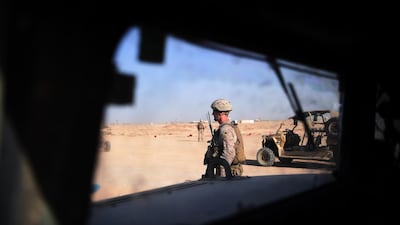
  • US Marines keep watch as unseen Afghan National Army soldiers participate in an IED (improvised explosive device) training exercise at the Shorab Military Camp in 2017. AFP
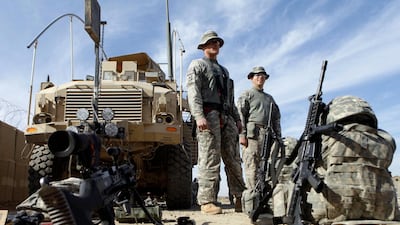
    US Marines keep watch as unseen Afghan National Army soldiers participate in an IED (improvised explosive device) training exercise at the Shorab Military Camp in 2017. AFP
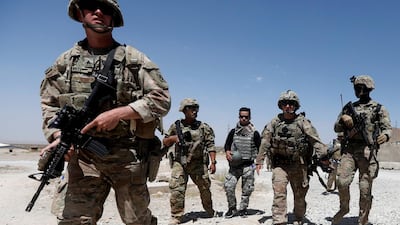
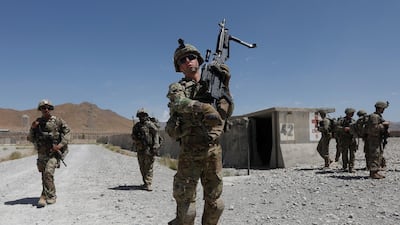
  • US troops patrol at an Afghan army Base in Logar province on August 7, 2018. Reuters
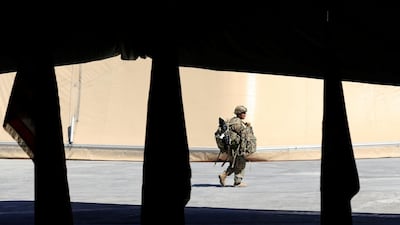
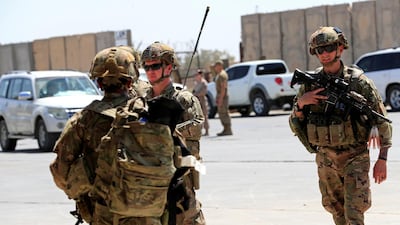
    US troops patrol at an Afghan army Base in Logar province on August 7, 2018. Reuters
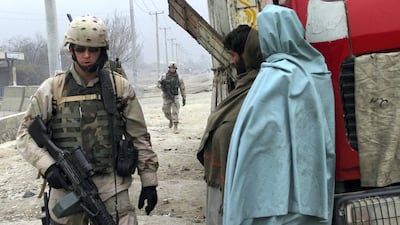
  • US soldiers patrol a street in central Kabul December 11, 2004. Reuters
    US soldiers patrol a street in central Kabul December 11, 2004. Reuters
  • US troops under Afghanistan's International Security Assistance Force, and Afghan National Army soldiers conduct a joint security patrol in the centre of Kandalay village. AFP
    US troops under Afghanistan's International Security Assistance Force, and Afghan National Army soldiers conduct a joint security patrol in the centre of Kandalay village. AFP
  • US troops patrol at an Afghan National Army (ANA) base in Logar province, Afghanistan in 2018. Reuters
    US troops patrol at an Afghan National Army (ANA) base in Logar province, Afghanistan in 2018. Reuters
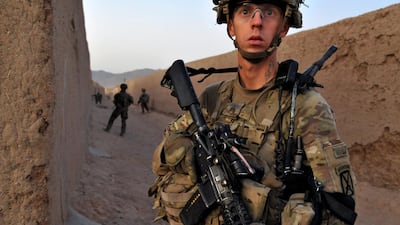
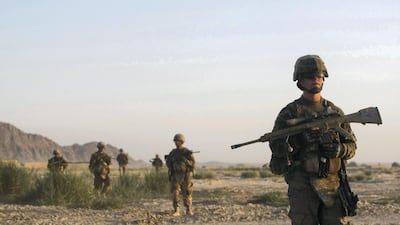
  • US Army soldiers patrol in the village of Chariagen in the Panjwai district of Kandahar province southern Afghanistan in 2011. Reuters
    US Army soldiers patrol in the village of Chariagen in the Panjwai district of Kandahar province southern Afghanistan in 2011. Reuters
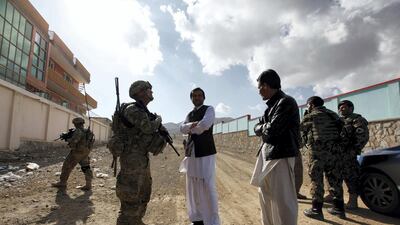
  • Afghan residents chat with US. Army Lieutenant Steven Gibbs as he patrols with his platoon in Pul-e Alam, a town in Logar province, eastern Afghanistan in 2011. Reuters
    Afghan residents chat with US. Army Lieutenant Steven Gibbs as he patrols with his platoon in Pul-e Alam, a town in Logar province, eastern Afghanistan in 2011. Reuters
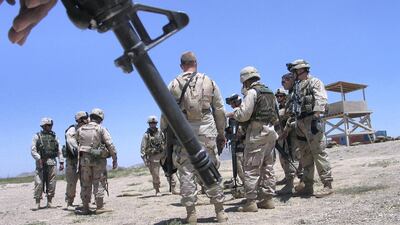
  • US soldiers gather during an exercise at the Kandahar airbase in Afghanistan in 2005. Reuters
    US soldiers gather during an exercise at the Kandahar airbase in Afghanistan in 2005. Reuters
  • U.S. Army soldiers with 1st Brigade, 1st Cavalry Division stand near their armored vehicles before they start their journey home at Contingency Operating Site Kalsu, south of Baghdad, Iraq. AP
    U.S. Army soldiers with 1st Brigade, 1st Cavalry Division stand near their armored vehicles before they start their journey home at Contingency Operating Site Kalsu, south of Baghdad, Iraq. AP
  • A handout photo made available by the US Marine Corps shows US Marines inside the perimeter of Al Asad Air Base in Iraq. EPA
    A handout photo made available by the US Marine Corps shows US Marines inside the perimeter of Al Asad Air Base in Iraq. EPA
  • A US soldier is seen during a handover ceremony of Taji military base from US-led coalition troops to Iraqi security forces, in the base north of Baghdad, Iraq August 23, 2020. Reuters
    A US soldier is seen during a handover ceremony of Taji military base from US-led coalition troops to Iraqi security forces, in the base north of Baghdad, Iraq August 23, 2020. Reuters
  • US soldiers have been in Iraq for nearly two decades. AFP
    US soldiers have been in Iraq for nearly two decades. AFP
  • US soldiers are seen during a handover ceremony of Taji military base from US-led coalition troops to Iraqi security forces, in the base north of Baghdad, Iraq on August 23, 2020. Reuters
    US soldiers are seen during a handover ceremony of Taji military base from US-led coalition troops to Iraqi security forces, in the base north of Baghdad, Iraq on August 23, 2020. Reuters

Before their 2016 arrest, the pair also worked with other people, including Muzghan's husband, to carry out a deadly grenade and shooting raid on a Sufi shrine, and another on a police station, their rap list reveals.

"I was arrested for murder, kidnapping and co-operating with the Haqqani network," Muzghan said in a video that authorities made prior to her release. "I will not join this group again."

It is rare for women to take part in attacks for the Taliban, an organisation notorious for banning school for girls, forcing women to wear burqas and sometimes executing those accused of adultery.

Of more than 5,000 Taliban prisoners released under a prisoner swap the insurgents made a condition of their participation in peace talks with the Afghan government, only five were women.

Cases such as theirs are almost unheard of, said analyst Ashley Jackson from the Overseas Development Institute think tank.

"The Taliban's norms and ideology firmly relegate women to the domestic sphere," she told AFP.

"To allow them to take part in, or admit that they played a role in waging the war, would go against core ideological tenets of the movement."

The prisoner swap, in which the Taliban freed about 1,000 Afghan security force members, garnered international condemnation when it emerged insurgents who had killed foreign troops were being released.

Kabul said many of the freed insurgents went straight back to the battlefield.

Nasreen and Muzghan were among a final batch of 400 of the most dangerous prisoners to be released.

Although the Taliban insisted on their freedom, spokesman Zabihullah Mujahid said the women were "ordinary members of Taliban families" arrested during US operations.

"Of course, women members of [insurgent] families co-operate ... but women are not included, recruited or ordered to take part in operations," he told AFP.

A third woman prisoner released in the swap was Nargis, an Iranian citizen who became an Afghan citizen and a police officer after marrying a local man.

She was convicted of killing a US police trainer in Kabul in 2012, in what officials said was the first insider attack by a woman.

Taliban officials said two other women from insurgent families were among the released prisoners and all have now returned to their homes.


UAE currency: the story behind the money in your pockets
If you go
Where to stay: Courtyard by Marriott Titusville Kennedy Space Centre has unparalleled views of the Indian River. Alligators can be spotted from hotel room balconies, as can several rocket launch sites. The hotel also boasts cool space-themed decor.

When to go: Florida is best experienced during the winter months, from November to May, before the humidity kicks in.

How to get there: Emirates currently flies from Dubai to Orlando five times a week.
Who's who in Yemen conflict

Houthis: Iran-backed rebels who occupy Sanaa and run unrecognised government

Yemeni government: Exiled government in Aden led by eight-member Presidential Leadership Council

Southern Transitional Council: Faction in Yemeni government that seeks autonomy for the south

Habrish 'rebels': Tribal-backed forces feuding with STC over control of oil in government territory

25%20Days%20to%20Aden
%3Cp%3EAuthor%3A%20Michael%20Knights%3C%2Fp%3E%0A%3Cp%3EPages%3A%20256%3C%2Fp%3E%0A%3Cp%3EAvailable%3A%20January%2026%3C%2Fp%3E%0A
Ten tax points to be aware of in 2026

1. Domestic VAT refund amendments: request your refund within five years

If a business does not apply for the refund on time, they lose their credit.

2. E-invoicing in the UAE

Businesses should continue preparing for the implementation of e-invoicing in the UAE, with 2026 a preparation and transition period ahead of phased mandatory adoption. 

3. More tax audits

Tax authorities are increasingly using data already available across multiple filings to identify audit risks. 

4. More beneficial VAT and excise tax penalty regime

Tax disputes are expected to become more frequent and more structured, with clearer administrative objection and appeal processes. The UAE has adopted a new penalty regime for VAT and excise disputes, which now mirrors the penalty regime for corporate tax.

5. Greater emphasis on statutory audit

There is a greater need for the accuracy of financial statements. The International Financial Reporting Standards standards need to be strictly adhered to and, as a result, the quality of the audits will need to increase.

6. Further transfer pricing enforcement

Transfer pricing enforcement, which refers to the practice of establishing prices for internal transactions between related entities, is expected to broaden in scope. The UAE will shortly open the possibility to negotiate advance pricing agreements, or essentially rulings for transfer pricing purposes. 

7. Limited time periods for audits

Recent amendments also introduce a default five-year limitation period for tax audits and assessments, subject to specific statutory exceptions. While the standard audit and assessment period is five years, this may be extended to up to 15 years in cases involving fraud or tax evasion. 

8. Pillar 2 implementation 

Many multinational groups will begin to feel the practical effect of the Domestic Minimum Top-Up Tax (DMTT), the UAE's implementation of the OECD’s global minimum tax under Pillar 2. While the rules apply for financial years starting on or after January 1, 2025, it is 2026 that marks the transition to an operational phase.

9. Reduced compliance obligations for imported goods and services

Businesses that apply the reverse-charge mechanism for VAT purposes in the UAE may benefit from reduced compliance obligations. 

10. Substance and CbC reporting focus

Tax authorities are expected to continue strengthening the enforcement of economic substance and Country-by-Country (CbC) reporting frameworks. In the UAE, these regimes are increasingly being used as risk-assessment tools, providing tax authorities with a comprehensive view of multinational groups’ global footprints and enabling them to assess whether profits are aligned with real economic activity. 

Contributed by Thomas Vanhee and Hend Rashwan, Aurifer

Know your camel milk:
Flavour: Similar to goat’s milk, although less pungent. Vaguely sweet with a subtle, salty aftertaste.
Texture: Smooth and creamy, with a slightly thinner consistency than cow’s milk.
Use it: In your morning coffee, to add flavour to homemade ice cream and milk-heavy desserts, smoothies, spiced camel-milk hot chocolate.
Goes well with: chocolate and caramel, saffron, cardamom and cloves. Also works well with honey and dates.

EA Sports FC 26

Publisher: EA Sports

Consoles: PC, PlayStation 4/5, Xbox Series X/S

Rating: 3/5

Five hymns the crowds can join in

Papal Mass will begin at 10.30am at the Zayed Sports City Stadium on Tuesday

Some 17 hymns will be sung by a 120-strong UAE choir

Five hymns will be rehearsed with crowds on Tuesday morning before the Pope arrives at stadium

‘Christ be our Light’ as the entrance song

‘All that I am’ for the offertory or during the symbolic offering of gifts at the altar

‘Make me a Channel of your Peace’ and ‘Soul of my Saviour’ for the communion

‘Tell out my Soul’ as the final hymn after the blessings from the Pope

The choir will also sing the hymn ‘Legions of Heaven’ in Arabic as ‘Assakiroo Sama’

There are 15 Arabic speakers from Syria, Lebanon and Jordan in the choir that comprises residents from the Philippines, India, France, Italy, America, Netherlands, Armenia and Indonesia

The choir will be accompanied by a brass ensemble and an organ

They will practice for the first time at the stadium on the eve of the public mass on Monday evening 

Email sent to Uber team from chief executive Dara Khosrowshahi

From: Dara

To: Team@

Date: March 25, 2019 at 11:45pm PT

Subj: Accelerating in the Middle East

Five years ago, Uber launched in the Middle East. It was the start of an incredible journey, with millions of riders and drivers finding new ways to move and work in a dynamic region that’s become so important to Uber. Now Pakistan is one of our fastest-growing markets in the world, women are driving with Uber across Saudi Arabia, and we chose Cairo to launch our first Uber Bus product late last year.

Today we are taking the next step in this journey—well, it’s more like a leap, and a big one: in a few minutes, we’ll announce that we’ve agreed to acquire Careem. Importantly, we intend to operate Careem independently, under the leadership of co-founder and current CEO Mudassir Sheikha. I’ve gotten to know both co-founders, Mudassir and Magnus Olsson, and what they have built is truly extraordinary. They are first-class entrepreneurs who share our platform vision and, like us, have launched a wide range of products—from digital payments to food delivery—to serve consumers.

I expect many of you will ask how we arrived at this structure, meaning allowing Careem to maintain an independent brand and operate separately. After careful consideration, we decided that this framework has the advantage of letting us build new products and try new ideas across not one, but two, strong brands, with strong operators within each. Over time, by integrating parts of our networks, we can operate more efficiently, achieve even lower wait times, expand new products like high-capacity vehicles and payments, and quicken the already remarkable pace of innovation in the region.

This acquisition is subject to regulatory approval in various countries, which we don’t expect before Q1 2020. Until then, nothing changes. And since both companies will continue to largely operate separately after the acquisition, very little will change in either teams’ day-to-day operations post-close. Today’s news is a testament to the incredible business our team has worked so hard to build.

It’s a great day for the Middle East, for the region’s thriving tech sector, for Careem, and for Uber.

Uber on,

Dara