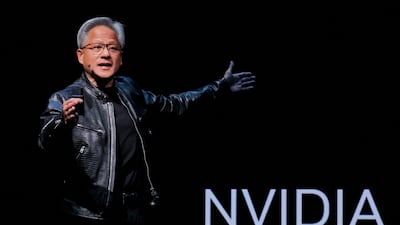
When the Nasdaq Composite added $2 trillion after Jensen Huang's stunning return as Nvidia chief executive on Monday, it underlined how dependent AI has become on one person.
Mr Huang’s return restored about $1 trillion in market cap for the company he cofounded in 1993. Silicon Valley cheered, with OpenAI's Sam Altman among those celebrating the return of the man in the black leather jacket. President Donald Trump told CNBC he had personally intervened.
“Jensen is not just a CEO. He’s the one with the relationships, with customers and with Washington,” said Mohammed Soliman, director of compute infrastructure at McLarty Associates and a senior fellow at the Middle East Institute.

“The AI ecosystem needed him back, given the current moment and the challenges facing the whole industry, not just Nvidia.”
The Nvidia board’s decision to bring Mr Huang back may help resuscitate an AI industry rocked by rising concerns over financing, a Democratic midterm sweep fuelling fears of a slower-than-expected buildout, a hawkish Federal Reserve and the CEO's removal less than two weeks ago.
AI kingmaker
All three major exchanges on the US market posted their best one-day performances since April 2025, largely pulled up by Nvidia’s 31 per cent gain. The chip maker gave up some of those gains during Tuesday trading, falling about 7 per cent.
“The scale of the rally also highlights how vulnerable the broader AI trade has become to developments at a single company,” wrote Utkarsh Ahuja, founder and managing partner at Moon Pursuit Capital.
Part of that vulnerability lays within Nvidia’s growing centrality in the multitrillion-dollar AI buildout.
But how did a company with roots in gaming emerge as the AI kingmaker?
It was Mr Huang who pushed the idea to include a standard software programming platform for Nvidia's graphics processing units just before the AI boom began.
The concept, introduced in 2006, became known as Compute Unified Device Architecture. Programmers and those trying to make the most of GPUs appreciated that there finally seemed to be a programming standard emerging for the units.
It did not make Nvidia money, but because it was so unique, it helped make the company's hardware products a standard.
Cuda is an integral part of the Blackwell GPU package, which trains and runs large-scale AI models in data centres and is the successor to the Hopper.
Microsoft, Meta, Google, Amazon and Oracle control 49 per cent of Blackwell compute with neoclouds CoreWeave, Nscale, Lambda, Nebius and Crusoe holding 18 per cent, according to American Compute, a GPU financing firm. The remaining compute is spread across enterprises, sovereign AI and smaller neoclouds.

That has helped build out a portfolio worth more than $100 billion that touches frontier labs and cloud-computing companies. Nvidia owns $48 billion in eight publicly traded companies, including Space Exploration Technologies, Intel, CoreWeave and Nebius, according to its 13F filing.
It also invested roughly $10 billion alongside Anthropic's IPO and $30 billion in OpenAI.
Nvidia is also a major investor in start-ups, investing in 129 venture capital deals so far this year, according to Pitchbook. This accounts for 27.2 per cent of venture capital deals globally.
Asked if he was concerned about the AI bubble, Mr Trump told CNBC: “I’m not concerned now because I think we have one of our great stars back in play.
“The bigger impact was, you know, he’s [Mr Huang] got other chips in his brain that nobody else knows about, including me, that nobody else understands. And you know the amazing thing about, like, if you take the Blackwell, if you take some of these super advanced chips, they can’t be copied.”

'Reckless' decision
The board’s decision marked a surprise reversal after its chairman Harvey Jones last week said Mr Huang would not be reinstated as chief executive after allegations surfaced that he had an extramarital affair with a purported Chinese spy.
But just a few days later, the board voted unanimously to bring him back.
“How can a board of directors in 12 days reverse a decision that is such a complicated discovery process that I would think would take at least six months to figure out what the heck is going on with all moving parts, and that it's a unanimous decision, and that the statement that they released was insane?” said Peter Anderson, founder of Andersen Capital Management.
Politicians are pushing for answers into whether Mr Huang’s affair compromised national security. Megaspeed, the Singapore-based company the woman at the centre of the affair worked for, is alleged to have smuggled Nvidia’s advanced chips to China. Megaspeed denies the allegations.
Mr Huang is expected to appear before four congressional committees next week, including one public hearing before the Senate Banking Committee on December 3.
“The reckless decision to bring Jensen Huang back as CEO does not change the fact that Mr Huang, Nvidia executives and the company’s board still owe Congress answers about the company’s compliance with US export controls,” Democratic senator Elizabeth Warren said.
Ms Warren, who will take over the committee in the next Congress, told Politico the grilling will likely be partisan, though separate comments from Republican senators Tim Scott and John Kennedy suggest they will also push for answers.
Incoming speaker of the House of Representatives Hakeem Jeffries also argued the National Defence Authorisation Act “must include ironclad export control legislation” to keep advanced AI technology out of the hands of China and other US rivals.
Still, Wall Street’s Monday rally showed how markets crucial Mr Huang’s presence at Nvidia is to the AI buildout.
“The investigation is still ongoing, and nobody is pretending that part is finished, but the market wasn't going to wait for a perfect answer,” Mr Soliman said.