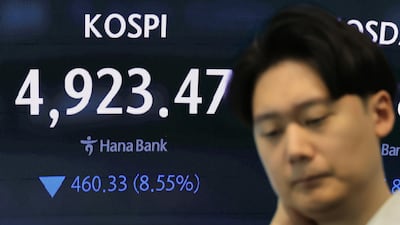
Asian stock markets tumbled on Friday as a technology-led sell-off on Wall Street spread to the region, with investors increasingly concerned that political shifts in the US could threaten the artificial intelligence investment boom.
Japan's Nikkei index slumped 7 per cent shortly after the opening bell, while South Korea's Kospi and Taiwan's benchmark index fell more than 8 per cent. The declines subsequently eased as investors stepped in to buy shares at lower prices.
South Korea's Kospi briefly fell more than 8 per cent, causing a circuit breaker that halted trading for 20 minutes. The index recovered some losses after trading resumed.

The sell-off follows an intense session on Wall Street on Thursday, when the Nasdaq Composite dropped 5.5 per cent, entering correction territory, reversing a brief post-election rally, as investors worry that the Democrats' control of the US Congress will delay the AI buildout.
The S&P 500 slid 4.3 per cent and the Dow Jones Industrial Average fell more than 1,833 points, or 3.44 per cent, erasing the previous session's gains that followed the Democrats' stunning midterm sweep. It was the worst day for all three indexes since April 2025.
Technology shares bore the brunt of a global retreat sparked by mounting concerns over the AI boom. Concerns about whether the enormous sums being poured into AI infrastructure will generate sufficient returns have added to the pressure on technology stocks.
AI-related stocks tumbled as investors considered the question of whether Democratic control of both chambers of Congress would lead to greater oversight and regulation of data centre construction.
The Philadelphia Semiconductor Index plunged 12.2 per cent overnight, while major chip makers in Asia, including Samsung Electronics, SK Hynix and Taiwan Semiconductor Manufacturing Company, came under heavy selling pressure.
Tech sell-off
In the US on Thursday, the tech-heavy index was down 5.4 per cent at market close and 10 per cent lower from its October 6 record high close, crossing the threshold for a technical correction.
Chip bellwether Nvidia declined 926 per cent, while Broadcom tumbled more than 10 per cent. Shares in Qualcomm closed 9.49 per cent lower after issuing weak fourth-quarter guidance in its latest earnings report.
Shares in neocloud companies also fell, with CoreWeave and Nebius tumbling 9.83 and 14.94 per cent, respectively. Iren shed nearly 17 per cent, and software company Oracle declined 6.96 per cent.
Investors fear the Democrats' sweep in the midterms that put them in control of Congress could delay the multitrillion-dollar AI buildout at a time when the industry is already facing intensifying backlash over the financing needed for infrastructure and its energy demands.
“The theme we are watching most closely is AI scrutiny. We anticipate more congressional hearings on who pays for the power-hungry buildout,” Vijay Valecha, chief investment officer at Century Financial, wrote in a note.
Voters nationwide overwhelmingly rejected data centres in this week's elections. As of Thursday, voters opted for decisions that would restrict data centres in 39 of 40 measures with complete counts, according to Redbud Consulting.
The so-called hyperscalers at the heart of the AI buildout, drawing the most scrutiny over Big Tech's spending, also declined.
Amazon fell 2.19 per cent, Apple 1.53 per cent, Meta 3.96 per cent and Microsoft 3.58 per cent.
A stunning upset in the contest to become Texas governor could also have major ramifications for the state, which Goldman Sachs analysts estimate accounts for 25 per cent of planned data centre capacity.
Elon Musk's companies Tesla and SpaceX declined 10.77 and 9 per cent, respectively, continuing their decline from the previous trading session.
Thursday's sell-off continues US markets' October downturn, where Nasdaq shed about 5.3 per cent last month.
A report from the Institute for International Finance showed emerging market portfolio flows at negative $33.8 billion in October and minus $19.3 billion in September, with Asian equities suffering the largest hit.
The report said every region recorded outflows, with the Middle East and North Africa at minus $1.2 billion.
"Among the stress episodes we track, only the Covid shock in 2020 and the Iran war shock in March 2026 produced larger outflows, at close to minus $100 billion each," it said.

