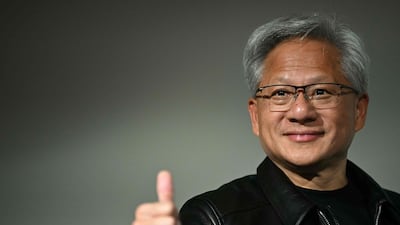

Nvidia's board of directors on Monday brought back Jensen Huang as chief executive, less than two weeks after his resignation from the chip-making giant.
Mr Huang resigned after admitting to an extramarital affair with a technology executive who US authorities believe was spying for China.
He also faces accusations he knowingly circumvented US export laws designed to keep American AI and semiconductor technology out of China.
Yet there was no hint of the seriousness of those allegations in Mr Huang's initial statement upon returning as chief executive.
"I am honored to return to Nvidia and lead one of the most consequential technology companies in the world at the beginning of a new industrial revolution," he said. "I am grateful for the love and support of my family, I can’t wait to get back to work."
US President Donald Trump, who for several days has been vocal about pushing Nvidia's board of directors to allow for Mr Huang's return, welcomed the decision.
“On a personal note, I have gotten to know Jensen and he is a great patriot and national treasure,” Mr Trump posted on Truth Social.
“Separately, Nvidia should continue its thorough internal investigation of the company’s compliance with US export controls in order to ensure that it is fulfilling its legal obligations and patriotic duty to protect US national security.”
In an interview with CNBC on Monday, President Trump said that he personally intervened and spoke with Nvidia's board of directors to try and convince them to bring Mr Huang back.
Nvidia's share price leapt by 30 per cent at market opening.
Mr Huang's return brings lingering controversy related to his dealings with China.
Democrats and Republicans in Congress have called for inquiries into Mr Huang and Nvidia. Several media reports indicate that the Securities and Exchange Commission is conducting an investigation into the company.
“The SEC does not comment on the existence or non-existence of a possible investigation,” a representative for the federal agency told The National.
Democratic strategist and former campaign chief for president Barack Obama, David Axelrod, said: “For those who believe the super rich and powerful play by a different set of rules, this is no huge surprise. Maybe this was the big thing on which [Chinese President] Xi and Trump could agree!”
Technology tycoon Elon Musk, who also pushed in recent days for Mr Huang's return to Nvidia, celebrated on Monday.
"The mistake has been corrected," he posted on X.
OpenAI's chief executive Sam Altman, with whom Mr Huang and Nvidia have several business deals, also boasted of Mr Huang once again having the title of chief executive.
"Jensen!" he posted on X.
Yet Democratic Senator Elizabeth Warren, who has not exactly been shy about being critical of Big Tech, made clear that she would continue to try and hold Mr Huang and his company accountable.
"The reckless decision to bring Jensen Huang back as CEO does not change the fact that Mr Huang, Nvidia executives, and the company’s board still owe Congress answers about the company’s compliance with US export controls," the Massachusetts senator said, adding that she planned to direct more scrutiny to the White House in light of recent events.
"The Trump Administration also needs to explain to Congress what ‘input’ was given and by which senior officials in the United States government to support his reinstatement," she continued, adding that Mr Huang's return to Nvidia "only increases the urgency of passing bipartisan export control bills into law and making sure Nvidia does not lobby to kill that legislation and put our national security at risk."
Making matters even more interesting is that just after he resigned as Nvidia's chief executive, Mr Huang had agreed to meet privately with several committees in the US House of Representatives and Senate amid rising concerns about national security matters related to his actions at Nvidia.
Before he resigned Mr Huang had also been slated to speak at one of Nvidia's flagship technology conferences, GTC, which is scheduled to take place from November 30 to December 3 in Washington.
It's not yet clear if Mr Huang will still testify on December 1st.
Morningstar's director of institutional insights, Lindsey Stewart didn't mince words about the unprecedented developments.
"The return of Jensen Huang at the helm of Nvidia is almost as big a shock as his departure," he said.
"It’s possible that many investors will conclude this is a good move given his history of value creation at the company ... but alongside that sense of relief, there are sure to be questions about who is best placed to provide appropriate governance and oversight of key risks at the now-giant company at the centre of a critically important global AI ecosystem," Mr Stewart explained.
Even by Silicon Valley standards where mercurial executives are often given the benefit of the doubt, the reemergence of Mr Huang is being viewed as a surprise.
All infidelity aspects aside, the allegations he faces are by no means insignificant.
Mohammed Soliman, director of compute infrastructure at McLarty Associates and a senior fellow at the Middle East Institute said that at this point in time when the AI boom hangs in the balance, there was a lot of concern about what it might mean to decouple Mr Huang from Nvidia.
"Jensen is not just a CEO, he's the one with the relationships, with customers and with Washington," Mr Soliman explained. "
"The AI ecosystem needed him back, given the current moment and the challenges facing the whole industry, not just Nvidia," he said, while also pointing out that it would be ill advised for anyone to think that the allegations faced by Mr Huang will simply go away.
"The investigation is still ongoing, and nobody is pretending that part is finished, but the market wasn't going to wait for a perfect answer," Mr Soliman said.