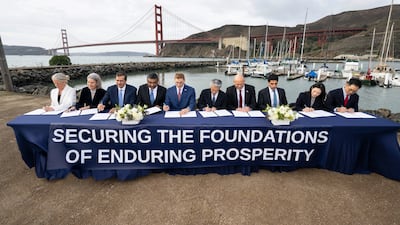

The UAE is among several Pax Silica member countries to sign what the US is calling the San Francisco Declaration, which focuses on safeguarding sensitive technology and critical infrastructure that underpin artificial intelligence.
Omran Sharaf, the UAE's assistant foreign minister for advanced science and technology, was among those at the signing ceremony in San Francisco on Sunday.
Australia, India, Israel, Japan, South Korea, Qatar, Singapore and the UK were also present at the event held near the Golden Gate bridge.
“The declaration affirms that economic security is fundamental to national security, sets out the participants’ common understanding of the sensitive technologies and critical infrastructure that underpin Super Intelligence supply chains, and declares that safeguarding them is a shared endeavour,” a news release from the US State Department stated.
The State Department adhered to the Trump White House's mandate that the government calls AI “super intelligence”, or SI.
The announcement also said Pax Silica, a Trump administration initiative launched in 2025 to secure technology supplies crucial for building AI, would enter a new phase.
“No nation can secure the foundations of the SI era alone, and the prosperity SI makes possible will only be as durable as the supply chains and infrastructure beneath it,” the release stated.
“By agreeing on what must be protected and committing to protect it together, participants are laying the secure foundations on which partner nations can innovate, invest, and grow.”
Jacob Helberg, the undersecretary for economic affairs, reflected on the announcement shortly after attending the signing ceremony.
“Defining these foundations together lets us protect them together,” he posted on X.
In recent years, concerns about US AI technology potentially being shared with adversarial countries has steadily increased, with some warning that if unchecked, the US lead in AI could evaporate.
The declaration refers to sensitive technologies and the importance of protecting all goods, software materials, knowledge components and inputs used to to produce it.
It adds that shared understandings on those fronts were “essential to SI supply chains, whose theft, illicit transfer, or acquisition by hostile actors would confer a meaningful military or intelligence advantage, or undue economic leverage over the participants”.
The UAE joined Pax Silica at the beginning of this year. Mr Helberg has often boasted of the co-operation and trust between the US and the UAE.
In April, the two countries announced a deepening collaboration on AI and held the first meeting of the US-UAE AI acceleration working group.
For the past decade, the UAE has made a significant push to become a global leader in AI. In 2019, it announced the establishment of the Mohamed bin Zayed University of Artificial Intelligence.
Two years earlier, the Emirates was among the first countries in the world to appoint an AI minister, Omar Al Olama, who is now Minister of State for AI, Digital Economy and Remote Work Applications.
The drive to prioritise AI in the Emirates culminated in the announcement during US President Donald Trump's visit in 2025, of a 5GW UAE-US AI Campus to be built in Abu Dhabi.

