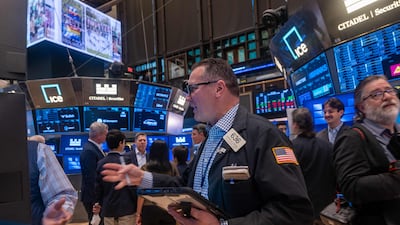

Last Thursday, the Nasdaq plunged 5.5 per cent, wiping approximately $2.5 trillion off its market value, with the turmoil spreading to Asian markets the following day. The US midterm elections had intensified concerns over potential restrictions on data-centre construction, at a time when investors were already questioning when huge AI investments would deliver equally extraordinary returns.
The numbers explain their anxiety. Gartner forecasts worldwide AI spending of $2.7 trillion this year, almost 50 per cent higher than the previous year. Such spending raises legitimate questions about market valuations, electricity demand and the sustainability of returns that have yet to fully materialise.
It is difficult to avoid comparing the present situation with the dotcom bubble, but this confuses two fundamentally different questions: whether investors are paying too much for AI companies, and whether artificial intelligence will transform the global economy. Back in the late 1990s and early 2000, the dotcom crash wiped trillions of dollars in market value, yet the internet went on transforming almost every industry. Financial bubbles can burst without the underlying technology disappearing.
Now is the time to separate the noise from the signal and adopt a three-to-five-year perspective. Stanford University estimates that the cost of running AI models at a given benchmark performance fell more than 280-fold between November 2022 and October 2024. AI is becoming dramatically cheaper, regardless of what happens to technology shares.
Perhaps the most revealing perspective comes from Anthropic, the five-year-old American AI company behind Claude, which is now preparing one of the largest stock market flotations in history, with a potential valuation of approximately $1.5 trillion. In its recently published IPO prospectus, Anthropic makes a remarkable observation: “For the first time in history, intelligence is something humans can build.”
Its argument is that the capacity to reason, analyse, create and solve problems can now be produced at industrial scale and made available on demand, potentially transforming the economy more profoundly than electricity, industrialisation or the internet. Coming from a company seeking such an extraordinary valuation, these claims require scrutiny, but they capture the distinction investors should be able to understand: we are no longer simply building premium hardware, faster computers or better software; we are creating the capacity to manufacture intelligence itself. That possibility will outlast any stock market losses or corrections.
Against this backdrop, I offer five predictions for next year and beyond.
-
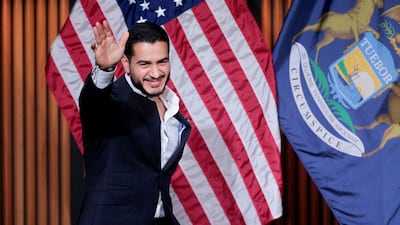
Abdul El-Sayed, who has become the first Muslim to be elected to the US Senate, celebrates his milestone victory in Detroit, Michigan. Reuters -
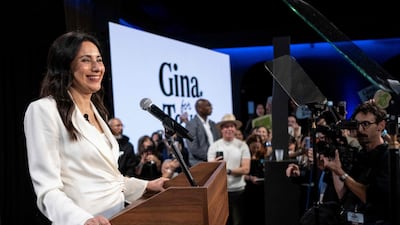
Gina Hinojosa, who has been elected as the first Latina governor of Texas, addresses supporters. AFP -
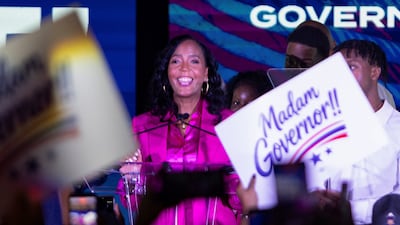
Democrat Keisha Lance Bottoms addresses supporters in Atlanta, Georgia, after becoming the first African American woman to be elected governor of a state. Reuters -

Adam Hamilton, Democratic Senate candidate for Kansas, celebrates in Overland Park as the results pour in. Reuters -
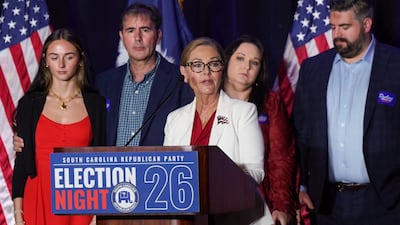
Republican Senator Darline Graham concedes defeat to Annie Andrews in the South Carolina race. AFP -

Annie Andrews, the Democratic Senate candidate for South Carolina, celebrates with her family in Charleston as results pour in. Senate. AFP -

Supporters of Adam Hamilton, the Democratic Senate candidate for Kansas, cheer during an election night event in Overland Park. Bloomberg -

Roy Cooper, Democratic Senate candidate and former North Carolina governor, attends an election night rally. Reuters -

Supporters of US Senate candidate Abdul El-Sayed attend the Michigan Democrats' election night watch party in Detroit. EPA -
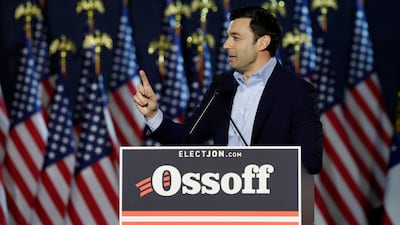
US Senator Jon Ossoff, Democrat from Georgia, speaks in Atlanta after winning re-election. AFP -
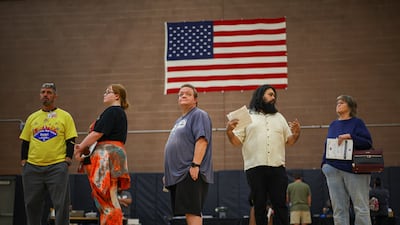
People stand in line to vote in the US midterm elections at Boulder City High School in Boulder City, Nevada. Reuters -
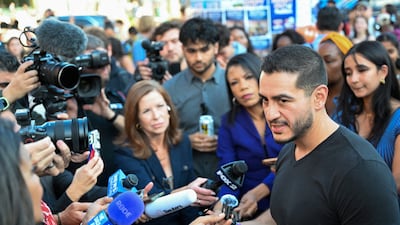
Democratic candidate for US Senate, Abdul El-Sayed, speaks to the media as he visits a polling site in Ann Arbor, Michigan. Reuters -
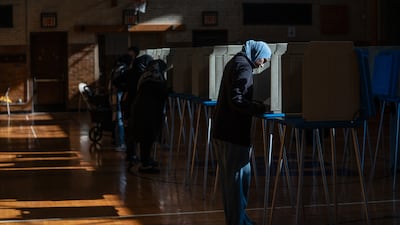
Voter cast their ballots in Dearborn, Michigan. Bloomberg -

A voter cries after placing their "I Voted" sticker on a memorial for Lorenzo Salgado Araujo, who was shot dead by an Immigration and Customs Enforcement officer in July, in Houston, Texas. Bloomberg -
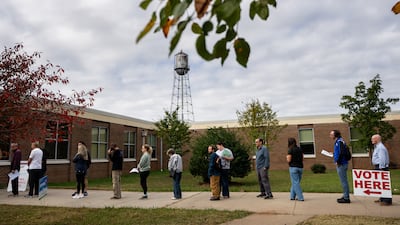
Voters wait in line to cast their ballots in Durham, North Carolina. Bloomberg -
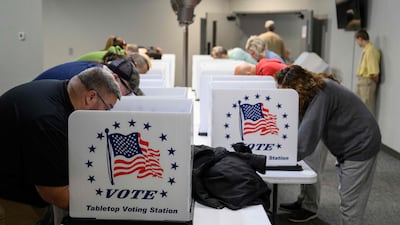
Voters cast their US midterm election ballots at a polling station at the Bridge of Hope Church in Youngstown, Ohio. AFP -
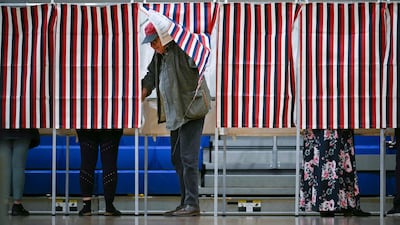
Voters in South Portland, Maine. AFP -
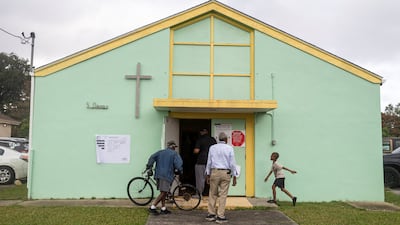
Orleans parish election commissioner Calvin Alexander stands outside St David Baptist Church, as residents arrive to vote in New Orleans, Louisiana. Reuters -
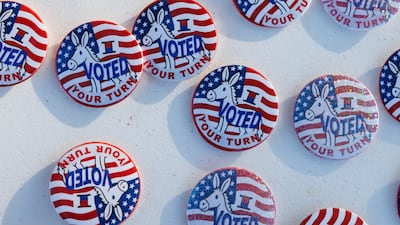
Badges at a polling site in Clayton, North Carolina. Bloomberg -

US voters cast their ballots at the Museum of Contemporary Art in Arlington, Virginia. EPA -
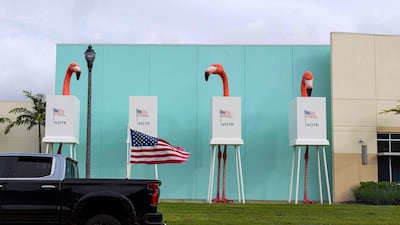
Flamingos created by artist Matthew Mazzotta outside the Supervisor of Elections building in West Palm Beach, Florida. AFP -

Abdul El-Sayed, Democratic US Senate candidate, from Michigan, speaks during a campaign event at the Majestic Theatre in Detroit. Bloomberg -

Republican Senate candidate Mike Rogers greets supporters as he takes the stage at a campaign rally in Rochester Hills, Michigan. AFP -
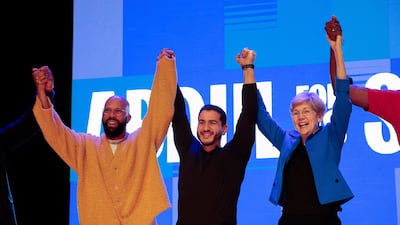
Mr El-Sayed attends a campaign rally with rapper Common and US Senator Elizabeth Warren ahead of the midterm elections, in Detroit, Michigan. Reuters -
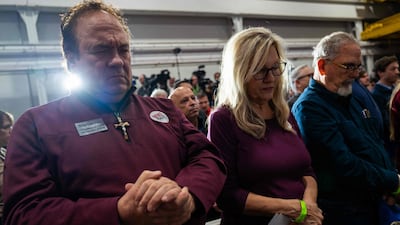
People pray during a rally for Michigan Republican Senate candidate Mike Rogers, in Rochester Hills. AFP -

Supporters attend Mr El-Sayed's campaign rally with Common, in Detroit. Reuters -
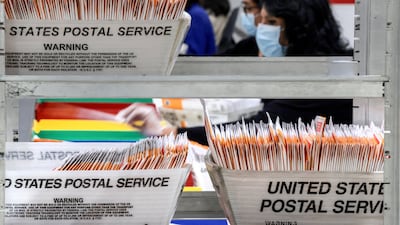
Midterm election ballots are extracted from envelopes at the Los Angeles County Ballot Processing Centre, in City of Industry, California. Reuters -
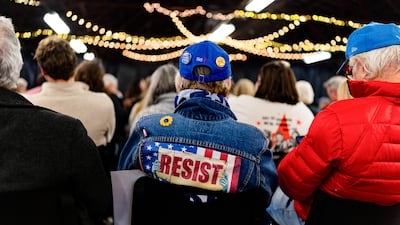
An attendee wears a "Resist" jacket during a campaign event with Abdul El-Sayed, Democratic US Senate candidate from Michigan. Bloomberg -
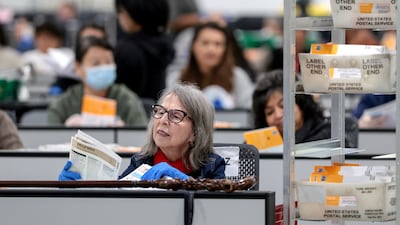
Election staff at work at the LA County Ballot Processing Centre. Reuters -

US President Donald Trump delivers a speech marking the end of the midterm election campaign, in Washington DC, the day before voting starts. AFP


First, AI colleagues will become a normal part of professional life. The next revolution will not be employees occasionally consulting chatbots, but organisations deploying agents that execute entire workflows. Imagine a government department where AI agents process applications, verify documentation and prepare decisions, leaving officials to exercise judgment and handle exceptions. Next year, managing AI agents could become as familiar as managing employees. Indeed, we might be the last generation to work in, and manage, human-only organisations.
Second, markets will increasingly reward AI-driven productivity rather than investment in AI. This week’s market correction reinforces the distinction between building computing capacity and generating tangible economic value. A company employing only 20 people supported by hundreds of AI agents could potentially match the output of a much larger organisation. We may even witness the first billion-dollar business operated by a single founder, with AI handling software development, marketing, customer service and operations. Nvidia’s Jensen Huang has suggested that AI could create more millionaires in five years than the internet did in twenty.
AI is also poised to accelerate scientific discovery at an unprecedented pace . DeepMind’s AlphaFold has already predicted the structure of more than 200 million proteins, providing researchers with valuable information that would otherwise have required enormous experimental effort. AI is also helping identify new materials, explore drug candidates and improve battery chemistry.
My prediction is that by next year, we will see increasingly important discoveries where AI contributes not merely to analysing results but to generating scientific hypotheses. The greatest prize is compressing research cycles from years into months, potentially transforming medicine, energy and manufacturing.
Fourth, national AI infrastructure will become as strategically important as energy and defence. The International Data Corporation, a market intelligence company, forecasts that annual AI infrastructure spending could exceed $1 trillion by 2029, illustrating the scale of the emerging industrial competition. Yet Thursday’s market turmoil revealed another constraint: data centres compete with households and industries for electricity, water and land. Countries capable of combining affordable energy, computing infrastructure, secure data and predictable regulation will possess considerable advantages.
Fifth, governments will have to rethink employment, education and human purpose. Goldman Sachs has estimated that generative AI could expose the equivalent of 300 million full-time jobs to automation, although exposure does not necessarily mean displacement.
The challenge extends beyond reskilling workers for emerging occupations. What happens when machines can perform an expanding share of economically valuable cognitive work, and when productivity grows faster than employment? Governments may eventually need to invest as deliberately in human purpose, lifelong learning and social participation as they currently invest in job creation. The question is not only how people will earn a living, but how they will contribute meaningfully to society.
None of these predictions depends on technology shares recovering next week. Indeed, the correction may accelerate the transition from financial speculation into measurable productivity, scientific progress and practical applications.
The coming years will produce failures, extraordinary successes and difficult adjustments. Yet the greatest mistake would be to confuse the price investors are willing to pay for artificial intelligence with the value that increasingly abundant intelligence could create for humanity.

