

The corporate world’s eternal challenge is how to get the right balance between short, medium and long-term goals. This is now especially true in the sustainability domain. For much of the past two decades, the sustainability debate has focused on carbon, which is critical for our future, but the next decade needs to begin to focus on jobs, critical for our present.
That does not mean abandoning climate ambition. Far from it. However, it does mean recognising an uncomfortable political and economic reality: a green transition that does not create opportunity for people will eventually lose the support of those people, and nowhere is this question more urgent today than among the young.
Globally youth unemployment is about 12.4 per cent, and of those, about 260 million young people – roughly one in five – are not in employment, education or training.
In the Arab world, the challenge is significantly greater. About 60 per cent of the population is under 30, which means a little more than 300 million youth, around which 110 million people are aged 15 to 29 (working age according to International Labour Organisation). Yet youth unemployment stood at about 27.7 per cent last year, double the global average. On the eve of the Arab uprisings in 2010, about one in four young people in the region’s labour force was unemployed. Fifteen years later, the figure remains about one in four. A generation has changed, but one of the region’s most fundamental economic challenges has not.
This is more than a stubborn labour statistic. It represents millions of delayed careers, postponed households, underused skills and unrealised growth. It can also carry a deeper social cost. Prolonged exclusion from economic opportunity can breed frustration, alienation and a loss of trust in institutions – conditions that can leave some young people more vulnerable to radicalisation and extremist narratives. More troublingly, today’s young people are often better educated, more ambitious and more digitally connected than the generation before them. The region’s challenge is no longer simply producing talent, but also converting talent into opportunity – and giving young people a meaningful stake in their societies’ future.
These are also not merely labour-market statistics, they are sustainability metrics because no society can call itself sustainable if a generation of young people cannot see a credible route into productive work.
This becomes even more important because the labour market itself is being rewritten. Artificial intelligence will affect about 40 per cent of jobs globally, according to the International Monetary Fund. The ILO estimates that one in four jobs worldwide has some exposure to generative AI. Its conclusion is not that one quarter of jobs will disappear; most will be transformed rather than eliminated. But this transformation has consequences, particularly for young people trying to enter the labour market for the first time.
-

Egyptians celebrate the resignation of former president Hosni Mubarak in Tahrir Square in February 2011 / AP -

Tunisians were the first to see their protests bring down a long-established leader, since when the 'Arabic spring' has spread through the Middle East. AFP -

Demonstrators shout slogans against the Syrian regime during a protest following the Friday prayers in Wadi Khaled on the Lebanese-Syrian border on December 30, 2011 AFP -

Anti-government protesters flash victory sign in the city of Daraa, Syria. -

Demonstrators shout slogans against the Syrian regime during a protest following the Friday prayers in Wadi Khaled on the Lebanese-Syrian border on December 30, 2011. AFP -
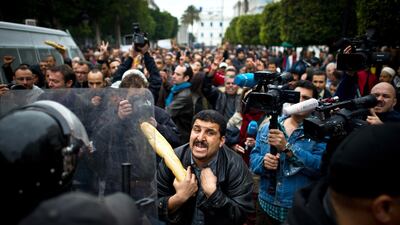
A Tunisian protester holding a baguette talks to riot policemen during a demonstration in Tunis on January 18, 2011. AFP -

A protester pleads with soldiers to allow her through the wire barricade outside the Tunisian prime minister's office on January 24, 2011 in Tunis. Getty Images


This is why policymakers should redesign a new age of sustainability, or perhaps, more accurately, going back to the future. The original idea of sustainability was never supposed to mean environment alone. It was the triple bottom line: people, planet and prosperity.
Over time, however, the environmental pillar became dominant. Carbon targets, net-zero commitments, ESG reporting and disclosure frameworks became proxies for sustainability itself. All are important, but somehow sustainability became something organisations frequently reported, rather than something communities necessarily experienced. That equation must now be corrected.
We already see the signs of this shift across Europe, the Gulf, Asia and the US, where industrial policy, energy policy and technology policy are increasingly being connected to jobs, domestic capabilities, skills, supply-chain resilience and national competitiveness. In the UK, government contracts will now require job creation instead of green targets under new rules. From January, companies competing for major central government contracts will face a much tougher test of the jobs, skills and opportunities they create locally, turning the enormous government procurement budget into labour-market policy. Bidders for public contracts will be rewarded for creating quality jobs, apprenticeships, work experience and pathways specifically for young people.
While some might portray this as a retreat from sustainability, that is simply the wrong interpretation. It is the maturation of sustainability as the choice should never be jobs or climate, nor should “jobs first” become an excuse to postpone environmental responsibility. The real objective must be much harder: jobs and growth and environmental stewardship at the same time. A solar project that reduces emissions but creates little local capability is an incomplete sustainability success. A new industrial plant that employs thousands but locks an economy into unsustainable resource use is equally incomplete.
Governments therefore need a new scoreboard. For every major investment, infrastructure programme, industrial policy or green transition initiative, policymakers should be asking at least three questions. How much economic value will it create? How many people will it enable to participate productively in that value? And can that value be created within the environmental limits that future generations will inherit? That is the triple bottom line brought into the AI age.
For a young person looking for their first opportunity, sustainability cannot only be a target for 2050. It must also look like a job on Monday morning.

