

Lebanon’s Prime Minister Hassan Diab has pushed back against media reports that he is demanding $1 million (Dh3.67m) from the cash-strapped American University of Beirut to cover his expected salary until 2025, despite leaving his job late last year to run the country.
In a statement published on Thursday, Mr Diab’s lawyers said there was an “orchestrated media campaign” against the prime minister misconstruing the lawsuit and blasted AUB for its “negative, even deceitful, attitude.”
While Mr Diab’s lawyer did confirm that proceedings had been filed with the judge of urgent matters in Beirut on May 21 regarding “his dues and compensations after 35 years of contractual relationship with the American University of Beirut” it did not disclose the amount being sought.
Two sources at AUB told The National that Mr Diab's lawsuit against AUB demands he be paid his annual salary of $200,000 for the next five years into an overseas account.
“He thinks he’s entitled to this money that he never worked for and he’s obviously using his status as prime minister to bully the university,” one source said.
By contrast, Mr Diab’s lawyers accuse the AUB of “persistent coercive pressure” against the prime minister since 2017.
Just last month, the institution’s head Fadlo Khury laid out the dire state of AUB’s finances, battered by the economic crisis and the Covid-19 pandemic. He said that departments would have to close and up to a quarter of staff laid off.
-

A man on his scooter passes next to garbage containers and tires that were set on fire by anti-government protesters to block the main road in Beirut, Lebanon. Protesters closed several major roads in the Lebanese capital amid rising anger as the currency hit a new record low on the black market, electricity cuts increased and the government raised the price of bread for the first time in more than a decade. AP Photo -
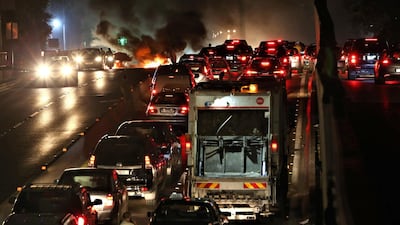
Smoke from burning garbage bins set on fire by anti-government protesters block a main road of the city cause traffic jam during a protest over deteriorating living conditions in Beirut, Lebanon, after the Lebanese government had raised subsidized bread prices. EPA -
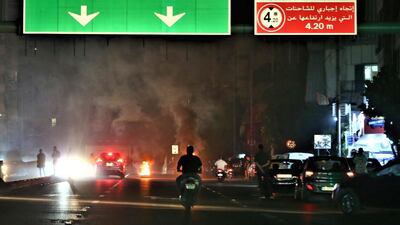
Smoke from burning garbage bins set on fire by anti-government protesters block a main road to the city's airport during a protest over deteriorating living conditions in Beirut, Lebanon, after the Lebanese government had raised subsidized bread prices. EPA -
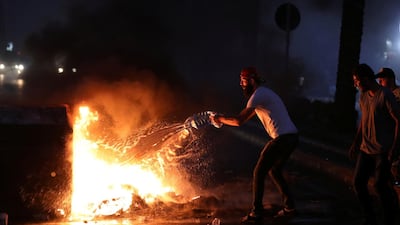
Demonstrators start a fire during a protest over deteriorating living conditions and after the Lebanese government raised subsidised bread prices, in Beirut, Lebanon. REUTERS -
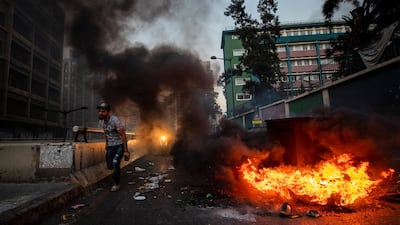
People pass garbage containers and tires that were set on fire by anti-government protesters to block the main road in Beirut, Lebanon. AP Photo -
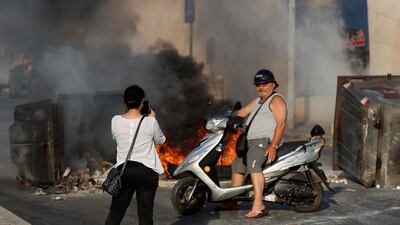
A woman, left, takes photos with her phone of her relative on his scooter in front of burned tires and garbage containers set on fire by anti-government protesters to block roads, during a protest against the economic crisis, in Beirut, Lebanon. AP Photo -
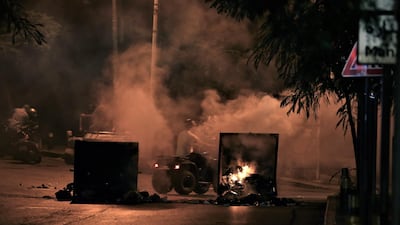
Anti-government protestors have garbage bins set on fire to block a road during a protest over deteriorating living conditions in Beirut, Lebanon. EPA -
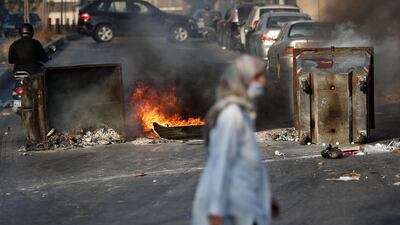
A woman passes in front of burned tires and garbage containers set on fire by anti-government protesters to block roads, during a protest against the economic crisis, in Beirut, Lebanon. AP Photo -
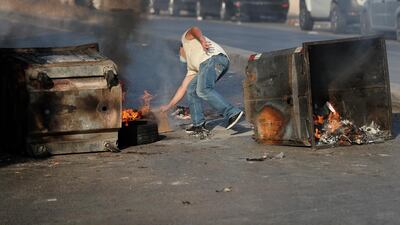
An anti-government protester burns tires and garbage containers to block roads, during a protest against the economic crisis, in Beirut, Lebanon. AP Photo -
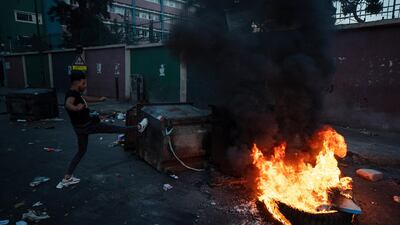
Anti-government protesters burn tires and garbage containers to block a main road, during ongoing protests against the Lebanese government, ,in Beirut, Lebanon. AP Photo -
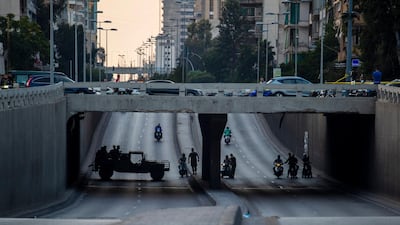
Lebanese army soldiers deploy on a street where anti-government protesters block a main road with garbage containers, during ongoing protests against the Lebanese government, in Beirut, Lebanon. AP Photo -
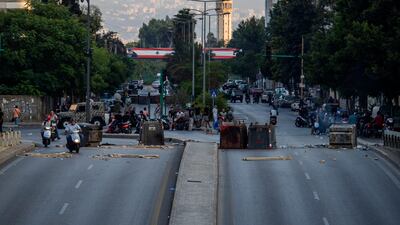
Anti-government protesters block a main road with garbage containers, in Beirut, Lebanon. AP Photo -
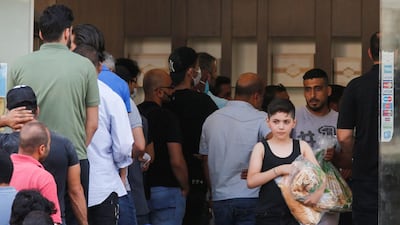
People queue to buy bread at a bakery in Beirut, Lebanon. REUTERS -
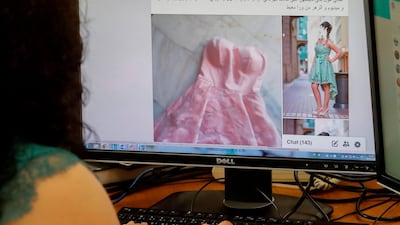
A Lebanese woman checking a Facebook page where Lebanese people exchange their goods with food, baby clothes and diapers. Tens of thousands of people across the social spectrum have lost their job or part of their income as part of Lebanon's worst economic crisis in decades. As Lebanese parents watch prices soar amid a historic low for the local currency on the market, they are taking to bartering online to survive. AFP


The news that the prime minister, brought in to head a technocratic government that can halt the country’s total economic collapse, is now suing his old employer has left staff reeling.
“He wants all the payments outside [Lebanon], in dollars, while we are struggling to keep the university open.”
Reports of Mr Diab’s apparent demand to be paid into overseas accounts shocked university staff members, who are paid in the local currency.
Since October, the Lebanese lira has dropped from the official peg of 1,507 to the dollar to upwards of 9,000 to the dollar. In November, two weeks after nation-wide protests erupted because of the crisis, local banks capped cash dollar withdrawals and barred overseas transfers.
One of the AUB sources said that the prime minister had made the request to be paid overseas verbally. “It’s incriminating, you don’t write that down,” the source said.
Mr Diab’s extensive 134-page CV shows that he worked at AUB for 35 years, first as an assistant professor at the faculty of engineering and architecture before he was appointed vice president for AUB’s regional external programmes between 2006 and 2011, a position he returned to in 2013 after serving as education minister.
Ministers in Lebanon continue to accrue a salary even after leaving office, as will Mr Diab in his position as prime minister on 17.7m lira a month, which equates to about $11,687 at the official peg but is worth as little as $2,000 at the current black market rate.
Mr Diab took office on January 21 and vowed a raft of urgent reforms and fixes to slow the collapse of the lira and begin shoring up the battered economy. As he marked 100 days on May 21, he said he had completed almost all of those urgent tasks despite the lira's continuing fall, companies continuing to lay off staff or close and despite the poverty rate rising above 40 per cent of the population.
American dollars, which had been used in parallel with the local currency, have all but disappeared and inflation has risen from 17.5 per cent in February to an eye-watering 56 per cent in May.
The AUB source said that Mr Diab simply walked away from his job, without resigning or asking for unpaid leave. ”No formal request was made, not even an email, he did not communicate with the administration,” they said.
This is why he lost rights to healthcare benefits, which AUB staff can keep even after retirement. They were reinstated after he did the necessary paperwork, said the source. In their statement, Mr Diab’s lawyers accused AUB of “deliberately lagging behind” in healthcare payments.
Mr Diab did not ask for unpaid leave either, said the source. AUB grants two years of unpaid leave to employees who are appointed to positions in government. Mr Diab benefitted from this leave – which can be extended – during his stint as education minister from 2011 to 2014.

