
The UAE's environment ministry joined the International Union for Conservation of Nature as a state member, it was announced on Monday.
Dr Abdullah Al Nuaimi, Minister of Climate Change and Environment, said the move was another indication of the country's commitment to conservation and sustainability.
"Our ... leadership views nature conservation as one of its key priorities and an integral part of the country’s sustainable development strategies," he said.
The UAE is a signatory to major international conventions on climate and biodiversity.
"The ministry’s membership into the IUCN, the oldest and largest international environmental organisation, reaffirms our country’s commitment to supporting global conservation efforts and tackling important environmental issues, from climate change to biodiversity loss," Dr Al Nuaimi said.
With nearly 1,400 government and non-government members across 185 countries, the IUCN is involved in data gathering, analysis, research and advocacy. Its knowledge products, including the Red List of Threatened Species, Green List of Protected and Conserved Areas, and Key Biodiversity Areas, are global benchmarks for conservation.
"The UAE has a long-standing partnership with the IUCN, particularly through our work with its Species Survival Commission– the publisher of the Red List," said Razan Al Mubarak, managing director of the Mohamed bin Zayed Species Conservation Fund, and a candidate for the post of IUCN President.
"The IUCN, SSC, and the IUCN Global Species Programme has enjoyed a close working relationship with the UAE for the past 20 years, particularly on issues such as species conservation and reintroduction, as well as Red List assessment and training," she said.
Dr Shaikha Al Dhaheri, secretary-general of Environment Agency Abu Dhabi, chair of the IUCN National Committee, and IUCN Regional Councillor for West Asia, said the agency had been a long-time supporter of SSC’s Reintroduction Specialist Group.
"Our reintroduction of the scimitar-horned oryx in Chad is a conservation success story and an excellent example of what can be achieved through partnerships," she said.
"The joining of the ministry as an IUCN member fills an important gap in memberships from the UAE.
"With the ministry becoming a state member, we now have a full set of IUCN memberships in the country.
Before the ministry’s joining, the UAE had four IUCN members – two government entities and two NGOs. These included EAD, Dubai Desert Conservation Reserve, Emirates Nature-WWF, and Emirates Environmental Group.
Endangered species in the UAE - according to the IUCN Red List:
-
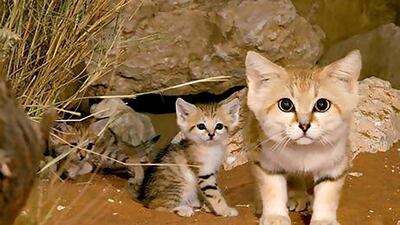
The sand dune cat (Felis margarita) is a nocturnal creature that lives in shallow burrows and hunts rodents. Research published in 2005 indicated that only 250 remained in Abu Dhabi emirate. Courtesy, Al Ain Zoo -

The Arabian leopard is currently listed as critically endangered. Pawan Singh / The National -
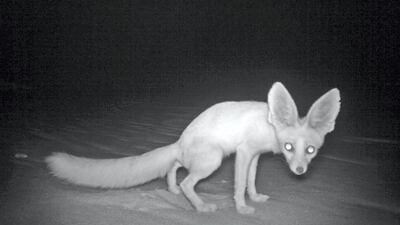
This is the first sighting of the rare Rüppell's fox (Vulpes rueppellii) in 13 years. Environment Agency – Abu Dhabi -
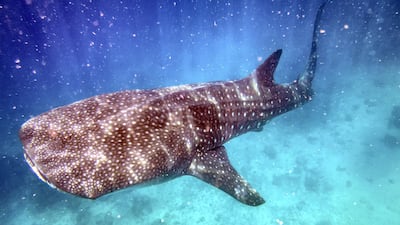
Whale sharks are known as jinbe zame in Japanese, inspiring their newly discovered residents' name.. Getty Images -
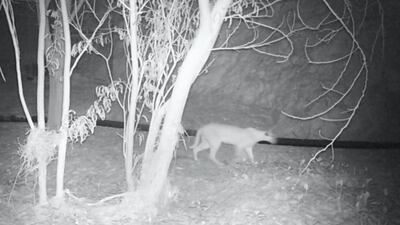
Arabian Caracal (Caracal caracal) - IUCN status: least concern - thought to be extinct, the environment agency captured daytime and nighttime footage of the creature for the first time since 1984. Courtesy EAD -
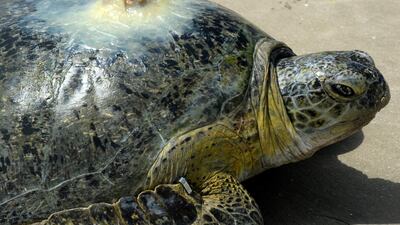
Green turtle (Chelonia mydas) - IUCN status: Endangered - The UAE is one of 140 countries where the green turtle is a native species; numbers have fallen worldwide - Two years ago Emirates Wildlife Society – WWF launched Gulf Green Turtle Conservation. Courtesy Paul Velasco/EWS-WWF -
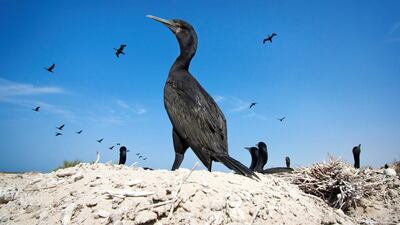
Socotra cormorant (Phalacrocorax nigrogularis) - IUCN status: Vulnerable - Found on islands of the coast of several Gulf states, including the UAE - Threatened by development and oil spills, the species has a total population of less than half a million. Courtesy- Rob Gubiani -
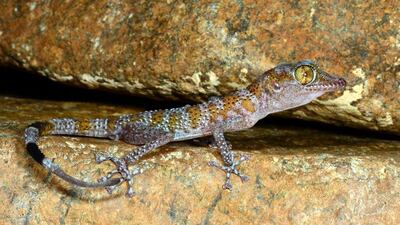
Emirati leaf-toed gecko (Asaccus caudivolvulus) - IUCN status: Least concern - Only found in mountainous regions of north-eastern UAE and northern Oman - More recent research suggests it actually consists of three species, one of which is unique to the UAE – making it the country's only endemic vertebrate – and threatened by development. Photo Courtesy: Johannes Els. -
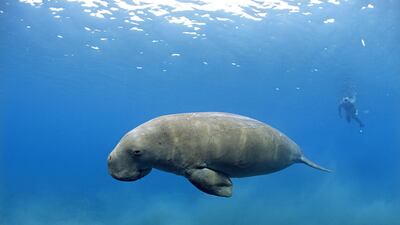
Sea cow (Dugong dugon) - IUCN status: Vulnerable - Locally, boat strikes and fishing net entanglement is a threat, although there are major conservation efforts - The population in UAE waters is thought to be several thousand -
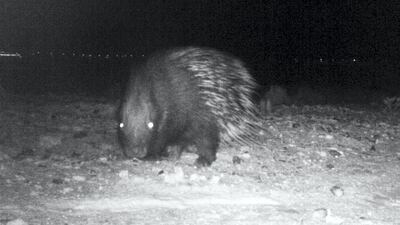
The Crested Porcupine, a rodent thought to be extinct in the UAE, was recorded by camera traps in Abu Dhabi. Environment Agency – Abu Dhabi -
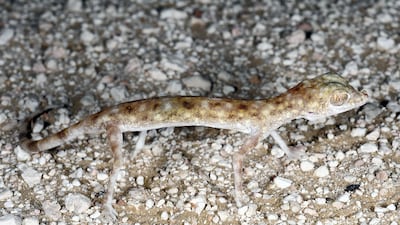
Gulf sand gecko (Pseudoceramodactylus khobarensis) - IUCN status: Least concern - Found widely in the Arabian peninsula, especially in the UAE - This species is not endangered but its population is declining, and in the UAE it faces threats from the development of coastal sabkha habitat. Photo courtesy-Salvador Carranza) -
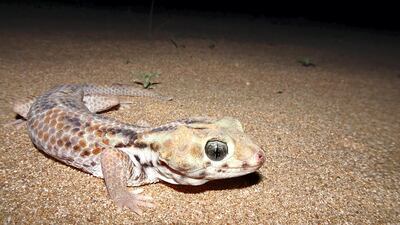
Keyserling's wonder gecko (Teratoscincus keyserlingii) - IUCN status: Not yet evaluated - Although this species is also found in Iran, the UAE population is the only one in Arabia - Heavily threatened by development, it could be driven to extinction locally, although the Mohamed bin Zayed Species. Pritpal Soorae / Environment Agency Abu Dhabi -

Hammerhead shark (Sphyrna mokarran) - IUCN status: Endangered - Widely distributed, but threatened by fishing for its fins and as accidental bycatch - Numbers have plummeted by four-fifths over the last quarter of a century. Image by © Norbert Wu/Science Faction/Corbis -
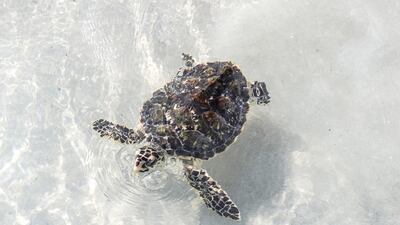
Hawksbill turtles, rated as Critically endangered on the International Union for Conservation of Nature Red List of Threatened Species, have begun laying their eggs on a beach in Dubai. Antonie Robertson / The National -
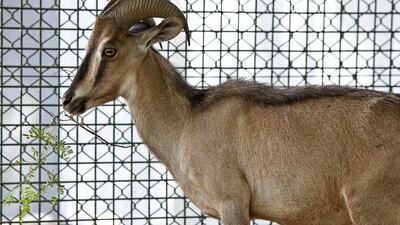
Arabian tahr (Arabitragus jayakari) - IUCN status: Endangered - Restricted to mountainous regions of north-eastern UAE and northern Oman - Worldwide population is probably below 5,000. ANTONIE ROBERTSON / The National -
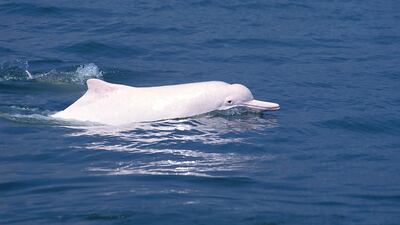
Indian Ocean humpback dolphin (Sousa plumbea) - IUCN status: Endangered - Often become entangled in fishing nets - A recent census found 701 individuals, so the waters off Abu Dhabi have the world's largest single population. Roland Seitre / Minden -
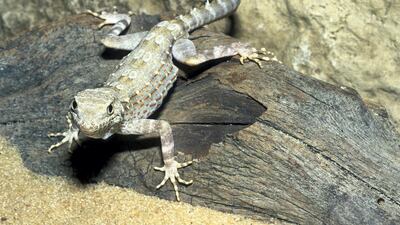
The semaphore gecko is one of several species we have learned a great deal about in recent years. Getty Images -
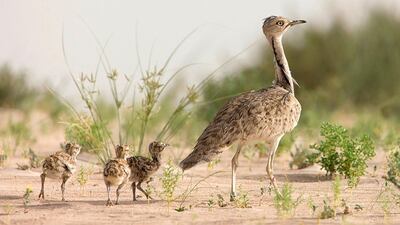
The Houbara bustard is classified as a vulnerable species by the International Union for Conservation of Nature. Courtesy International Fund For Houbara Conservation -
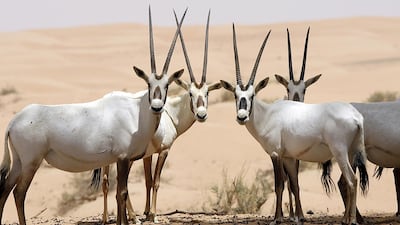
Arabian oryx (Oryx leucoryx) - IUCN status: Vulnerable - Formerly listed as endangered, the UAE's reintroduction programme has helped to increase numbers - The wild population is about 1,200, just over half of which are UAE reintroduced individuals. Mike Young / The National -
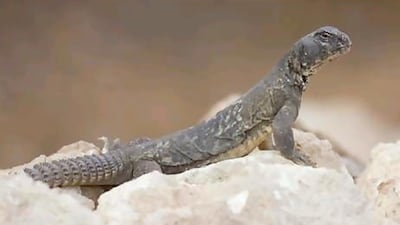
Egyptian spiny-tailed lizard (Uromastyx aegyptia) - IUCN status: Vulnerable - Found in much of the Middle East in gravelly and stony areas, but numbers have declined - Two sub-species exist in the UAE, where it is threatened by habitat loss -
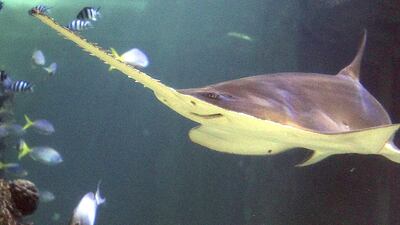
Green sawfish (Pristis zijsron) - IUCN status: Critically endangered - The largest sawfish, it can reach up to seven metres in length - This coastal species has declined across its range and has become extinct from some countries. AP Photo -
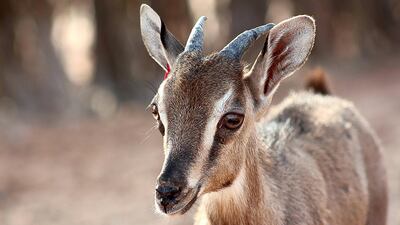
The Arabian tahr has been categorised as an endangered species, with a global population of less than 5,000. Courtesy TDIC -
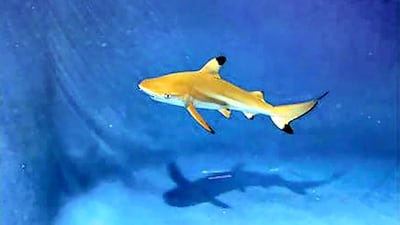
Blacktip reef shark (Carcharhinus melanopterus) - IUCN status: Near threatened - Populations have suffered because of fishing - This species was spotted this year off the UAE's east coast



