

More than eight out of 10 private schools in Abu Dhabi scored the highest rating available during assessments of distance learning standards.
Abu Dhabi Department of Education and Knowledge (Adek), which oversees private schools in the emirate, said 146 out of 173 schools evaluated 984 per cent) earned the top 'developed' rating with 27 private schools rated ‘partially developed’ (16 per cent) and none rated ‘not developed’.
More than two thirds of private schools in Dubai also received the 'developed' rating.
The Knowledge and Human Development Authority (KHDA), Dubai's private schools regulator, revealed 67 per cent of schools were ranked 'developed' under the Distance Learning Evaluation (DLE).
A further 32 per cent of schools received a 'partially developed' score, with only one per cent marked 'not developed'.
“I am proud of the collective efforts of schools, teachers and parents in adapting to a very challenging education environment,” said Sara Musallam, chair of Adek.
“Before the closure of schools, we identified organization, collaboration and inclusion as our three core process metrics, and we worked diligently with parents and partners across the education ecosystem to ensure vital Distance Learning programs could be implemented and the results reflect that.”
KHDA said schools which were rated outstanding or very good by the Dubai Schools Inspection Bureau in the 2018-19 academic year were found to have offered the highest level of distance learning.
Distance learning was implemented across the Emirates in March when schools closed their doors to stem the spread of Covid-19.
Dr Abdulla Al Karam, KHDA's director general, applauded the efforts of teachers, pupils and parents during a challenging period for the education sector.
“Earlier this year, school leaders, teachers, parents and students in Dubai had to respond very quickly to a completely new way of teaching and learning," he said.
-
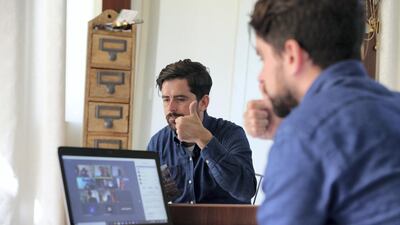
Zack Stewart , Grade 12 teacher at the Dubai American Academy, teaching online class from his home in the Springs in March. Pawan Singh / The National -
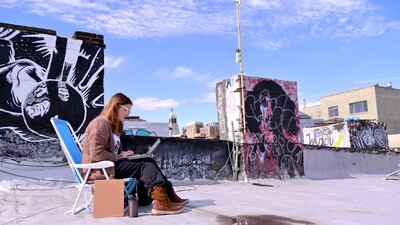
A teacher from Yung Wing School in New York, USA remotely teaches on her laptop from her roof on March 24, 2020 in New York City. Getty Images / AFP -
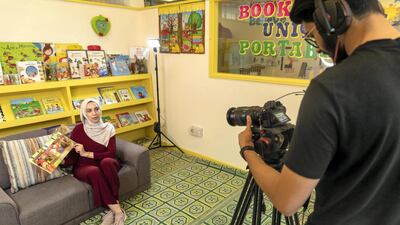
Shorooq Sharaf, a teacher at Chubby Cheeks Nursery in Abu Dhabi, gives an Arabic reading lesson to children at home via video link. Antonie Robertson / The National -
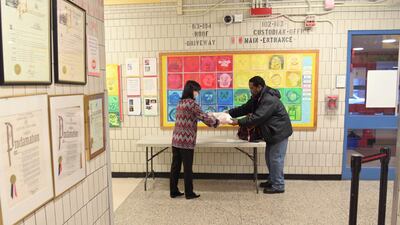
The parent of a student (R) receives one of many laptops being loaned to students in need for remote learning at Yung Wing School in New York City. Getty Images / AFP -
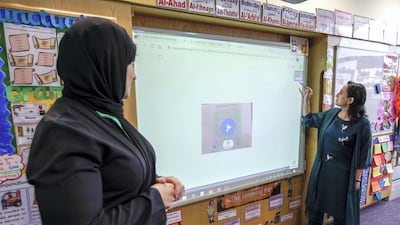
Teacher, Taira Astab during an online lecture at the Al Yasmina Academy in Abu Dhabi, on March 19, 2020. Victor Besa / The National -
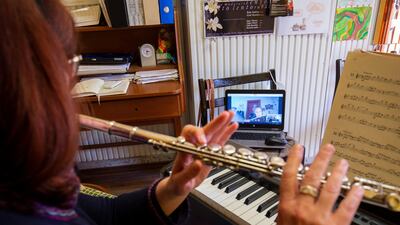
A music school teacher holds a one-to-one online flute lesson in her home in Nagykanizsa, southwestern Hungary, on March 17, 2020. EPA -
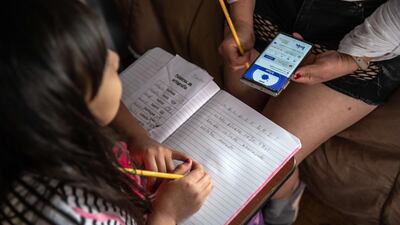
A mother and daughter, 8, from Honduras, study English on March 30, 2020 in Mineola, New York. Getty Images / AFP -
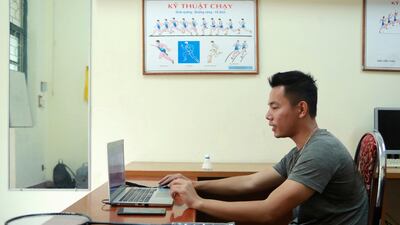
A PE teacher talks with his students during an online class at Nguyen Tat Thanh school in Hanoi, Vietnam, on March 19, 2020. AP -
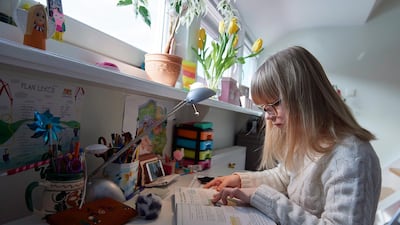
A girl in primary school does her homework, which was received on a digital portal, in her home in Gdansk, Poland, on March 17, 2020. EPA


"They’ve shown great resilience, commitment and love during this period, and we’re grateful for their effort.
“The DLE was put in place to give us a common language and measure to talk about the quality of distance education.
"Because schools will provide options of face-to-face and distance learning in the next academic year, the DLE will help parents to get a complete picture of the quality of education their children are receiving, and will help schools to provide even better quality learning, no matter where it takes place.”
In Sharjah, 70 out of 112 private schools (63 per cent) were rated developed for distance learning, while 42 schools (37 per cent) were partially developed, according to the Sharjah Private Education Authority (SPEA).
“The schools’ distinguished performance enhances the position of education in Sharjah and its flexibility to overcome challenges,' said Dr Muhadditha Al Hashimi, chairman of SPEA.
“We are very proud of schools’ performance and their co-operation and readiness to continue the process of progress; an achievement that is worth preserving by continuing to develop with the assistance of parents as active partners."
More than six in 10 private schools and two in 10 public schools in the Northern Emirates were rated advanced for distance learning by the Ministry of Education.
The ministry assessed all private schools and 29 per cent of government schools in Ajman, Umm Al Quwain, Ras Al Khaimah and Fujairah.
The ministry also ranked schools in three categories, with top performers named 'advanced', ahead of partially developed and underdeveloped schools.
Twenty-two per cent of government schools were rated advanced and 78 per cent were rated partially developed.
According to the results, 62 per cent of private schools were advanced, while 36 percent of schools were graded partially developed, and two per cent were assessed as underdeveloped.
Distance learning evaluations focused on a number of areas; on how well pupils learn and whether their well-being is safeguarded, on the level of teacher's instruction and monitoring of pupils’ learning, and how well school leaders managed pupils’ learning.
A five-hour-long evaluation was carried out with each school through discussions with school leaders, reviews of pupils' work, observation of online lessons, and feedback from parents, pupils and teachers.
The Distance Learning Evaluation is a collaborative initiative between the Ministry of Education, the Abu Dhabi Department of Education and Knowledge, Sharjah Private Education Authority and KHDA.

