
The stand-off between India and China along the Line of Actual Control, as their contested border is known, remains tense. The latest round of talks last week failed to lead to a significant breakthrough, and both sides have amassed thousands of troops with considerable military inventory – including artillery and tanks – along the LAC. October 20, 1962 is the day when a short, but intense war broke out between the Asian giants across the same border. Today, exactly 58 years later, the issue continues to fester.
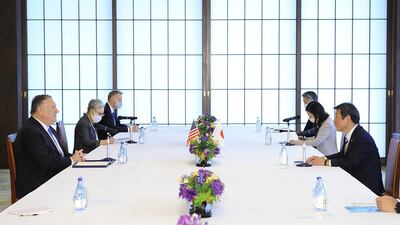
Concurrently, other developments point to a discordant Indo-Pacific, with a grouping that includes Australia, India, Japan and the US – known as the "Quad" – coming to the fore. The countries' foreign ministers met in Tokyo a fortnight ago. The event will have a bearing on the emerging post-Covid-19 Asian and world orders.
At a time when virtual meetings have become the norm, the ministers opted to meet in person. Further, the fact that US Secretary of State Mike Pompeo chose to travel to Japan, even though President Donald Trump had tested positive for Covid-19 a few days earlier, was indicative of the importance Washington attached to the meeting.

The meeting was also remarkable because, despite the perception that the Quad has a single-point anti-China agenda, the ways in which the different participants chose to characterise Beijing varied widely. The US was explicit in referring to the challenge it faces from a rising China. But the other three members made elliptical references to regional affairs: the need to adhere to rules and norms at sea, the urgency for co-operation in re-wiring supply chains and the need to deal with the pandemic and its consequences and cyber security.
Most observers were puzzled by the fact that, India's Foreign Minister Subrahmanyam Jaishankar refrained from raising the issue of the LAC. Perhaps, quiet, high-level talks between Delhi and Beijing are on the cards.
The Tokyo meeting did not result in a joint statement. The four ministers did, however, highlight the areas that they understood to be shared priorities, where collective action or more discussion might be needed. It is a wide spectrum, encompassing the security and strategic domain, economic and trade matters and the public health challenge posed by Covid-19. Australia, meanwhile, will rejoin the trilateral Malabar maritime exercise that includes India, Japan and the US, scheduled to be held next month.
Beijing's response to the Quad meeting was along expected lines. Previously, China had been dismissive about the viability of the Quad, with Foreign Minister Wang Yi referring to it in March 2018 as "the foam on the sea that gets attention but will soon dissipate". It found this most recent Tokyo meeting, however, to be more irksome.
In an interview to the Xinhua news agency on Friday, Mr Wang was sharply critical, describing the Quad as an "Indo-Pacific Nato" and added that “the aim [of the Quad] is to trumpet the old-fashioned Cold War mentality to stir up confrontation among different groups and blocs and to stoke geopolitical competition, in a bid to maintain the dominance and hegemonic system of the US".

Mr Wang also sounded a note of caution for the 10-member Association of South-East Asian Nations (Asean) – five of whose member states he had visited a week ago in order to allay their anxiety about Beijing’s assertiveness. He said the US-led Quad “will undoubtedly damage Asean's centrality and undermine regional peace and stability, contravening the common, long-term interests of regional countries".
While the Quad is yet to evolve into the maritime Nato that makes Beijing uncomfortable, there have been other developments related to the Quad nations that point to a certain pattern of military and maritime co-operation that could lead to a cluster of nations banding together to deal with the China challenge. In a little-noted development late last month, a US maritime reconnaissance P-8 aircraft landed in India’s Andaman and Nicobar Islands for refuelling, as part of an India-US logistics agreement. Separately, the US and its military allies have engaged in multilateral naval exercises in the Indo-Pacific that included Japan and Australia. In other initiatives, intelligence gathering among the nations comprising the Five Eyes – Australia, Canada, New Zealand, UK and US – is acquiring an Indo-Pacific focus.
The Quad remains a work in progress, and the degree to which it acquires muscle and resolve that will pose a tangible challenge to China is opaque. Among the Indo-Pacific nations, many look to the US to assuage their security concerns about Beijing. But they are in a dilemma about the degree to which they can count on American consistency and reliability in the long term, especially given how turbulent Mr Trump's term has been. The outcome of the US presidential election on November 3 will not result in a dramatic change in US-China ties, but they will impact the manner in which Washington deals with both Beijing and its many partners and allies in Asia.

The policy conundrum for the post-pandemic world is stark. Globalisation and the intricate web of trade dependency, supply chains, technological advances and the myriad challenges of an increasingly digitised society have rendered past structures and arrangements redundant. China is set to recover faster than most major nations from the pandemic, and its rise under President Xi Jinping remains relentless. While security considerations may impel a collective anxiety about China, trade and economic compulsions cannot be easily jettisoned. India, Japan and South Korea are among Beijing's top five trading partners. De-linking with China totally is not a viable option.
The 19th Communist Party Congress, which will begin next Monday, October 26, in Beijing, will provide some cues about Mr Xi's policy orientation for the next five years.
When the tragic fallout of Covid-19 is accurately assessed and the pandemic ends, and a bruised world seeks a new strategic framework, Asian geopolitics will be discordant and volatile. Prickly nationalism, alas, is likely to be in the ascendant.
C Uday Bhaskar is director of the New Delhi-based think tank Society for Policy Studies

