• Britain's Prime Minister Boris Johnson (left), US President Donald Trump (centre), German Chancellor Angela Merkel (second right), Turkey's President Recep Tayyip Erdogan (right) and other Nato leaders leave the stage after the family photo to head to the plenary session at the NATO summit at the Grove hotel in Watford. AFP
    Britain's Prime Minister Boris Johnson (left), US President Donald Trump (centre), German Chancellor Angela Merkel (second right), Turkey's President Recep Tayyip Erdogan (right) and other Nato leaders leave the stage after the family photo to head to the plenary session at the NATO summit at the Grove hotel in Watford. AFP
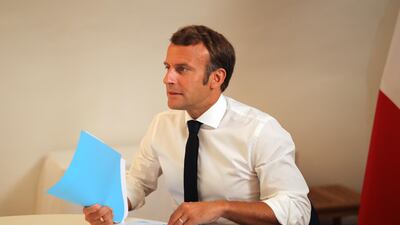
  • Emmanuel Macron, France's president, gestures while speaking during a news conference. Bloomberg
    Emmanuel Macron, France's president, gestures while speaking during a news conference. Bloomberg
  • Britain's Princess Anne, right, talks to Nato delegates from left, Canadian Prime Minister Justin Trudeau and Britain's Prime Minister Boris Johnson. AP
    Britain's Princess Anne, right, talks to Nato delegates from left, Canadian Prime Minister Justin Trudeau and Britain's Prime Minister Boris Johnson. AP
  • US President Donald Trump speaks during a bilateral meeting with Italy's Prime Minister Giuseppe Conte (unseen) at the Nato summit at the Grove hotel in Watford. AFP
    US President Donald Trump speaks during a bilateral meeting with Italy's Prime Minister Giuseppe Conte (unseen) at the Nato summit at the Grove hotel in Watford. AFP
  • Donald Trump and Italian Prime Minister Giuseppe Conte meet on the sidelines of the Nato summit in Watford. Reuters
    Donald Trump and Italian Prime Minister Giuseppe Conte meet on the sidelines of the Nato summit in Watford. Reuters
  • France's President Emmanuel Macron (right) greets Poland's President Andrzej Duda (left) during a meeting at the Nato summit at the Grove hotel in Watford. AFP
    France's President Emmanuel Macron (right) greets Poland's President Andrzej Duda (left) during a meeting at the Nato summit at the Grove hotel in Watford. AFP
  • France's President Emmanuel Macron gives a press conference. AFP
    France's President Emmanuel Macron gives a press conference. AFP
  • US President Donald Trump speaks during a bilateral meeting with Italy's Prime Minister Giuseppe Conte. AFP
    US President Donald Trump speaks during a bilateral meeting with Italy's Prime Minister Giuseppe Conte. AFP

What is Nato good for?


  • English
  • Arabic

if Nato didn’t already exist, would it be necessary to invent it today?

Several factors make this a timely question. The first, involving as it does Donald Trump, has provoked fits of the vapours in the usual quarters. According to a new book, the US President's former chief of staff, retired marine general John Kelly, said that "one of the most difficult tasks he faced with Trump was trying to stop him from pulling out of Nato". Even if Mr Trump doesn't officially do so – either before the presidential election or after, if he wins – there is speculation that he could effectively destroy Nato by reinterpreting Article 5 of Nato's founding treaty.

This has always been deemed to mean that an attack on one member would be followed by collective, armed self-defence. But the wording is not strict. In such circumstances, each member is bound to take "such action as it deems necessary, including the use of armed force". But as Thomas Wright of the Brookings Institution told The New York Times: "He could just reinterpret it as, 'I could just send a strongly worded letter'."

This may have partisans of the Atlantic alliance wringing their hands, but in a period when Nato members Turkey and Greece have exchanged threats of war over disputed gas resources in the Mediterranean – and may escalate further – instant invocation of armed collective action would be impossible. Nato could not come to the defence of both sides, after all.

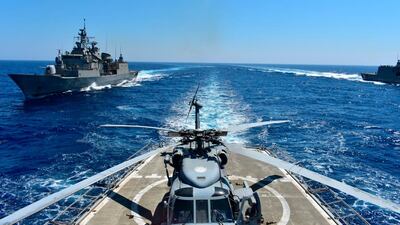
  • Greek warships take part in military exercises in Eastern Mediterranean sea, as tensions rise with Turkey over the waters. Greek Defense Ministry/AP
    Greek warships take part in military exercises in Eastern Mediterranean sea, as tensions rise with Turkey over the waters. Greek Defense Ministry/AP
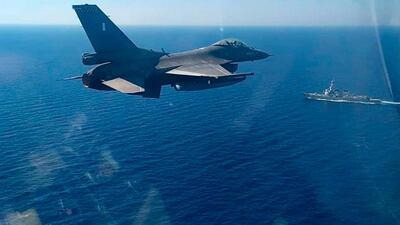
  • The Greek air force joined the exercises. Greek Defense Ministry/AP
    The Greek air force joined the exercises. Greek Defense Ministry/AP
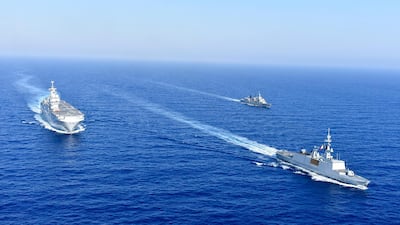
  • The Tonnerre is escorted by Greek and French military vessels. Greek National Defence/AP)
    The Tonnerre is escorted by Greek and French military vessels. Greek National Defence/AP)
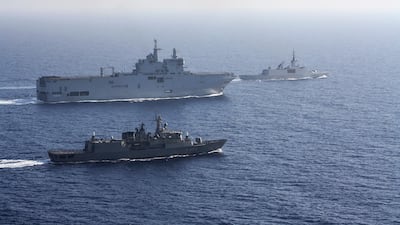
  • The French Tonnerre helicopter carrier, rear left, is escorted by Greek and French military vessels during a maritime exercise in the Eastern Mediterranean, where Greek and Turkish warships are also closely shadowing each other. (Greek National Defence/AP)
    The French Tonnerre helicopter carrier, rear left, is escorted by Greek and French military vessels during a maritime exercise in the Eastern Mediterranean, where Greek and Turkish warships are also closely shadowing each other. (Greek National Defence/AP)
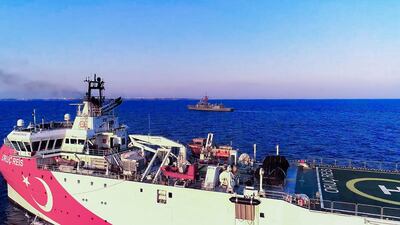
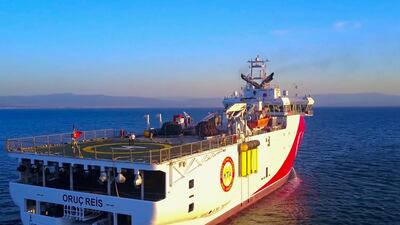
  • The Turkish seismic research vessel 'Oruc Reis' heading west of Antalya in the Mediterranean Sea. Turkish Defence Ministry/AFP
    The Turkish seismic research vessel 'Oruc Reis' heading west of Antalya in the Mediterranean Sea. Turkish Defence Ministry/AFP
  • Tension are high between Greece and Turkey, over the 'Oruc-Reis' and its mission in the eastern Mediterranean. IHA via AP
    Tension are high between Greece and Turkey, over the 'Oruc-Reis' and its mission in the eastern Mediterranean. IHA via AP
  • Turkey’s claims to the waters, which it says are on its continental shelf, have repeatedly been dismissed as illegal by Greece and its allies. Turkish Defence Ministry/AFP
    Turkey’s claims to the waters, which it says are on its continental shelf, have repeatedly been dismissed as illegal by Greece and its allies. Turkish Defence Ministry/AFP
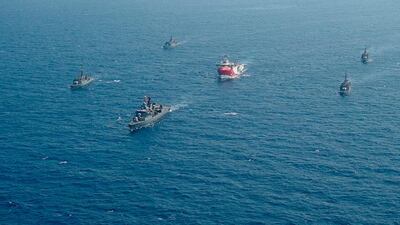
  • Turkish ships accompany the 'Oruc Reis,' a seismic research vessel. Turkish Defence Ministry/AFP
    Turkish ships accompany the 'Oruc Reis,' a seismic research vessel. Turkish Defence Ministry/AFP
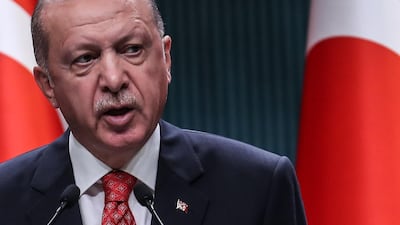
  • Turkish President Recep Tayyip Erdogan has called for dialogue while still pushing ahead with a Mediterranean gas development plan that has outraged Greece. AFP
    Turkish President Recep Tayyip Erdogan has called for dialogue while still pushing ahead with a Mediterranean gas development plan that has outraged Greece. AFP
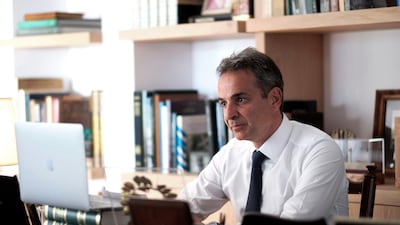
  • Greek Prime Minister Kyriakos Mitsotakis warned of the potential for a mishap with Greek and Turkish navies both in the area.. EPA
    Greek Prime Minister Kyriakos Mitsotakis warned of the potential for a mishap with Greek and Turkish navies both in the area.. EPA
  • France will strengthen its military presence in the eastern Mediterranean. Reuters
    France will strengthen its military presence in the eastern Mediterranean. Reuters

Further, Nato has expanded so egregiously in recent decades that there is uncertainty that Article 5 is the same cast-iron guarantee that it was during the Cold War. Would all parties go to war for North Macedonia, or over an "accidental" Russian border incursion into Estonia?

Mr Trump is not alone in asking what Nato is for these days. He is echoed by French President Emmanuel Macron, who last November declared that the organisation was "brain dead". Mr Macron also queried whether Article 5 would still trigger a collective response.

This not only a matter for the 30 members of the alliance. For Nato has long been looking east. It established Global Partnerships with South Korea, New Zealand, Mongolia, Australia and Japan in the first half of the last decade, and is now focusing increasingly on China. Other voices are urging the “Quad” of the US, Japan, Australia and India to become the basis of an “Indo-Pacific Nato”, as the US Deputy Secretary of State Stephen Biegun put it at the end of last month.

If Nato is to have a larger presence and an enhanced role in East Asia, or is to be joined by a regional version, the question still remains: what is its purpose?

One answer to that is that it is an alliance of democracies. Mr Biegun alluded to that in his remarks, saying that the Trump administration’s “Indo-Pacific strategy is focused around democracies”. Nato’s London Declaration issued last December also states in the second sentence that the organisation “guarantees… the values we share, including democracy, individual liberty, human rights, and the rule of law”.

As a core raison d'etre of the alliance this is problematic, however. Firstly because one of Nato's current challenges is that a number of members – including Hungary, Poland and Turkey – remain democracies but are deemed to have taken a markedly illiberal or even authoritarian turn. Secondly, as the US academics James Goldgeier and Garret Martin pointed out in a recent article, being a democracy during the Cold War was not a pre-condition of membership: "Portugal did not become a democracy until 1974. As for Greece and Turkey, the former was governed by a military dictatorship from 1967 to 1974, while the latter was the subject of multiple military-led coups."

President Macron’s pointed questions remain the key ones. “Who is our common enemy?” he said. “This question deserves to be clarified. Is our enemy today, as I hear sometimes, Russia? Is it China? Is it the Atlantic alliance’s purpose to designate them as enemies? I don’t think so.”

It is worth asking whether Nato today should consider Vladimir Putin's Russia or Xi Jinping's China as enemies or as partners against a common threat. AP Photo

I agree with Mr Macron, but there are plenty of Nato boosters who don’t. For instance Ian Brzezinski, a senior defence official under former US president George W Bush, proposes setting up a Nato-China Council, which sounds promising. He then writes, though, that “its establishment would underscore that this dimension of great power competition is not between China and the United States but between China and the transatlantic community".

The London Declaration similarly oscillates between sounding conciliatory – “Nato is a defensive Alliance and poses no threat to any country” – and more bellicose, declaring that “Russia’s aggressive actions constitute a threat to Euro-Atlantic security” and that “China’s growing influence and international policies present both opportunities and challenges that we need to address together as an alliance".

Nato leaders at the highest level have agreed to assemble the 19-nation armada during the Covid-19 outbreak. AFP

The truth is that for all the airy talk of “the values we share”, what bound Nato together during the Cold War was standing up to the Soviet Union. It is a security alliance; it is not and cannot be an alliance of liberal democracies (otherwise several members would have to be expelled and others in Asia would not want to join). For it to be strong, perhaps it does need a common enemy; but that is not an argument for choosing one that makes confrontation more likely.

Better, perhaps, for Nato to expand to become a global security umbrella and agree with Mr Macron when he said that our common enemy is “terrorism, which has hit all of our countries".

This would be a much scaled-down, less ambitious Nato. It would be a shadow of the military alliance that once kept the West safe – no disadvantage in the Covid-19-straitened present. But with Russia and China inside it, or at least as strong partners, it would be a better one for our times. And it would be a Nato that could adequately answer the question: “what is it for?”

Sholto Byrnes is an East Asian affairs columnist for The National

Mercer, the investment consulting arm of US services company Marsh & McLennan, expects its wealth division to at least double its assets under management (AUM) in the Middle East as wealth in the region continues to grow despite economic headwinds, a company official said.

Mercer Wealth, which globally has $160 billion in AUM, plans to boost its AUM in the region to $2-$3bn in the next 2-3 years from the present $1bn, said Yasir AbuShaban, a Dubai-based principal with Mercer Wealth.

Within the next two to three years, we are looking at reaching $2 to $3 billion as a conservative estimate and we do see an opportunity to do so,” said Mr AbuShaban.

Mercer does not directly make investments, but allocates clients’ money they have discretion to, to professional asset managers. They also provide advice to clients.

“We have buying power. We can negotiate on their (client’s) behalf with asset managers to provide them lower fees than they otherwise would have to get on their own,” he added.

Mercer Wealth’s clients include sovereign wealth funds, family offices, and insurance companies among others.

From its office in Dubai, Mercer also looks after Africa, India and Turkey, where they also see opportunity for growth.

Wealth creation in Middle East and Africa (MEA) grew 8.5 per cent to $8.1 trillion last year from $7.5tn in 2015, higher than last year’s global average of 6 per cent and the second-highest growth in a region after Asia-Pacific which grew 9.9 per cent, according to consultancy Boston Consulting Group (BCG). In the region, where wealth grew just 1.9 per cent in 2015 compared with 2014, a pickup in oil prices has helped in wealth generation.

BCG is forecasting MEA wealth will rise to $12tn by 2021, growing at an annual average of 8 per cent.

Drivers of wealth generation in the region will be split evenly between new wealth creation and growth of performance of existing assets, according to BCG.

Another general trend in the region is clients’ looking for a comprehensive approach to investing, according to Mr AbuShaban.

“Institutional investors or some of the families are seeing a slowdown in the available capital they have to invest and in that sense they are looking at optimizing the way they manage their portfolios and making sure they are not investing haphazardly and different parts of their investment are working together,” said Mr AbuShaban.

Some clients also have a higher appetite for risk, given the low interest-rate environment that does not provide enough yield for some institutional investors. These clients are keen to invest in illiquid assets, such as private equity and infrastructure.

“What we have seen is a desire for higher returns in what has been a low-return environment specifically in various fixed income or bonds,” he said.

“In this environment, we have seen a de facto increase in the risk that clients are taking in things like illiquid investments, private equity investments, infrastructure and private debt, those kind of investments were higher illiquidity results in incrementally higher returns.”

The Abu Dhabi Investment Authority, one of the largest sovereign wealth funds, said in its 2016 report that has gradually increased its exposure in direct private equity and private credit transactions, mainly in Asian markets and especially in China and India. The authority’s private equity department focused on structured equities owing to “their defensive characteristics.”

The%20Roundup
%3Cp%3EDirector%3A%20Lee%20Sang-yong%3Cbr%3EStars%3A%20Ma%20Dong-seok%2C%20Sukku%20Son%2C%20Choi%20Gwi-hwa%3Cbr%3ERating%3A%204%2F5%3C%2Fp%3E%0A
Gulf Under 19s final

Dubai College A 50-12 Dubai College B

The%20specs%3A%202024%20Mercedes%20E200
%3Cp%3E%3Cstrong%3EEngine%3A%20%3C%2Fstrong%3E2.0-litre%20four-cyl%20turbo%20%2B%20mild%20hybrid%0D%3Cbr%3E%3Cstrong%3EPower%3A%20%3C%2Fstrong%3E204hp%20at%205%2C800rpm%20%2B23hp%20hybrid%20boost%0D%3Cbr%3E%3Cstrong%3ETorque%3A%20%3C%2Fstrong%3E320Nm%20at%201%2C800rpm%20%2B205Nm%20hybrid%20boost%0D%3Cbr%3E%3Cstrong%3ETransmission%3A%20%3C%2Fstrong%3E9-speed%20auto%0D%3Cbr%3E%3Cstrong%3EFuel%20consumption%3A%20%3C%2Fstrong%3E7.3L%2F100km%0D%3Cbr%3E%3Cstrong%3EOn%20sale%3A%20%3C%2Fstrong%3ENovember%2FDecember%0D%3Cbr%3E%3Cstrong%3EPrice%3A%20%3C%2Fstrong%3EFrom%20Dh205%2C000%20(estimate)%3C%2Fp%3E%0A
Jetour T1 specs

Engine: 2-litre turbocharged

Power: 254hp

Torque: 390Nm

Price: From Dh126,000

Available: Now

Masters%20of%20the%20Air
%3Cp%3E%3Cstrong%3EDirectors%3A%3C%2Fstrong%3E%20Cary%20Joji%20Fukunaga%2C%20Dee%20Rees%2C%20Anna%20Boden%2C%20Ryan%20Fleck%2C%20Tim%20Van%20Patten%3C%2Fp%3E%0A%3Cp%3E%3Cstrong%3EStarring%3A%3C%2Fstrong%3E%20Austin%20Butler%2C%20Callum%20Turner%2C%20Anthony%20Boyle%2C%20Barry%20Keoghan%2C%20Sawyer%20Spielberg%3C%2Fp%3E%0A%3Cp%3E%3Cstrong%3ERating%3A%3C%2Fstrong%3E%202%2F5%3C%2Fp%3E%0A