
Kuwait should reduce its expat population to 30 per cent from the current 70 per cent, Prime Minister Sheikh Sabah Al Khalid Al Sabah said, amid the coronavirus pandemic and a slump in oil prices.
Foreigners account for nearly 3.4 million of Kuwait’s 4.8 million people, and that’s a “big imbalance, and we have a future challenge to redress this imbalance,” Sheikh Sabah told the top editors of local newspapers.
Despite running one of the Gulf’s smallest crisis stimulus packages, top lender National Bank of Kuwait predicts the country’s shortfall will reach 40 per cent of gross domestic product in the fiscal year that started on April 1, the most since the 1991 Gulf War and its aftermath.
In his comments, the prime minister emphasised the need for Kuwait to diversify its economy away from its 90 per cent dependence on oil.
He also said two dozen companies had been referred to public prosecutors based on information they broke laws by trading in residency permits, a practice that illegally brings overseas workers into the country and transfers them between employers.
“We are responsible for everyone who lives on this land and the residency trade has exhausted the state and the services in all institutions, especially when dealing with the current situation,” he said.
Coronavirus in Kuwait - in pictures
-
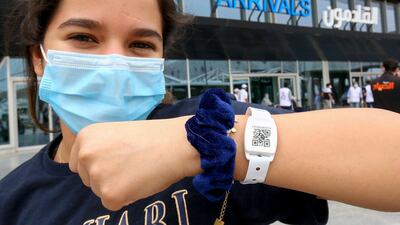
A Kuwaiti national, residing abroad, shows the tracking bracelet provided by authorities as she leaves at the Kuwait International airport in the capital upon her return as part of a repatriation plan on April 19, 2020, and ahead of being taken to mandatory home quarantine. AFP -
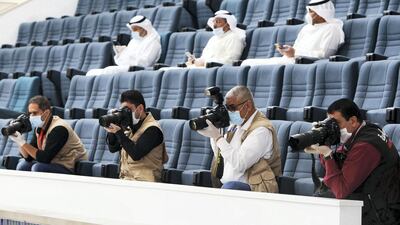
Press photographers wearing protictive masks attend a parliament session at Kuwait's national assembly in Kuwait City on March 24, 2020. AFP -
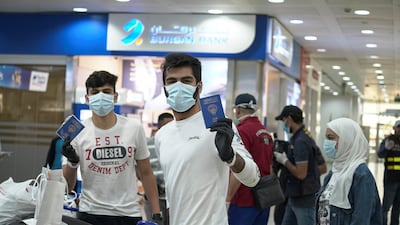
Kuwaiti boys wearing protective face masks and quarantine tracking bracelets, following the outbreak of the coronavirus disease (COVID-19), pose for the camera as they hold up their passports upon arrival from Amman, to Kuwait Airport in Kuwait, Kuwait April 21, 2020. REUTERS -
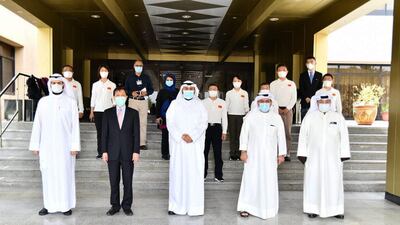
Hand out photo released by KUNA on April 28, 2020, shows Kuwait's Health Minister Sheikh Basil al-Sabah (C), as he receives members of a Chinese health delegation visiting Kuwait to exchange experiences on strategies, plans, and procedures to contain COVID-19 coronavirus disease. AFP -
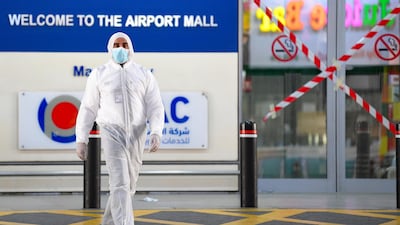
An airport staff member wearing Personal Protective Equipment (PPE) stands at entrance of the Kuwait International Airport, in Kuwait city, Kuwait, 25 April 2020, during the coronavirus disease (COVID-19) pandemic. Kuwait is repatriating its citizens from abroad, the country's national aviation authority announced. EPA -
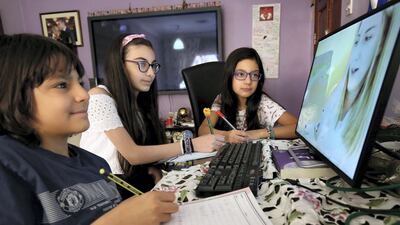
Children continue their school curriculum online via a computer screen at their home in Kuwait City on March 23, 2020. AFP -
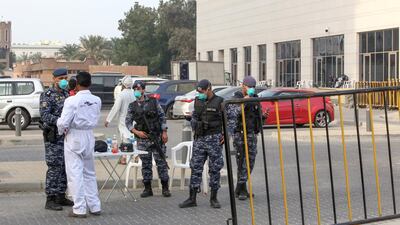
Members of Kuwait's national guard wearing safety masks keep watch outside a hotel in the capital where Kuwaitis returning from Iran are quarantined and tested for coronavirus COVID-19, on February 24, 2020. Kuwait confirmed three cases who tested positive for coronavirus, a 53-year-old Kuwaiti man, a 61-year-old Saudi citizen, and a 21-year-old stateless Arab (Bidoon), after returning from Iran's holy city of Mashhad. AFP -
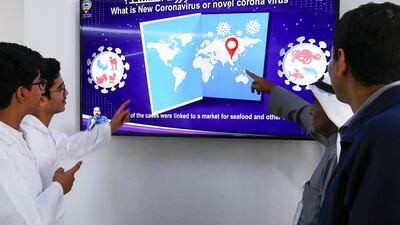
Students watch an instructional video on Coronavirus infection at a school in Kuwait City on February 10, 2020. AFP -
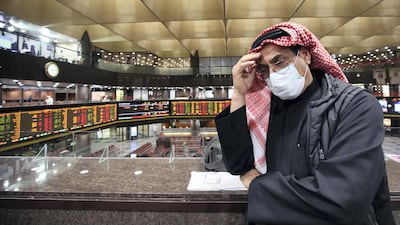
A Kuwaiti trader wearing a protective mask follows the market at the Boursa Kuwait stock exchange in Kuwait City on March 1, 2020. Boursa Kuwait decided to close the main trading hall due to the COVID-19 coronavirus disease developments. Stock markets in the oil-rich Gulf states plunged on March 1 over fears of the impact of the coronavirus, which also battered global bourses last week. All of the seven exchanges in the Gulf Cooperation Council (GCC), which were closed the previous two days for the Muslim weekend, were hit as oil prices dropped below $50 a barrel. The region's slide was led by Kuwait Boursa, where the All-Share Index fell 10 percent, triggering its closure. Kuwait's bourse was closed for most of last week for national holidays. AFP -

Expatriate returning from Egypt, Syria, and Lebanon arrive to be re-tested at a Kuwaiti health ministry containment and screening zone for COVID-19 coronavirus disease in Kuwait City on March 16, 2020. AFP -
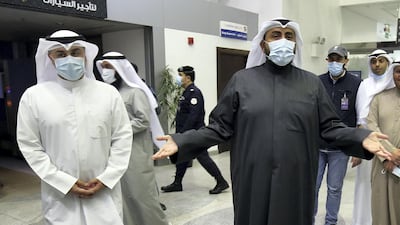
Kuwaiti health minister Sheikh Basel al-Sabah (R) speaks to the press at Sheikh Saad Airport in Kuwait City, on February 22, 2020, as Kuwaitis returning from Iran wait before being taken to a hospital to be tested for coronavirus. - Iran ordered the closure of schools, universities and cultural centres after a coronavirus outbreak that has killed five people in the Islamic republic, the most outside the Far East. AFP -
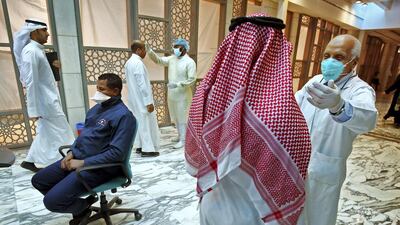
Kuwaiti health ministry workers scan employees and visitors of the ministries complex, as they arrive to their work, in Kuwait City on March 4, 2020. AFP -

Muslim men wearing protective masks perform Friday prayers at a mosque in Kuwait City on February 28, 2020. - Kuwait's Ministry of Awqaf and Islamic Affairs set the Friday prayer sermon to not exceed 10 minutes, and to discuss precautions against COVID-19 coronavirus disease infections. Kuwait has recorded 43 coronavirus cases since its outbreak, the United Arab Emirates reported 13, while Bahrain has 33, and Oman is at four cases. Government institutions in the gulf country suspended the use of fingerprint recognition to clock in and out. AFP


Sheikh Sabah's comments follow a renewed push by members of parliament to reduce the number of overseas workers, particularly unskilled labour. They are proposing a quota system in addition to replacing expat government employees, estimated at 100,000, with Kuwaitis.
Parliamentary elections are scheduled for later this year, and anti-expat rhetoric is attractive to some voters, especially when it concerns well-paid government jobs. At the end of 2019, only 19 per cent of the Kuwaiti workforce was in the private sector.
Foreigners have accounted for the majority of Kuwait’s virus cases as the disease spread among migrant workers living in crowded labour camps.
While Kuwait eased its 24-hour lockdown on Sunday, some areas remain under isolation in a bid to stem the outbreak.
Kuwait’s Ministry of Health announced 562 new cases of Covid-19 on Thursday, bringing the number of infections in the country to 29,921.
Six new deaths brought the death toll to 236.
So far, 17,223 people have recovered from the infection.
Coronavirus around the region - in pictures
-

A closed souvenir shop in front of the treasury site in the ancient city of Petra is seen empty of tourists after the government closed all tourist facilities in the country amid concerns over the spread of the coronavirus in Jordan. Reuters -

A mask-clad worker walks near a mural depicting Dubai Ruler Sheikh Mohammed bin Rashid riding a horse as a jockey, along Al Mustaqbal Street in Dubai. AFP -

Iraqi Karate-coach Asif Mohamed (right) gives a Karate lesson to a young man it his house in Baghdad, Iraq. All training centers for Karate are closed in Baghdad. EPA -

The ancient city of Petra is seen empty of tourists after the government closed all tourist facilities in Jordan. Reuters -

A mask-glad young anti-government protester faces members of the security forces during a demonstration in the southern Iraqi city of Basra, despite the ongoing threat of the coronavirus. AFP -
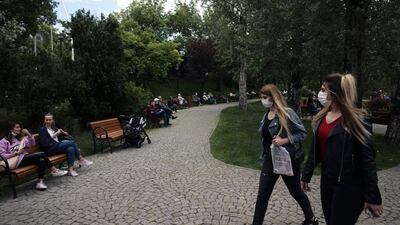
People visit Kugulu public garden, in Ankara, Turkey days after the government lifted a series of restrictions. AP Photo -
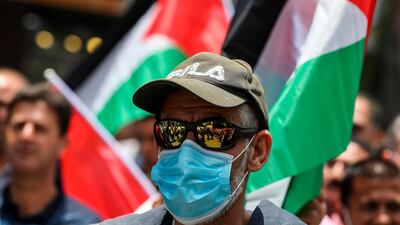
A demonstrator clad in sunglasses and mask looks on during a protest against Israeli plans to annex parts of the occupied West Bank, in the West Bank city of Nablus. AFP -
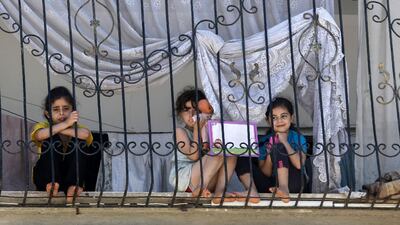
Young Palestinian girls sit at the window sill in Gaza City amid the coronavirus pandemic crisis. AFP -

Young Palestinians play at the seashore in Gaza City amid the coronavirus pandemic. AFP -

A mask-clad Palestinian boy takes part in the noon (Dhuhr) prayers along with other worshippers, at mosque in Gaza City. AFP -
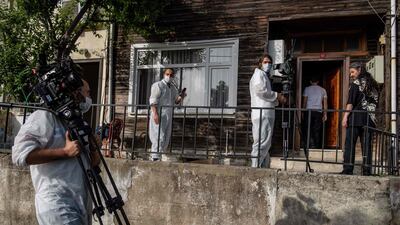
Members of the Tutunamayanlar's team (The Outcasts) and Turkish actor Dogu Demirkol prepare to record an episode, in Beykoz, in the outskirts of Istanbul. Turkey is known for its obsession with TV dramas -- which are also a massive export success -- and not even the coronavirus restrictions stopped the team on Tutunamayanlar (The Outcasts) from keeping the show going. AFP -

A woman sewing colourful bedouin-styled face masks, at the city of El-Arish the capital of Egypt's North Sinai province, to be sold online to customers as part of coronavirus prevention. AFP -

Colourful bedouin-styled face masks made by women members of the association, at the city of El Arish the capital of Egypt's North Sinai province, to be sold online to customers as part of coronavirus prevention. AFP -

A man who is in contact with people who have contracted the coronavirus wears a protective face mask as he receives through iron bars the free medicines provided by the ministry of health, at a medical centre in Cairo, Egypt. Reuters -

A street vendor wearing a mask sells roses in Sidon, Lebanon. Reuters -

A shoe polisher and his son wait for customers on Hamra Street, Beirut, Lebanon. EPA -

A Yemeni volunteer wearing a protective suit sprays disinfectant at a neighborhood amid the ongoing coronavirus pandemic in Sanaa, Yemen. EPA -

An Iranian man walks in front of a pastry shop in the capital Tehran. AFP



