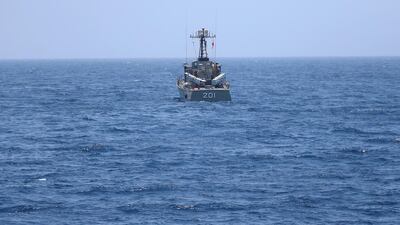

Iran's announcement that it is planning to build a permanent base in the Indian Ocean demonstrates that, for all the setbacks Tehran has suffered as a result of the coronavirus pandemic and US-led sanctions, it has lost none of its appetite for expanding its military operations.
One of the founding pillars of the Iranian revolution in 1979 was the requirement to disseminate its own brand of radical Islam throughout the Muslim world, to the extent that its Islamic Revolutionary Guard Corps (IRGC) has now established a truly global network of bases, ranging from Latin America to South-East Asia.
In the Middle East, Iran’s commitment to consolidating its military presence abroad has seen the IRGC extending its influence in Lebanon, Syria, Iraq and Yemen, a move that has put Tehran on a collision course with the Trump administration, which regards this expansionism as a threat to its interests in the region and those of its allies.
-
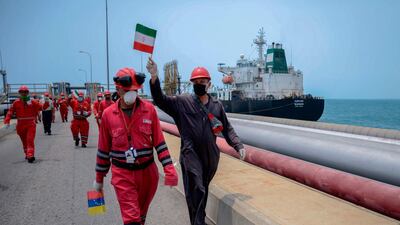
A worker of the Venezuelan state oil company PDVSA waves an Iranian flag as the Iranian-flagged oil tanker Fortune docks at the El Palito refinery in Puerto Cabello, in the northern state of Carabobo, Venezuela. AFP -
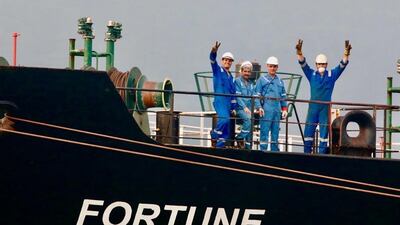
Workers on the 'Fortune' the Iranian ship with gasoline in Puerto Cabello, Venezuela. EPA -
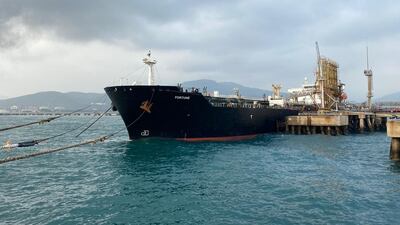
Iranian-flagged oil tanker Fortune docked at the El Palito refinery after its arrival to Puerto Cabello, in the northern state of Carabobo, Venezuela. AFP -

A worker of the state-oil company Pdvsa holds an Iranian flag during the arrival of the Iranian tanker ship "Fortune" at El Palito refinery in Puerto Cabello, Venezuela. Reuters -
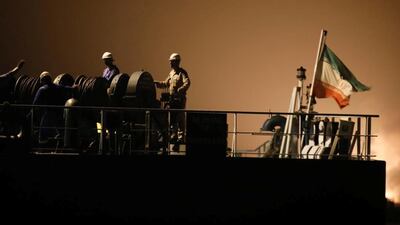
Crew of the Iranian tanker ship "Fortune" are seen at the deck during the arrival at El Palito refinery in Puerto Cabello, Venezuela. Reuters -
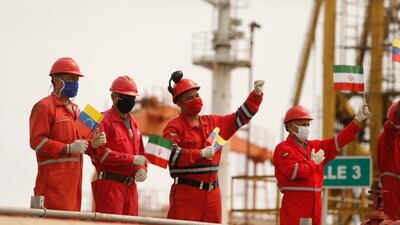
Workers of the state-oil company Pdvsa holding Iranian and Venezuelan flags greet during the arrival of the Iranian tanker ship "Fortune" at El Palito refinery in Puerto Cabello, Venezuela. Reuters -
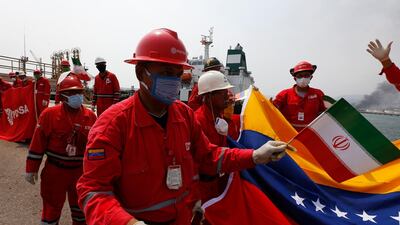
A Venezuelan oil worker holding a small Iranian flag attends a ceremony for the arrival of Iranian oil tanker Fortune at the El Palito refinery near Puerto Cabello, Venezuela. AP Photo -
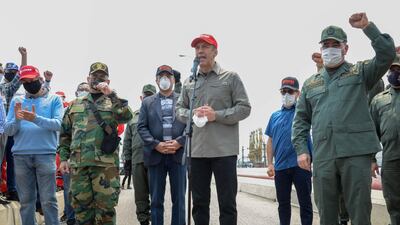
The Venezuelan industry minister Tareck El Aissami (C), speaks next to Venezuela's defence Minister Vladimir Padrino(R) after the Iranian oil tanker Fortune docked at the El Palito refinery in Puerto Cabello, in the northern state of Carabobo, Venezuela. AFP -

A worker of the Venezuelan state oil company PDVSA looks at the oil tanker Fortune as it docks at the El Palito refinery in Puerto Cabello in the northern state of Carabobo, Venezuela. AFP -
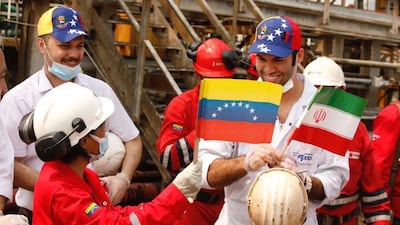
Workers with the flags of Venezuela and Iran waiting for Venezuela Minister of Petroleum Tareck el Aissami in Puerto Cabello, Venezuela during his visit to the 'Fortune' Iranian ship. EPA -
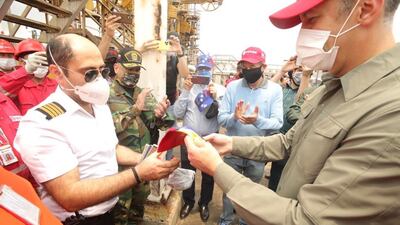
Venezuela Minister of Petroleum Tareck el Aissami in Puerto Cabello, Venezuela during his visit to the 'Fortune' Iranian ship. EPA


So this week's report by Iran's Fars news agency about an Indian Ocean base by the end of the year is likely to further exacerbate tensions with the US, which conducts regular naval operations in the area as part of its long-standing commitment to protect freedom of passage for Gulf shipping, especially through the bustling shipping lanes of the Strait of Hormuz.
Making the announcement, Admiral Alireza Tangsiri, the commander of the IRGC’s naval attachment, said that the base will be used to protect fishing and commercial vessels from piracy and “foreign ships”, a reference to the US-led multinational naval task force. “The deployment of the fleet by the IRGC navy to distant waters has been done in the past, and our second fleet was also sent to the waters of the Indian Ocean,” he said.
Iran has so far given no indication of where it intends to build the base. At present Iran's Chabahar Port in the Gulf of Oman – which is used, among other activities, for shipping goods to Afghanistan – is the nearest base Tehran has to the Indian Ocean, although attempts to develop it into a major import-export terminal with India's assistance have been hampered by US sanctions.
-
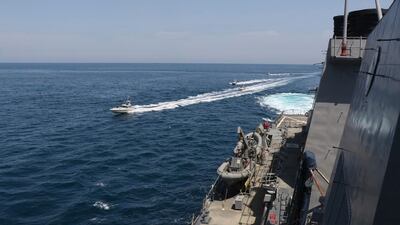
In this Wednesday, April 15, 2020, photo made available by the US Navy, Iranian Revolutionary Guard vessels sail close to US ships in the Arabian Gulf near Kuwait. All Photos supplied by US Navy -
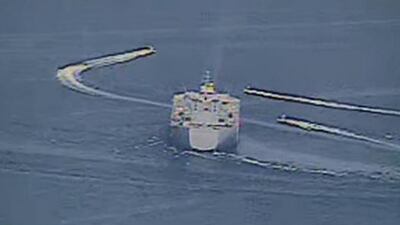
The Iranian vessels conducted unsafe and unprofessional actions, the US Navy said. -
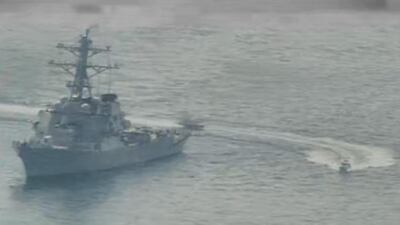
The US Navy said the IRGC vessels crossed the ships’ bows and sterns at close range. -
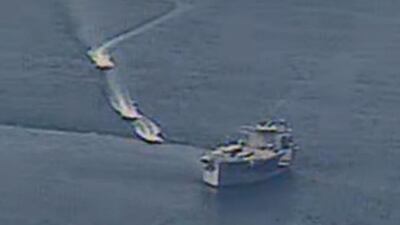
Iranian Revolutionary Guard Corps Navy vessels approach the USS Lewis B Puller in the northern waters of the Arabian Gulf. -
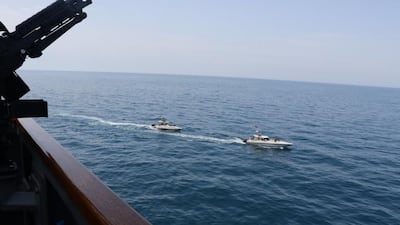
The US Navy said that the US crew took action "deemed appropriate to avoid collision”. -
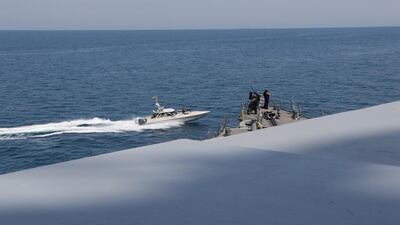
The Revolutionary Guard was blamed after a Hong Kong-flagged ship was boarded in the Gulf of Oman on Tuesday.


The announcement comes against a background of increasing tensions between Iran and the US and its allies in recent months. Iran has been accused of conducting attacks on Gulf shipping, including targeting commercial vessels operating in UAE waters. Last summer, Iranian naval forces seized the British-registered Stena Impero, prompting a furious backlash from the British government.
In April, US President Donald Trump announced on Twitter that he had authorised the US Navy in the region to attack any Iranian boats that approached American military assets after US commanders accused Iran of harassing their ships.
The warning provoked a fierce reaction from Maj Gen Hossein Salami, the head of the IRGC, who threatened a “crushing response” to any American attacks against Iran. Accusing the Trump administration of “bullying”, he warned: “I have ordered our naval forces to destroy any American terrorist force in the Persian Gulf that threatens the security of Iran’s military or non-military ships.”
Iran's continued commitment to expanding its military activities comes at a time when the regime is contending with the twin challenges of combating the pandemic and the impact of US sanctions on the Iranian economy.
It has been the worst-affected country in the Middle East by Covid-19, not least because the regime has been accused of trying to cover up the true extent of the outbreak when the virus was first identified in the country.
Moreover, the economy has suffered a precipitous decline. The rial, the national currency, has suffered sharp declines. Inflation and unemployment are both registering in double figures. Attempts by the European Union to find a financial mechanism for continuing to trade with Tehran have failed to make any material difference to Iran’s plight because too many European multinationals remain concerned that, if they maintain their trading ties with Tehran, they could find themselves subjected to punitive measures by Washington, and denied access to the far more lucrative American market.
-
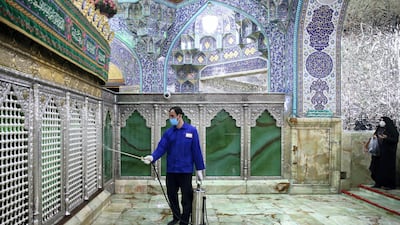
An Iranian sanitary worker disinfects Qom's Masumeh shrine on February 25, 2020 to prevent the spread of the coronavirus. AFP -
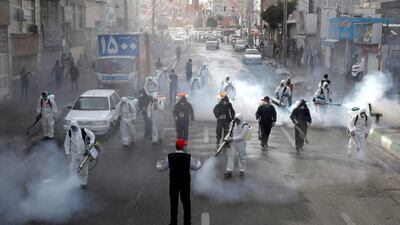
Iranian Firefighters disinfect streets in the capital Tehran in a bid to halt the wild spread of coronavirus on March 13, 2020. AFP -
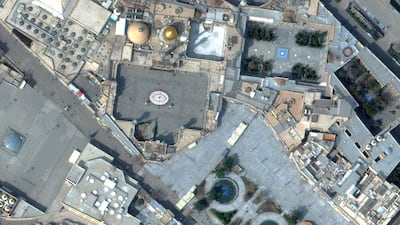
A nearly empty Hazrat Masumeh Shrine in Qom, Iran on March 1, 2020. AFP -
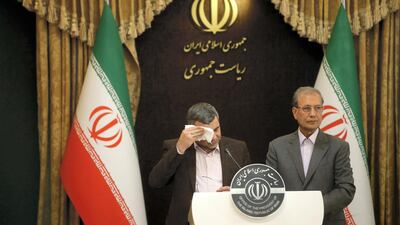
Iranian Deputy Health Minister Iraj Harirchi (left) wipes the sweat off his face, during a press conference with the Islamic republic's government spokesman Ali Rabiei in the capital Tehran on February 24, 2020. AFP -

An image grab of footage obtained from Iranian State TV IRINN on February 25, 2020, shows Iran's deputy health minister Iraj Harirchi speaking in a video apparently shot by himself, regarding being infected with coronavirus. AFP -
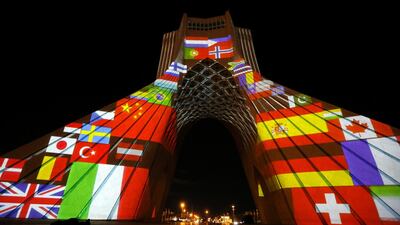
Iran's Azadi (Freedom) Tower is lit up with flags and messages of hope in solidarity with all the countries affected by the coronavirus pandemic, in Tehran on March 31, 2020. AFP -

Iranian workers set up a makeshift hospital inside the Iran Mall, northwest of Tehran, on March 21, 2020 amid the coronavirus outbreak. - Iran said that 123 more people had died from coronavirus, raising the official death toll to 1,556 in the Islamic republic, one of the world's worst affected countries. AFP -
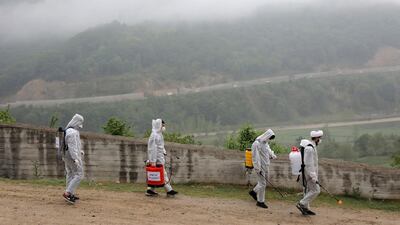
Volunteers wearing protective clothing, take part in disinfecting a village during the coronavirus outbreak, in the outskirts of the city of Ghaemshahr, in north of Iran, on Wednesday, April 29, 2020. AP Photo -
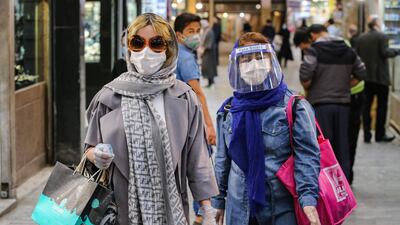
Shoppers clad in protective gear, including face masks and shields and latex gloves, due to the coronavirus pandemic, walk through the Tajrish Bazaar in Iran's capital Tehran on April 25, 2020. AFP -

A customer wears a protective masks at a pharmacy in the Iranian capital Tehran on February 24, 2020. AFP -

A Tehran Municipality worker cleans a bus to avoid the spread of Covid-19 on February 26, 2020. AFP -
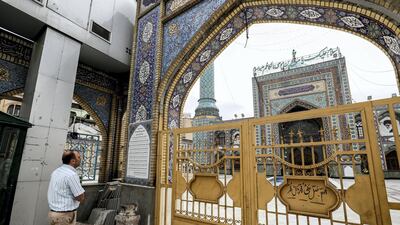
A man stands by the closed gate outside the Imamzadeh Saleh in the Iranian capital Tehran's Shemiran district on April 25, 2020 . AFP -

Labourers unloading medical equipment and coronavirus testing kits provided by the World Health Organisation, from a UAE military transport plane upon their arrival at Mehrabad International Airport in Iran's capital Tehran. AFP


Yet, to judge by the recent activity Iran has taken on the military front, the regime’s domestic woes have not prevented it from maintaining an ambitious military programme.
Iran has long considered America's heavy military presence in the Middle East a threat to its own security. In response to Washington's unilateral withdrawal from the nuclear deal, Iran is reported to have resumed work on its uranium enrichment activities, and in April Tehran announced it had launched its first satellite into orbit. In addition the IRGC says work is continuing on developing its arsenal of ballistic missiles.
US security officials warn that Iran’s base plans need to be seen in the context of its wider military build-up. There are concerns that this could have an impact on the jointly administered US-UK base on the island of Diego Garcia, one of the Pentagon’s most important military assets in the region.
At the height of the tensions over the Trump administration’s assassination of IRGC commander Qassem Suleimani in January, the Pentagon dispatched a fleet of B-52 nuclear-armed bombers to Deigo Garcia, which is well beyond the range of Iran’s existing arsenal of ballistic missiles.
By establishing its own base in the Indian Ocean, therefore, Tehran would be hoping to mount yet another challenge to Washington’s military dominance in the region.
Con Coughlin is the Telegraph’s defence and foreign affairs editor

