
The videos showed men stripped down to their underwear, forced to run across a stream in the freezing winter. Another image was of a man naked from the waist up, his back bruised, red lines marking where his torturer’s blows fell.
These were not images of survivors who had somehow escaped Syrian President Bashar Al Assad's dungeons. They were of refugees who had attempted to cross over to safety in Europe from Turkey. They were met with the batons and inhumanity of the Greek border guards, at the frontlines of fortress Europe, now closed forever to the destitute.
It was only the latest in the series of moral failures of the European Union’s leaders, whose actions have laid bare the rot at the core of the institution – one that is supposed to hold together Europe’s post-Second World War order, but is plunged into panic at the possibility of a few thousand non-white people seeking shelter there from war and poverty.
-

A migrant speaks to a Greek policeman during minor clashes at the port of Mytilene after locals block access to the Moria refugee camp, on the northeastern Aegean island of Lesbos, Greece. AP Photo -

Migrants travel on a horse carriage near the Turkey's Pazarkule border crossing with Greece's Kastanies, near Edirne, Turkey. REUTERS -
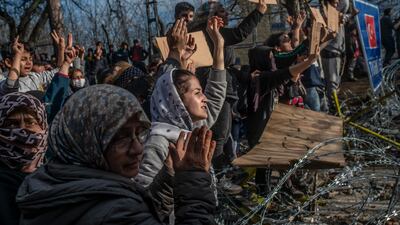
Migrants hold placards as they demonstrate, waiting at the buffer zone in front of the Pazarkule border crossing to Greece, in Edirne. AFP -

An aerial view shows refugees on road at Turkey's Pazarkule border crossing with Greece's Kastanies, southwest of Edirne. REUTERS -
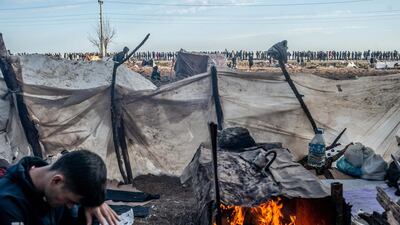
A migrant sits next to a bonfire as others wait for a food distribution in front of the Pazarkule border crossing to Greece, in Edirne. AFP -
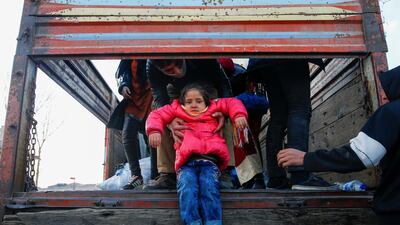
A migrant child is passed from a truck near the Turkey's Pazarkule border crossing with Greece's Kastanies, near Edirne, Turkey. REUTERS -
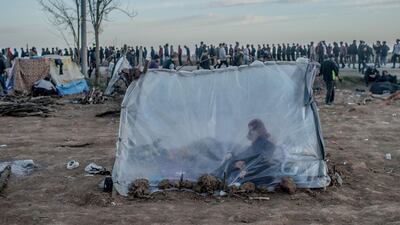
A Syrian woman sits in a tent with her son as others wait for food distribution in front of the Pazarkule border crossing to Greece, in Edirne. AFP -
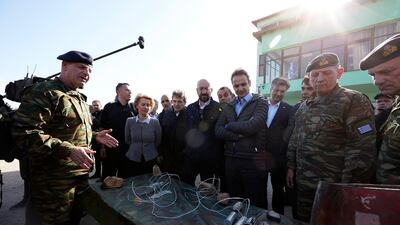
Greek Prime Minister Kyriakos Mitsotakis (4-R) with European Council President Charles Michel (C), European Commission President Ursula von der Leyen (3-L), European Parliament President David Sassoli (2-L) and Croatian Prime Minister Andrej Plenkovic (3-R) during a visit at the Greek-Turkish border in northern Greece. EPA -
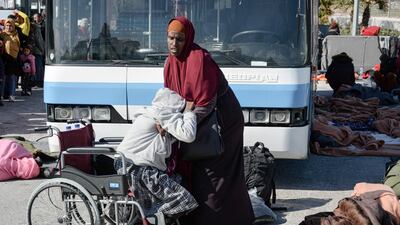
An elderly migrant woman is helped out of a wheelchair at the port of Mytilene on the northeastern Aegean island of Lesbos, Greece. AP Photo -
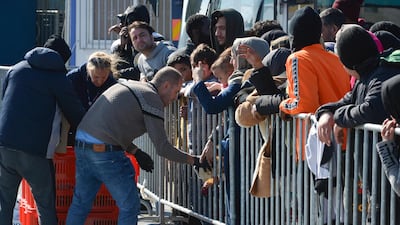
Migrants wait in line for food and water distribution at the port of Mytilene on the northeastern Aegean island of Lesbos, Greece. AP Photo -

Greek police in riot gear advance to push migrants away after minor clashes at the port of Mytilene on the northeastern Aegean island of Lesbos, Greece. AP Photo -

Greek police in riot gear stand before minor clashes with migrants at the port of Mytilene on the northeastern Aegean island of Lesbos, Greece. AP Photo


The immediate cause of this latest crisis was an announcement by Turkey that it would open its western borders and would no longer actively prevent refugees and migrants from attempting to cross over into Europe. Turkey already hosts close to four million Syrian refugees, and a ground offensive by the Assad regime and Russia in the border province of Idlib had driven a million people to seek shelter near the Turkish border. The issue of refugees is a lightning rod in Turkey, where a majority wants them to leave.
Ankara decided to intervene militarily to check Mr Al Assad's advance, while also pressuring western allies to support its campaign. For years, the Turkish government had prevented refugees from boarding flimsy rubber boats for the short ride to Greece, under the terms of an agreement that essentially established Turkey as Europe's border guard in exchange for money, and those who crossed the border illegally were forcibly returned to Turkey. The deal was a crude transaction; the Syrian people being its currency. The government in Ankara decided the deal was dead.
The agreement itself is a violation of international conventions that compel countries to accept asylum applications at the port of entry. While Ankara sought to politically exploit refugees, dehumanising them in the process, the ploy has exposed Europe's hypocrisy. While it continues to espouse human rights and international law, the EU has continued to outsource the dirty work of locking up migrants and refugees with the aim of keeping them off its shores. This is not just in Turkey, but also in Libya, where callous tactics to halt migration have empowered a modern-day slave trade. The sheer brutality of the latest response simply shone the light again on the hypocrisy.
The EU stood silent as the violence in Idlib unfolded over the past three months, barely concerning itself with even mild rebukes as hundreds of thousands of people were forced to flee their homes. But when Turkey said it was opening its borders, emergency meetings were called and officials began grappling with the question of halting the violence in Syria, the root cause of the refugee crisis.
-
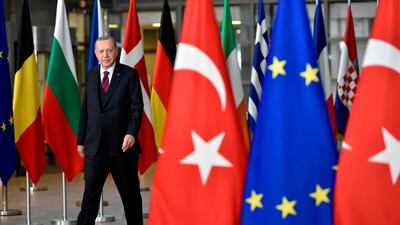
Turkish President Erdogan arrives before a meeting with European Commission President and EU Council President at the EU headquarters in Brussels. AFP -
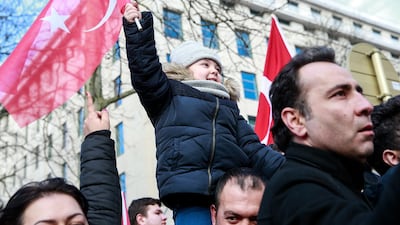
People from Turkish communities welcome Turkish President Erdogan ahead of a meeting and a press conference with NATO Secretary General Jens Stoltenberg in Brussels. EPA -
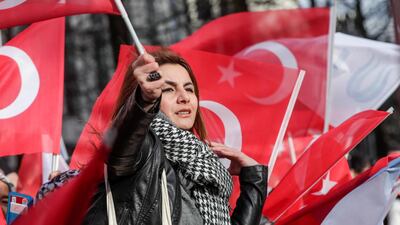
A member of a Turkish community welcomes Turkish President Erdogan ahead of a meeting and a press conference with NATO Secretary General Jens Stoltenberg in Brussels. EPA -

Turkish President Erdogan, center right, walks with European Council President Charles Michel, left, prior to a meeting at the European Council building in Brussels. AP -
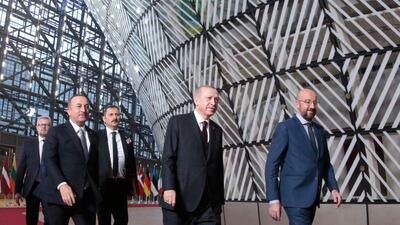
EU Council President Charles Michel (R) with Turkish President Erdogan (C) and Turkish Foreign Minister Mevlut Cavusoglu (L) attend their meeting at the European Council in Brussels. EPA -
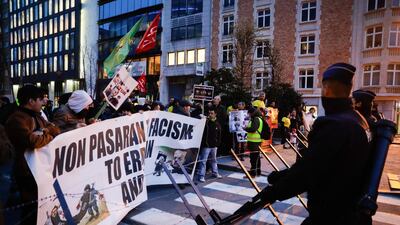
People gather to demonstrate against the arrival of Turkish President Erdogan in Brussels, Belgium. EPA -
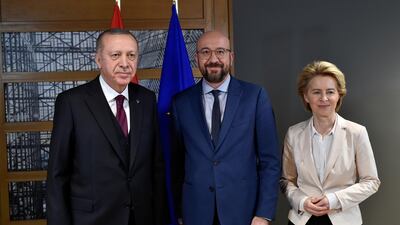
EU Council President Charles Michel (C) and European Commission President Ursula von der Leyen (R) pose with Turkish President Erdogan (L) before their meeting in Brussels. Reuters -
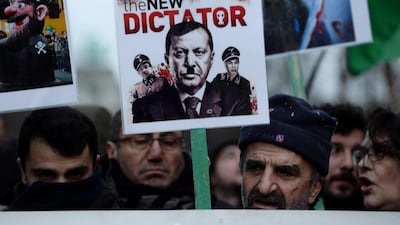
A protester holds a banner depicting Turkish President Erdogan during a demonstration against a visit of the president in Brussels. Reuters -
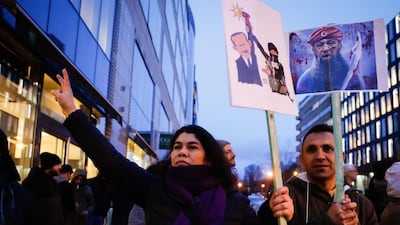
People gather to demonstrate against the arrival of Turkish President Erdogan in Brussels. EPA -
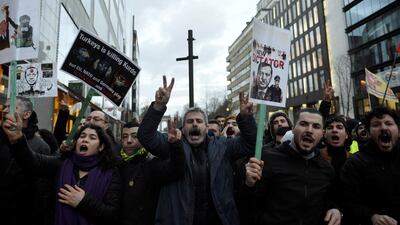
Protesters demonstrate against a visit of Turkey's President Erdogan in Brussels. Reuters -

Turkish President Erdogan addresses his supporters in Brussels, Belgium. Reuters


The EU's failures on Syria are myriad. The continent's security and intelligence services exacerbated the crisis by turning a blind eye towards the thousands of their citizens who left to fight in Syria and Iraq with ISIS, apparently hoping that they would die in a distant battlefield, and with them the problem of homegrown extremists in marginalised communities. Then, when the battle against ISIS was concluded, they largely decided to shirk the responsibility for the mess created by their citizens, leaving Arabs and Kurds in Syria and Iraq to deal with Europe's unwanted radicalised citizens.
Instead of trying to address the root cause of the refugee crisis, which is the violence inflicted by the Assad regime on its own citizens, and in the course of it standing up for enlightenment values like human rights and fundamental freedoms, the EU stood by in silence, paralysed by its fears and anxieties, which were exploited to the fullest by Moscow and Ankara. They wrested concessions from Europe, warning them that any critique of their policies or authoritarianism would be followed with a deluge of refugees and/or terrorists.
Brussels instead could have played a key role in pushing for a peace settlement, leveraging the lifting of sanctions and the provision of reconstruction funds to push the Syrian regime into making concessions for reform. Collective action to enforce a no-fly zone and create safe areas inside Syria, which Ankara proved in its recent campaign that it can be done, would have eliminated the need for the flight of so many millions of people. An orderly asylum process that helped Turkey, Lebanon and other neighbouring countries in sharing the economic burden of the refugee crisis would have allowed Europe to revive its stagnant economies with a fresh influx of labour and capital and would have been the right thing to do.
Instead, the Greek border guard is torturing freezing refugees, who gave up all they have for a chance at life. Europe has decided that international law and the idea of treating humans with decency and dignity are concepts that no longer apply to it.
Kareem Shaheen is a former Middle East correspondent based in Canada

