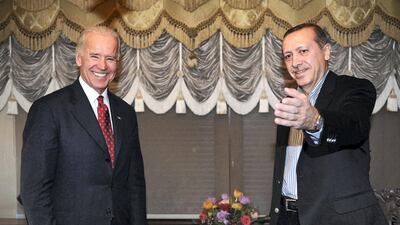

Suddenly the space for action for President Recep Tayyip Erdogan has shrunk dramatically.
Just a month ago the leading think tank, European Council on Foreign Relations, was bemoaning the lack of cards in the bloc's hand to play against the Turkish leader. The Europeans stand frustrated and apparently impotent in front of his expansionist power projects both at sea in the Mediterranean and conflict zones from Libya to Nagorno-Karabakh.
Why then is Mr Erdogan appearing to give ground?
His shake-up of his economic team this week was an uncharacteristic concession. Mr Erdogan engineered the exit of his son-in-law Berat Albayrak as finance and treasury minister. The Turkish President has also promised to shake up his country's institutions and enact judicial reforms.
It all suggests a reopening after a grim tailspin went into overdrive following the failed coup attempt in 2016.
-
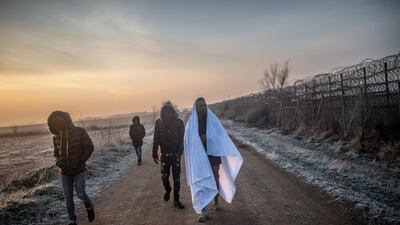
Migrants walk towards the Greek border in Pazarkule, in the Edirne district. Thousands of migrants stuck on the Turkey-Greece border clashed with Greek police. AFP -

Children sit on a beach near Skala Sykamineas on the Greek Lesbos island after crossing the Aegean sea between Turkey and Greece. AFP -
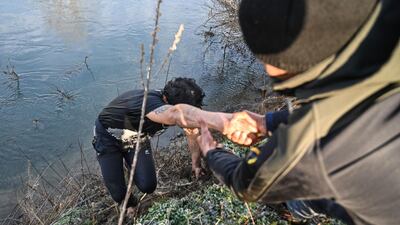
Migrants help each other after an attempt to enter Greece from a location near Edirne, Turkey, by crossing the Maritsa river. AFP -
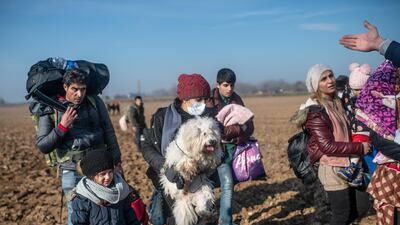
Migrants walk towards the Greek border in Pazarkule, in the Edirne district. AFP -

Migrants on a dinghy cross the Evros river to reach Greece, pictured from the Turkish border city of Edirne, Turkey. Reuters -
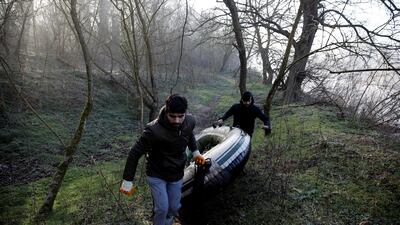
Migrants carry a dinghy to cross the Evros river to reach Greece, pictured near the Turkish border city of Edirne, Turkey. Reuters -
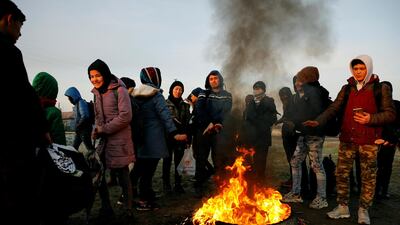
Migrants gather around a fire as they wait to cross the Evros river to reach Greece, near Doyran Village, near the Turkish border city of Edirne, Turkey. Reuters -
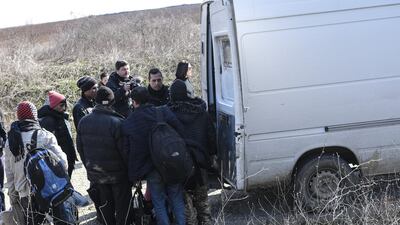
A group of migrants are detained after being caught by police on the side of the highway near the Greek-Turkish border. Getty Images -
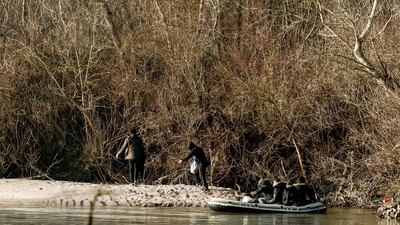
Migrants on a dinghy cross the Evros river and reach Greece, pictured from the Turkish border city of Edirne, Turkey. Reuters -
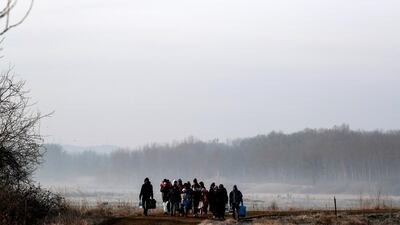
Migrants walk along the Evros river to reach Greece, near the Turkish border city of Edirne, Turkey. Reuters -

Migrants sit waiting near the buffer zone at Turkey-Greece border, at Pazarkule, in Edirne district. AFP -
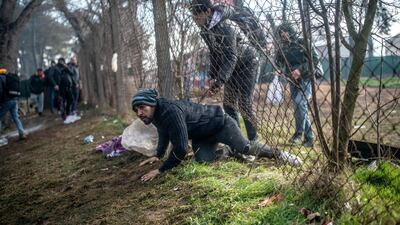
A migrant passes to the buffer zone during clashes with Greek police at the Turkey-Greece border, at Pazarkule, in Edirne distric. Thousands of migrants stuck on the Turkey-Greece border clashed with Greek police. AFP -
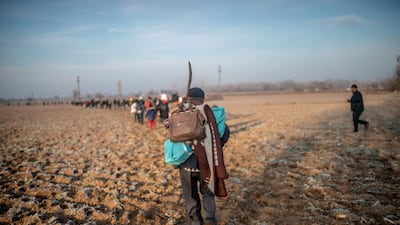
A migrant walk towards the Greek border in Pazarkule, in the Edirne district. AFP


There have been signs of a welcome for his moves. The lira has rallied on the removal of an economy tsar who dogmatically insisted that reduced interest rates were the path to low inflation. Tongues are wagging in Ankara and Istanbul that Mr Erdogan is shifting to accommodate the new pressures that the incoming US administration of Joe Biden will bring. The fragility of the economy robs Mr Erdogan of a narrative to present to a Democratic administration at a time when internal record of his leadership will be far more closely scrutinised.
It would be folly for Mr Biden’s team to fall for this window-dressing as a real platform for partnership. The Erdogan that Mr Biden is now dealing with has shed much of his political skin since the Democrats were last in power almost four years ago.
The assumption that the new administration can go back to the relationship – and the actors it worked with – before is not really on the cards. The Erdogan agenda is here to stay, makeover or not.
Even this week Mr Erdogan was pursuing his efforts to weaken the Europeans. This is a key policy that grants him the scope to meddle beyond Turkish borders in traditional stomping grounds of the Middle East, North Africa and the Caucuses.
He visited Northern Cyprus to push his "two-state, one-island" plan for the island. This is a direct confrontation with European interests and has firmed up the continent's pressure to promulgate sanctions on Ankara.
The Turkish exploration activity around Cyprus and in Greek waters is steadily weakening Nato. A clash earlier this year between a Turkish vessel and a French Corvette led to a complaint to the alliance. But the inquiry was never satisfactorily resolved.
-
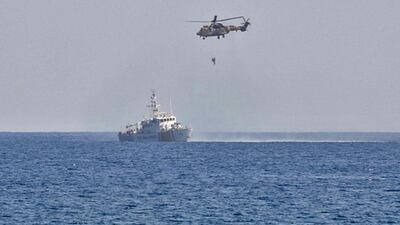
A soldier hangs from a helicopter during a military exercise in the self-proclaimed Turkish Republic of Northern Cyprus. AFP -

Turkey's research vessel, Oruc Reis, center, is surrounded by Turkish navy vessels as it was heading in the west of Antalya on the Mediterranean, Turkey. AP -
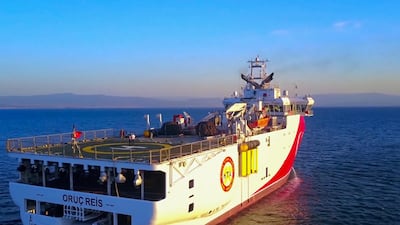
Turkish seismic research vessel 'Oruc Reis' heads in the west of Antalya on the Mediterranean Sea.AFP -

A Turkish Navy warship patroling next to Turkey's drilling ship "Fatih" dispatched towards the eastern Mediterranean near Cyprus. AFP -
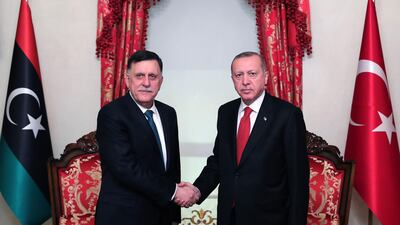
Turkish President Recep Tayyip Erdogan shakes hands with Fayez al-Sarraj, the head of the Tripoli-based Government of National Accord , during their meeting in Istanbul. Turkey signed a military deal late on November 27, 2019, with Libya's UN-recognised government following a meeting with Turkish President in Istanbul, his office said. AFP


In a note last week the Washington think tank, Centre for Strategic and International Studies, identified the Eastern Mediterranean as potential flash point for the Biden administration. To maintain Nato’s effectiveness and readiness in its “southern flank” will be a top priority for Washington as it seeks to shore up US global leadership.
Mr Erdogan's positioning is therefore a complicating factor for the US. Turkey has an opportunistic and symbiotic relationship with Russia that CSIS points out undermines policies based on reducing or eliminating threats in the Nato allies' sphere of influence.
The Turkish leader not so long ago declared that French President Emmanuel Macron "needed mental treatment". As European countries including France increasingly appreciate the threat to their social and political systems posed by Islamist extremism, Mr Erdogan has found himself on the wrong side of the dividing line.
In Germany, the Netherlands and Austria, the Diyanet – Turkey's directorate of religious affairs, which is directly controlled by the presidency – is increasingly seen as a hostile presence among the local community. Its role in controlling religious institutions is the primary reason that there are proposals for training or licensing imams across Europe to ensure a common standard and as a bulwark against extremism.
From a European vantage point, it remains essential to get Turkish relations right. The great wave of migration westwards in 2015 was a demonstration of how bad things can get when that relationship is overwhelmed.
The Europeans are also keen to find a role in the power balance that plays out between the US and China – and the White House and the Kremlin for that matter – once President-elect Biden formally assumes office.
With his instinct of these equations honed over 18 years at the helm of the Turkish state, Mr Erdogan no doubt wants to establish a first mover advantage.
The Obama administration, in which Mr Biden was vice president, was favourable to him in many ways. It reduced sanctions on Iran that allowed Ankara to enjoy a lucrative trading and financial relationship with Tehran. Officials had a benign attitude to the Muslim Brotherhood as Mr Erdogan came to the fore under that umbrella.
The troubles that follow from Mr Erdogan’s policies, as these play out in the Middle East and Europe, cannot be as easily ignored this time round. Not only will the administration acknowledge the Abrahamic Accords but it will seek stability and rebuilding in Libya, and perhaps even Syria, in a way that will not be compatible with Turkish interests.
As Mr Biden rebuilds America's relations with Europe and necessarily shores up Nato’s southern flank, he will find Turkey's place in that alliance an increasingly uncomfortable problem.
Damien McElroy is the London bureau chief of The National

