Lebanese diplomat Mustapha Adib was appointed prime minister in crisis-hit Lebanon on Monday after winning the backing of major political parties.
President Michel Aoun asked Lebanon’s ambassador to Germany Mr Adib to form a new government after he secured 90 votes in the 128-member Parliament.
Mr Adib, 48, was born in the northern city of Tripoli and is a Sunni Muslim, making him eligible to become prime minister under Lebanon's sectarian-based power-sharing system.
Iin his first comments after securing the appointment, he said his first priority was to form a government that would be able to implement reforms to regain the trust of the Lebanese and international community.
The consultations were being held hours before French President Emmanuel Macron was due to arrive for a two day-visit, during which he is expected to press Lebanese officials to formulate a new political pact to lift the country out of its economic crisis.
-
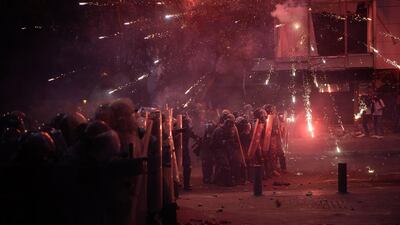
Fireworks thrown at riot police by anti-government protesters explode during clashes near the parliament building following last Tuesday's massive explosion in the seaport which devastated Beirut, Lebanon. AP Photo -
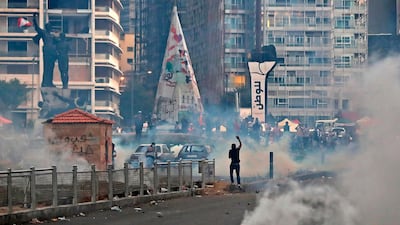
Lebanese protesters, enraged by a deadly explosion, clash with security forces at Martyrs' Square in Beirut. Lebanon's Prime Minister Hassan Diab stepped down amid fury within and outside his government over the deadly Beirut port blast he blamed on the incompetence and corruption of a decades-old ruling class. AFP -
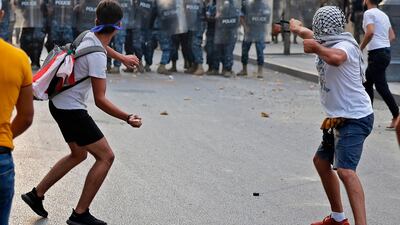
Lebanese protesters, enraged by a deadly explosion, hurl stones at security forces amid clashes in central Beirut. Lebanon's Prime Minister Hassan Diab stepped down amid fury within and outside his government over the deadly Beirut port blast he blamed on the incompetence and corruption of a decades-old ruling class. AFP -
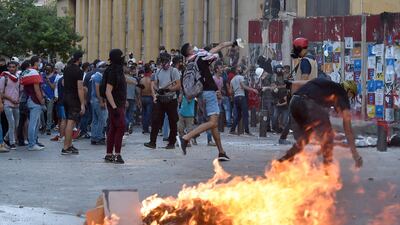
Lebanese anti-government protesters throw stones at security forces at one of the roads leading to the parliament building in Beirut, Lebanon. EPA -
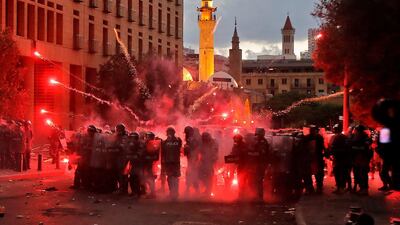
Lebanese security forces clash with protesters near the parliament building in central Beirut following a huge chemical explosion that devastated large parts of the Lebanese capital. AFP -
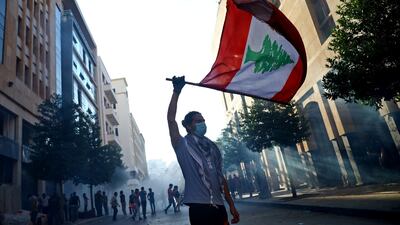
A demonstrator waves a Lebanese flag during anti-government protests that have been ignited by a massive explosion in Beirut, Lebanon. Reuters -
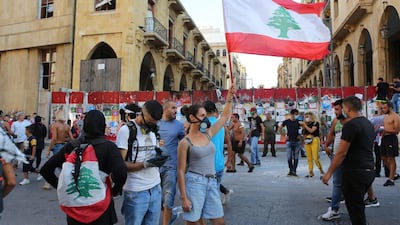
Protesters wave a Lebanese flag during demonstrations near the parliament building in Beirut, Lebanon. EPA -
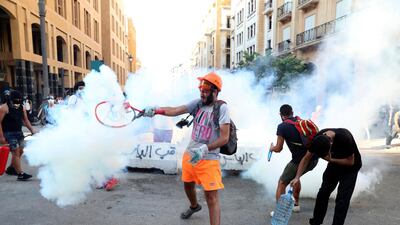
An anti-government protester uses a tennis racket to hit back a tear gas canister towards riot policemen during a protest following last Tuesday's massive explosion, which devastated Beirut, Lebanon. AP Photo -
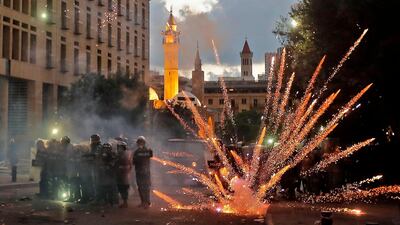
Lebanese security forces clash with protesters near the parliament in central Beirut following a huge chemical explosion that devastated large parts of the Lebanese capital. AFP -
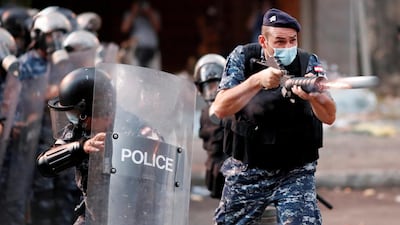
A member of Lebanese riot police fires a weapon during anti-government protests that have been ignited by a massive explosion in Beirut, Lebanon. Reuters -

Lebanese protesters try to storm the vicinity of the parliament in central Beirut following a huge chemical explosion that devastated large parts of the Lebanese capital. AFP -
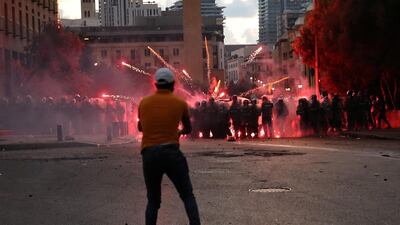
A demonstrator throws fireworks at riot police during anti-government protests that have been ignited by a massive explosion in Beirut, Lebanon. Reuters


The appointment comes weeks after a huge explosion in Beirut, which devastated the city’s port and caused widespread damage to residential and commercial areas in the capital. At least 190 people died and 6,000 were injured in the August 4 blast, prompting a backlash against the country's rulers. The government resigned less than a week after the blast.
Mr Adib said he would form a Cabinet of experts and work with parliament to “put the country on track of improvement and to end the dangerous financial, economic and social drainage”.
“The opportunity in front of our country is narrow, and the mission that I accepted is based on all political groups knowing that. The government should be formed very quickly,” he said.
Mr Macron and other world leaders as well as the International Monetary Fund have refused to give assistance to Lebanon before its leaders enact major reforms. The swift consensus around Mr Adib, a little known diplomat, signalled a sense of urgency by Lebanon’s traditional politicians to try and contain the rapidly worsening economic and financial crisis, and show movement before Mr Macron’s visit.
-

Greek rescue workers search amid the rubble three days after explosions that hit Beirut port. EPA -
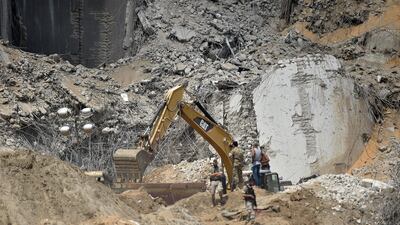
Workers and members of Lebanese civil defense search for bodies and survivors amid the rubble. EPA -
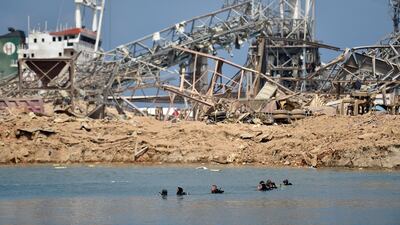
Divers inspect at the port waterfront. EPA -
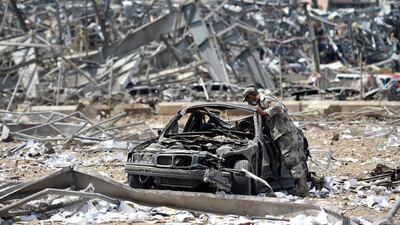
A Lebanese soldier looks at a damaged car. EPA -
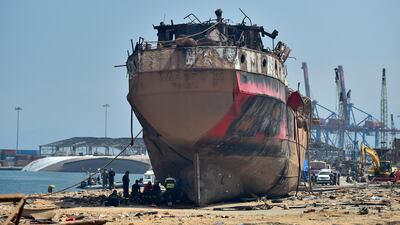
Workers and members of Lebanese civil defence rest next to a damaged vessel. EPA -
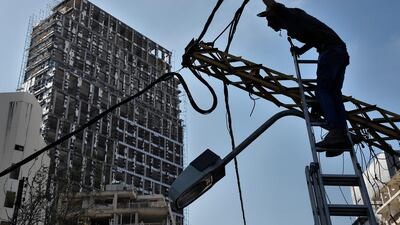
An electricity worker fixes power cables in front of a damaged building. AP Photo -
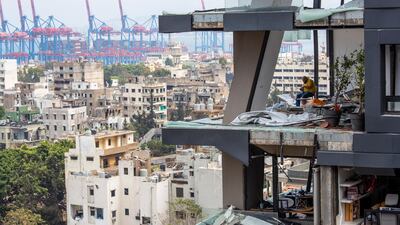
A man sits between debris inside his house damaged by Tuesday's explosion in the seaport of Beirut, Lebanon. AP Photo -

A man who sustained injuries to his legs looks at the rubble. AP Photo -
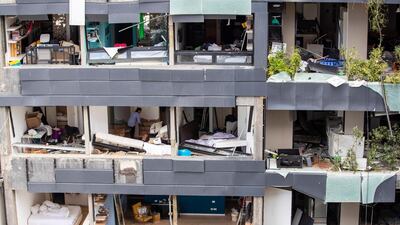
Workers remove debris from a house. AP Photo -
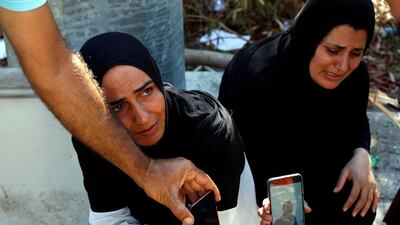
Zeinab Zer Eldin, left, and her sister-in-law shows a photo of her missing husband near the site of the explosion in the port of Beirut. AP Photo -
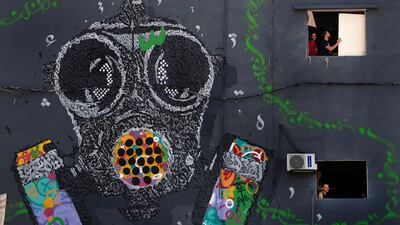
Residents fix windows in a house damaged by Tuesday's explosion that hit the port of Beirut. AP Photo


Former Prime Minister Saad Hariri emerged from his meeting with Mr Aoun on Monday, telling reporters his 18-member bloc had given its backing to Mr Adib. Mr Hariri called for the formation of a government of experts “that implement reforms aimed at restoring the world’s confidence in our economy so we can start to emerge from this crisis.”
Mr Adib, who returned from Germany to Lebanon on Saturday, was the only name to emerge as a favourite for the post of prime minister, who according to Lebanon’s sectarian-based power sharing system has to be a Sunni Muslim. The candidate who gets the most support is asked to form the new Cabinet, but Lebanon’s divided political class has often been bogged down over who holds senior posts and key ministries.
Mr Adib was named by four former prime ministers, including Mr Hariri, on the eve of Monday’s consultations.
Earlier on Sunday, the head of the powerful Hezbollah militant group, Hassan Nasrallah, said his supporters will co-operate and facilitate the formation of a government that would be able to improve economic conditions and undertake major reforms.
The Iran-backed militant group, which has a dominant role in Lebanon’s politics, has come under intense criticism and public scrutiny as the country faces multiple devastating crises. Hezbollah and its allies were also expected to name Mr Adib.
Even before the explosion, an unprecedented economic crisis had already sapped the Lebanese currency of more than 80 per cent of its value, driving unemployment, poverty and inflation through the roof.
Coronavirus infections and deaths have also surged, pushing authorities to reintroduce some restrictions on economic and social activities that have largely been ignored amid the slump. And the recent explosion badly damaged the port of Beirut, a main trade channel for the small country, which depends on imports.
Prime Minister Hassan Diab’s government, backed by Hezbollah and its allies, resigned on August 10, six days after nearly 3,000 tonnes of ammonium nitrate exploded in Beirut’s port, where it had been stored for six years.
Mr Adib, who has been Lebanon’s ambassador to Germany since 2013, served as an adviser to one of Lebanon’s former prime ministers, Najib Mikati. He took part in the committee in charge of writing Lebanon’s new electoral law in 2005 and 2006, and acted as chief of Cabinet in 2011.

