Over the weekend, Germany and Finland repatriated from Syria 18 children and five women, all suspected relatives of ISIS militants. They were brought home on humanitarian grounds, with the women described as being in "very poor health".
The decision is overdue. Most European states, some of the richest in the world, have done little to relieve the burden European ISIS detainees placed on stretched authorities in Syria and Iraq. The detention centres in which they are housed are dangerous, over-crowded, difficult to control and largely populated with women and children. Groups like the Al Khansaa brigade, a self-appointed ISIS female "police team", enforce their law, routinely dishing out beatings and intimidation.
Moral arguments appear largely to have failed in convincing European states to live up to their responsibility over these citizens. Fears over repatriating extremists are understandable; the number of returnees would be difficult for intelligence agencies to monitor over the long term. There are also fears that prosecutors would not be able to muster enough evidence to secure sentences. De-radicalistion will be hard, as European states still struggle to come up with effective strategies. And the resistance of many law-abiding European citizens will be significant. But any desire to give in to these fears is ultimately flawed. The moral and strategic arguments for returning ISIS relatives are stronger.
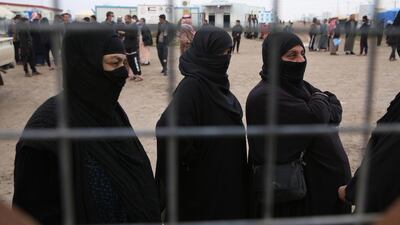
Iraqis wait to get personal Identification cards and birth certificates for their children who were born under the rule of ISIS. EPA
The most effective long-term strategy against the disillusionment that leads to terrorism is by consistently asserting our moral standards.
In the long run, Europe is not safer with the status quo. There are worries that detainees could overcome fragile security in the camps and smuggle themselves to ISIS cells in the Middle East or Europe. Formal repatriation allows for detainees to be documented properly. Keeping ISIS's most committed supporters – many people in these camps stayed until the very last days of the caliphate – grouped in one place, may help members plan attacks. It is dangerous for Europe to have tragically large numbers of its children in an environment so conducive to indoctrination. It also unconscionable to condemn them to a life of imposed extremism – a choice they, unlike their parents, did not make consciously.
Workarounds undertaken by countries like the UK, in cases such as that of Shamima Begum – a British ISIS wife stripped of her citizenship on the basis she might be eligible for a Bangladeshi passport by descent – place an unjust burden on some of the poorest states in the world, damaging the credibility of European values. Moreover, why should Bangladesh, a country Begum has never lived in, be responsible for her and justice for her victims, rather than Britain?
These shoddy attempts to displace responsibility also set a legal precedent of British dual nationals being cast out of the reach of the UK criminal justice system. Begum’s punishment could not be given to someone with British ancestry, implying that British law applies more completely to those with single nationality. Legal gymnastics of this kind also add to false narratives exploited by terrorists that Brits born to Muslim parents are second-class citizens.
Reconciling these issues with confidence in the integrity of Europe’s laws and values is of significant importance to the safety of Europeans. Furthermore, it demonstrates an understanding that the moral and strategic factors are intertwined. The most effective long-term strategy against the disillusionment and nihilism that leads to terrorism is not through watering down ethical standards and the law, but by asserting them consistently – even in the most difficult cases. By bringing these 18 children and their mothers home from a life of terror, Germany and Finland uphold their ideals.

The biog:
Favourite book: The Leader Who Had No Title by Robin Sharma
Pet Peeve: Racism
Proudest moment: Graduating from Sorbonne
What puts her off: Dishonesty in all its forms
Happiest period in her life: The beginning of her 30s
Favourite movie: "I have two. The Pursuit of Happiness and Homeless to Harvard"
Role model: Everyone. A child can be my role model
Slogan: The queen of peace, love and positive energy
BUNDESLIGA FIXTURES
Friday (all kick-offs UAE time)
Hertha Berlin v Union Berlin (10.30pm)
Saturday
Freiburg v Werder Bremen (5.30pm)
Paderborn v Hoffenheim (5.30pm)
Wolfsburg v Borussia Dortmund (5.30pm)
Borussia Monchengladbach v Bayer Leverkusen (5.30pm)
Zakat: an Arabic word meaning ‘to cleanse’ or ‘purification’.
Nisab: the minimum amount that a Muslim must have before being obliged to pay zakat. Traditionally, the nisab threshold was 87.48 grams of gold, or 612.36 grams of silver. The monetary value of the nisab therefore varies by current prices and currencies.
Zakat Al Mal: the ‘cleansing’ of wealth, as one of the five pillars of Islam; a spiritual duty for all Muslims meeting the ‘nisab’ wealth criteria in a lunar year, to pay 2.5 per cent of their wealth in alms to the deserving and needy.
Zakat Al Fitr: a donation to charity given during Ramadan, before Eid Al Fitr, in the form of food. Every adult Muslim who possesses food in excess of the needs of themselves and their family must pay two qadahs (an old measure just over 2 kilograms) of flour, wheat, barley or rice from each person in a household, as a minimum.
Where to apply
Applicants should send their completed applications - CV, covering letter, sample(s) of your work, letter of recommendation - to Nick March, Assistant Editor in Chief at The National and UAE programme administrator for the Rosalynn Carter Fellowships for Mental Health Journalism, by 5pm on April 30, 2020.
Please send applications to nmarch@thenational.ae and please mark the subject line as “Rosalynn Carter Fellowship for Mental Health Journalism (UAE programme application)”.
The local advisory board will consider all applications and will interview a short list of candidates in Abu Dhabi in June 2020. Successful candidates will be informed before July 30, 2020.
WOMAN AND CHILD
Director: Saeed Roustaee
Starring: Parinaz Izadyar, Payman Maadi
Rating: 4/5
Poland Statement
All people fleeing from Ukraine before the armed conflict are allowed to enter Poland. Our country shelters every person whose life is in danger - regardless of their nationality.
The dominant group of refugees in Poland are citizens of Ukraine, but among the people checked by the Border Guard are also citizens of the USA, Nigeria, India, Georgia and other countries.
All persons admitted to Poland are verified by the Border Guard. In relation to those who are in doubt, e.g. do not have documents, Border Guard officers apply appropriate checking procedures.
No person who has received refuge in Poland will be sent back to a country torn by war.
Founder of the Muslim Brotherhood, Hassan al Banna, "accepted the political utility of violence"
Views of key Muslim Brotherhood ideologue, Sayyid Qutb, have “consistently been understood” as permitting “the use of extreme violence in the pursuit of the perfect Islamic society” and “never been institutionally disowned” by the movement.
Muslim Brotherhood at all levels has repeatedly defended Hamas attacks against Israel, including the use of suicide bombers and the killing of civilians.
Laying out the report in the House of Commons, David Cameron told MPs: "The main findings of the review support the conclusion that membership of, association with, or influence by the Muslim Brotherhood should be considered as a possible indicator of extremism."
Profile of Foodics
Founders: Ahmad AlZaini and Mosab AlOthmani
Based: Riyadh
Sector: Software
Employees: 150
Amount raised: $8m through seed and Series A - Series B raise ongoing
