
The first study of the safety and effectiveness of a coronavirus vaccine in Iran began on Tuesday, state TV reported.
Dozens of people were due to receive the domestically developed shot even as details about its production remained slim.
The vaccine is produced by Shifa Pharmed, part of a state-owned pharmaceutical conglomerate known as Barekat. It is the first in the country to reach human trials.
The company’s website describes it as being involved in the large-scale production of antibiotics and penicillin. There are no details about its coronavirus research, results of animal trials or previous vaccine development since its founding in 1995.
Iran has struggled to stem the worst virus outbreak in the region, which has infected over 1.2 million people and killed nearly 55,000.
The study, a Phase 1 clinical trial, will enrol a total of 56 volunteers to receive two shots , according to Hamed Hosseini, a clinical trial manager.
Results are to be announced roughly a month after the second shot.
Three people received the first injections on Tuesday in a ceremony at a Tehran hotel attended by the country’s health minister. State TV announced that none of the injections had so far caused any “fevers” or “bodily shocks”.
“I am happy that the scientific process went ahead in a proper way,” said Tayebeh Mokhber, daughter of the Setad Foundation chairman, who was the first to get jabbed. “I hope the conclusion will be health for our people.”
_______________
Coronavirus around the world
-

Registered nurse Patricia Cummings administers the COVID-19 vaccine to Vice President-elect Kamala Harris at the United Medical Center in Washington, DC. AFP -

The first five vaccinated hospital staff and Health Director Alberto Deales pose for a photo as the Covid-19 vaccine is administered at the Umberto I Hospital in Rome, Italy. A vaccination campaign against Covid-19 started across the EU on 27 December. EPA -

A patient with the COVID-19 breaths in oxygen in the COVID-19 ward at Khayelitsha Hospital, about 35km from the centre of Cape Town. The patents in this ward are not critically serious, but do require oxygen and to lie down. South Africa has become the first African nation to record one million coronavirus cases, according to new data published by the country's health ministry on December 27, 2020. Currently suffering a second wave of infections, of which the majority are a new variant of the coronavirus, South Africa is the hardest hit country on the African continent. AFP -

City of Tshwane's Special Infection Unit Leading Emergency Care Practitioner Rocco Veer and Station Officer Arrie Visser do final check on the isolation chamber equipped with a negative pressure filtration system used to transport positive Covid-19 patients before starting their night shift at the Hatfield Emergency Station in Pretoria. AFP -
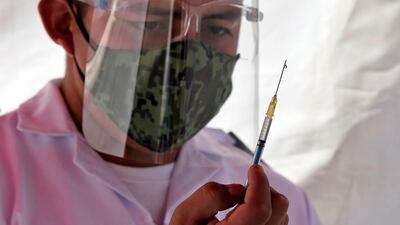
Medical staff administer the Pfizer/BioNTech vaccine against the coronavirus, at the Military Field Number 1A in Mexico City. Mexico will first apply the vaccine to all health personnel and the elderly as part of their mass immunization program. AFP -

A woman on a scooter has her temperature taken and is given a facemask at a checkpoint set up to examine people in a bid to halt the spread of the Covid-19 coronavirus in the southern Thai province of Narathiwat. AFP -

Gabriel Cervera and Sanjana Krishnan take a break from treating patients infected with the coronavirus disease at United Memorial Medical Center in Houston, Texas, U.S. Reuters -

People line up in their vehicles at Dodger Stadium as post-Christmas COVID-19 testing resumes during a surge in positive coronavirus disease cases in Los Angeles, California, U.S. Reuters -

People wait for their turn during a mass coronavirus testing in Palma de Mallorca, Spain. Palma de Mallorca records 621 cases per 100,000 inhabitants and has become Spain's hardest hit area. EPA -

Passengers wearing protective face masks wait at a station for a subway during an evening rush hour in Wuhan, China. Life in Wuhan, a Chinese city of more than 11 million, which nearly a year ago became the epicenter of the coronavirus outbreak is returning to normal. Since May the capital of Hubei province has not recorded locally-transmitted cases of Covid-19. EPA -

An Iranian health worker prepares a dose of locally made COVID-19 vaccine during phase one of its trial test in Tehran, Iran, 29 December 2020. Media reports state that Iran inaugurated and tested its local made coronavirus disease vaccine during the first phase of trial session. EPA -

Buses carrying some inmates infected with coronavirus disease leave Dongbu Detention Center in Seoul, South Korea, for a medical clinic. A total of 792 inmates there have come down with the virus so far. EPA -

People wearing face masks to protect against the spread of the coronavirus visit the Ameyoko shopping street to purchase ingredients for New Year's dishes, in Tokyo. AP -

Villagers wave away journalists visiting a village near Danaoshan in southern China's Yunnan province. A mine shaft in the area once harbored bats infected with the closest known relative of the COVID-19 virus. AP -

A medical worker waits for the next individual to take a swab test for the COVID-19 coronavirus at a hospital in Beijing. AFP


_______________
The Setad Foundation, controlled by the office of Iran’s supreme leader, oversees the Barekat conglomerate.
The treatment, dubbed Coviran, is a so-called inactivated vaccine, meaning it is made of a coronavirus that’s been weakened or killed by chemicals, similar to how polio immunisations are made. Leading Western vaccines, like the shot made by Pfizer and its German partner BioNTech, use newer, less-proven technology to target the coronavirus’ spike protein using RNA.
Iranian authorities expect the vaccine to hit the market by late spring 2021, an extremely aggressive timeline. Before this year’s fast-tracked development of coronavirus vaccines, the usual methods of testing a vaccine for safety and efficacy with mass trials could take up to a decade.
With government-funded research into viral proteins and genetics accelerating the development of vaccines worldwide, countries have approved vaccines for emergency use and launched inoculation programmes at record-breaking speed.
American drug makers Pfizer and Moderna received endorsements after reporting their vaccines were more than 90 per cent effective at protecting against the coronavirus in large, advanced clinical trials. China and Russia approved their vaccines for emergency use while still in late-stage testing. Their early interim data, although promising, lacks clarity and raises questions about vaccine efficacy.
Iran has not elaborated on its regulatory approval process or plans for more advanced trials.
President Hassan Rouhani has said Iran is co-operating with a “foreign country” to produce another vaccine expected to run in tests in human volunteers in February, without offering further details.
The government has touted Iran’s domestic vaccine research, repeatedly alleging that tough American sanctions undermine efforts to purchase foreign-made vaccines and launch mass inoculation campaigns like those under way in the U.S. and Europe. While U.S. sanctions do have specific carve-outs for medicine and humanitarian aid to Iran, international banks and financial institutions hesitate in dealing with Iranian transactions for fear of being fined or locked out of the American market.
Still, Iran retains routes to imported vaccines, including through Covax, an international programme designed to distribute coronavirus vaccines to participating countries around the world.
Iran’s energy minister, Reza Ardakanian, told state news agency IRNA on Tuesday during a visit to Baghdad that Iran will pay for the Covax vaccines from some $6 billion that Iraq owes Iran for gas imports over the years.
On Monday, Iran said it expects a group of US-based benefactors to ship thousands of Pfizer coronavirus vaccines in the coming weeks.

