When Sheikh Zayed, the Founding Father, sought to unite the emirates in 1971 the scale of the task was immense.
One of his biggest challenges was to unite the Bedouins and it took a man such as Sheikh Zayed to convince the tribes to abandon decades of nomadic living, commit to belonging to one place and believe in the dream of the UAE.
Though most had barely spoken to him, the first President of the UAE was such a formidable force that his ideas were enough to bring together camel herders, pearl divers and so many more from all corners of the emirates.
He built houses for them, schools to educate their children and hospitals to treat their sick.
Although many could barely read or write and were so set in their ways, they believed in a man they barely knew.
He was younger than most of them but his strength of leadership made him instantly known as "Baba Zayed". To mark the UAE's 49th National Day, and as the country enters its 50th year, The National interviewed six people who lived through these days of change.

Bakheet Al Mansoori, 76, cannot remember the exact year of his birth.
He wrote down 1944 but that was based on family tales and great events that took place.
"They would write down our birth year according to the events of the year so the year of hunger or the year of war," says Mr Al Mansoori.
He is a Bedouin from the Manasir tribe and spent the early years of his life close to the Liwa oasis in the shade of the palm trees.
There he spent his time with camels and hunted amid the dunes. It was a way of life that had been unchanged for centuries.
Mr Al Mansoori, like many other Bedouins, did not have a formal education but the oil companies that came to the region early on provided opportunities and led to changes that transformed this way of life.
"I was around 10 and began working for them as a labourer, like other Emiratis. There are those who worked as labourers, kitchen boys and cleaners at these companies," he says.
About a year later, Mr Al Mansoori moved to Abu Dhabi and began working for Sheikh Shakhbut, who was Ruler of the emirate at the time.
Mr Al Mansoori used to water the plants in front of Qasr Al Hosn.
“Bedouin boys are smart and quick," he says. "They go to the desert and back on their own. A boy of 10 at the time is like a man in his twenties today, so I started working watering the plants of Al Hosn palace."
He left and worked as a driver for various companies and employers in the emirate.
“I was driving. You would drive without a licence. Driving licences came much later," he says.
He also worked as one of the first tractor drivers for construction work in Al Dhafra.
But, restless for the desert, Mr Al Mansoori left work again. “I got bored and excused myself and went back to the desert," he says.
When unification took place, Mr Al Mansoori was in the desert but the significance and ambition of what happened filtered across the dunes.
"Sheikh Zayed met with the Rulers and established the union," he says.
"I wasn’t there but when the union formed it affected all of us. Everything changed. There is power in the union.”

He never spoke to or met Sheikh Zayed, the man behind this change. "We never crossed paths," Mr Al Mansoori says.
"I love the desert. I love camels. Civilisation and modernity has come but we are old."
Mr Al Mansoori, who still lives in Al Dhafra, is not disturbed by all the development. He still travels to the desert and attends every camel race.
“It doesn’t bother us. You can’t want money and air-conditioning and a house and want the desert at the same time," he says.
"Look at us now, if you switch off the air conditioning then it bothers us. The desert is over – we can't go back to living there any more.
“Life is better now. I go to the hospital when I am sick, I pray at the mosque and life is comfortable.
"May God bless the union. Make it strong and protect our leaders."
_________________
Sheikh Zayed and the story of a nation
-
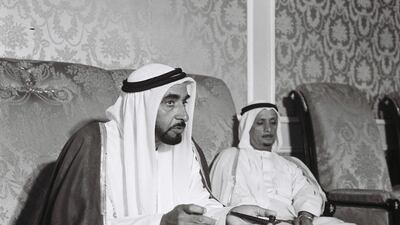
Sheikh Zayed, Ruler of Abu Dhabi, at Manhal Place in Abu Dhabi in November or December, 1971, as talks reached a climax. Courtesy: Al Ittihad -

The signing and speech at Union House, Dubai. December 2, 1971. Courtesy: Al Ittihad -

Sheikh Zayed raising the flag at Union House in Dubai. December 2, 1971. Courtesy: Al Ittihad -

The UAE flag about to be raised outside the UN on December 10, 1971. From left to right are: Adam Malik, President of the 26th session of the General Assembly; Secretary-General, U Thant; Adnan Pachachi, Minister of State of the UAE and chairman of the delegation; and Mohamed Abdul Latif, Director of the Department of International Organizations of the Ministry of Foreign Affairs. Courtesy: Saw Lwin / UN Photo -
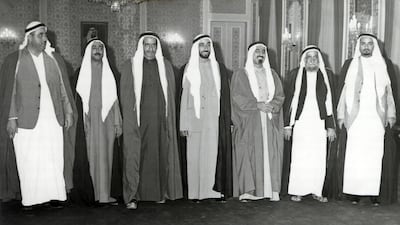
The Rulers of the 7 Emirates: Sheikh Zayed; Sheikh Rashid; Sheikh Sultan Al Qasimi; Sheikh Rashid Al Mualla; Sheikh Saqr Bin Mohammed Al Qasimi, Sheikh Mohammed Bin Hamad Al Sharqi, Sheikh Humaid Bin Rashid Al Nuaimi at the Presidential Palace in Abu Dhabi after Ras Al Khaimah joined the United Arab Emirates, 10th February 1972 National Archives images supplied by the Ministry of Presidential Affairs to mark the 50th anniverary of Sheikh Zayed Bin Sultan Al Nahyan becaming the Ruler of Abu Dhabi.



