

International research is under way to better understand the psychological, social and neuroscientific effects of the Covid-19 pandemic. The early work has established what many of us would have anticipated: a rise in rates of depression and anxiety.
Our own survey work across the UAE of 1,051 people and counting, undertaken by psychologists at Zayed University, echoes these findings.
Beyond depression and anxiety, however, there is a host of other psychological implications connected with the current crisis.
Uncertainty is one of the psychological consequences of Covid-19 we are all experiencing.
When will it end? What are the long-term effects of contracting the illness? When will we find a vaccine? What will happen to my job?
-
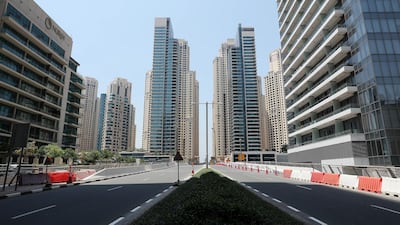
Empty roads in Dubai Marina in mid-April. 24 hour restrictions on leaving home which were in place since March were eased for Ramadan, allowing people to leave home from 6am to 10pm. Pawan Singh / The National -
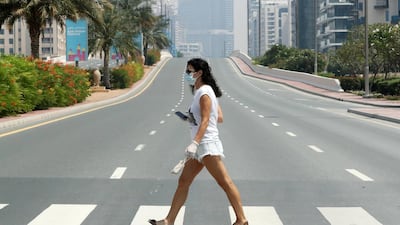
A pedestrian wearing a mask crosses the main street on Palm Jumeirah in Dubai. Pawan Singh / The National -

A police barrier stands in front of Atlantis Hotel, one of the largest hotels in the country. Pawan Singh / The National -
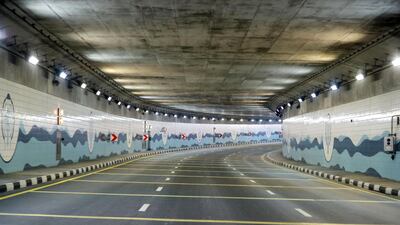
The tunnel underneath the palm is usually packed with traffic on a Friday. Pawan Singh / The National -

A solitary shopper walks past the yachts quay at Dubai Marina. Pawan Singh / The National -

A resident looks out from his apartment building in Dubai Marina. Pawan Singh / The National -

A security guard takes the body temperature of a delivery driver in the Al Furjan suburb. Pawan Singh / The National -

Talabat delivery drivers, who have permission to operate at all times of day, collect their orders in Dubai Marina. Pawan Singh / The National -

A sign in Fujairah urges people to 'stay home' as people do their shopping. Chris Whiteoak / The National -

A Dubai Police officer stops the vehicles and checks for permit to leave home near Dubai's Madinat Jumeirah. Pawan Singh / The National -
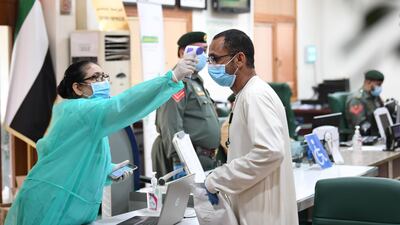
A man has his body temperature reading taken upon arriving at the police station of Naif in Dubai. AFP -
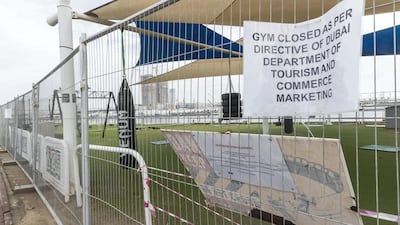
The closed open air gym at Skydive Dubai. Antonie Robertson / The National -

Dibba Al Hisn’s seafood market. Reem Mohammed / The National -

A sign warns people to stay home along the Dubai Marina. Antonie Robertson / The National


READ Mental health help in the UAE during the coronavirus crisis: five organisations to know about
Rumours tend to rise in times of uncertainty. Occasionally, idle talk morphs into full-blown conspiracy theories.
Unlike more harmless rumours, conspiracy theories centre on a rejection of mainstream ideas and common sense in favour of a more sinister and secret narrative.
Dangerous ideas are being peddled about the virus being caused by 5G wireless networks (#5GCoronavirus).
There is also the bizarre notion that the whole pandemic is an overblown hoax (#Covid-19hoax).
Then there is the outlandish proposal of this being the plot of certain philanthropists to depopulate the planet.
These opinions spread via social media and have made some people disregard the advice to maintain physical distancing.
They have incited others to set fire to 5G towers, at a time when telecommunications are vital to the emergency services and the general public.

A 2019 Pew Research Centre study suggests that 62 per cent of adults in the US get their news from social media.
In our survey in the UAE, which explores the psychological consequences of Covid-19, social media was also reported as the primary source of news about the virus.
Unfortunately, social media can act as a petri dish for conspiracy theories, where half-truths cross with decontextualised facts and outright delusions.
The resulting ideas often go viral, infecting the minds of millions of people around the globe.
The current pandemic has created the perfect psychological conditions for conspiracy theories to propagate, mutate and flourish.
Social media is the wind carrying these noxious notions far and wide.
To flatten the Covid-19 curve, it will help if we can find ways of flattening the conspiracy theory curve too.
Last week Facebook announced it would inform users if they had liked or commented on Covid-19-related posts that later turned out to contain harmful misinformation.
This is a start, but think of the millions of other passive readers, those who didn’t like or comment on the posts, but still exposed themselves to toxic ideas. Can we vaccinate people against conspiracy theories? Some would argue that this is one of the goals of our education system.
Another significant psychological consequence of the Covid-19 pandemic, or rather our response to it, is rising levels of loneliness. Physical distancing and lockdown measures have disrupted and diminished opportunities for face-to-face social interaction.
SocialPro, a popular social psychology website, undertook an email survey on this topic among people across North America and the UK. Lockdown-related loneliness was found to be 70 per cent more common among millennials than in baby boomers.
Men also reported experiencing higher levels of “lockdown loneliness” than women, with millennial men the loneliest of all.
Our survey data for the UAE tells a similar story. Loneliness and a sense of social isolation are key concerns for many, but particularly for residents who are physically separated from friends and their immediate and extended families.

Of course, this is where social media and digital platforms can play a health-promoting role and provide meaningful and enriching social interactions.
This sense of connection and belonging is an essential protective mechanism in these difficult times.
Watching our neighbours share their musical abilities on balconies or gathering for an online book club can promote a healthy sense of "we".

What impact might the communal fasting and other Ramadan rituals have on the psychological well-being of those celebrating the holy month?
It is in this time that we need high-quality research to better understand the psychological consequences of what we are going through.
Justin Thomas is a psychology professor at Zayed University

