

“America First” was the slogan of the Trump administration – and what that meant in practice was “America Alone”.
The Trump administration withdrew from the Paris climate accords, launched trade wars against allies like Canada and Germany, ripped up security agreements with South Korea, and reneged on its promise of a rapid post-Brexit trade agreement with the United Kingdom.
Most seriously of all, the Trump administration chose a path of conflict with China, without much by way of either partners or plan.
Yet not everything in Donald Trump’s foreign policy was a failure. The area of greatest success was in the Middle East, where new peace agreements offer the promise of stability and prosperity to a historically volatile region.
Can the incoming administration of Joe Biden secure Mr Trump's few accomplishments – and correct his many mistakes?
-
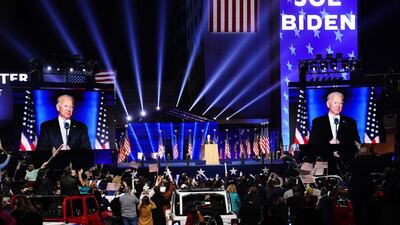
US President-elect Joe Biden delivers his victory address after being declared the winner in the 2020 presidential election in Wilmington, Delaware. EPA -

A man dressed as Abraham Lincoln holds a sign as people celebrate in the streets before US president-elect Joe Biden delivers remarks from Delaware AFP -
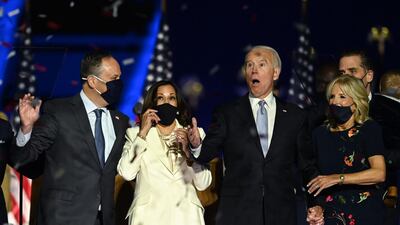
US President-elect Joe Biden and Vice President-elect Kamala Harris react as confetti falls, with Jill Biden and Douglas Emhoff, after delivering remarks in Wilmington, Delaware. AFP -

A family reacts as they listen to Democratic presidential nominee Joe Biden and vice presidential nominee Kamala Harris' speeches. Reuters -

People celebrate in West Hollywood, California. AFP -
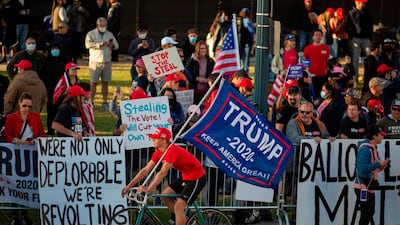
Supporters of US President Donald Trump rally in Beverly Hills, California. AFP -
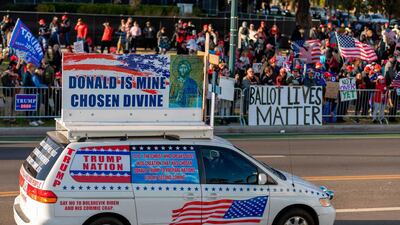
Supporters of US President Donald Trump rally in Beverly Hills, California. AFP -

People celebrate at Times Square in New York. AFP -
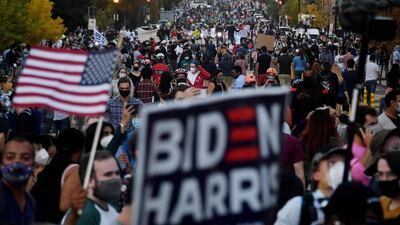
People celebrate on Black Lives Matter plaza across from the White House in Washington, DC. AFP -

A man dressed as Uncle Sam celebrates while standing on a statue outside City Hall, Philadelphia. AFP -
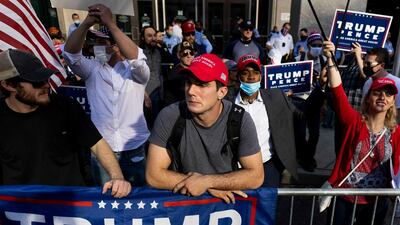
Trump supporters react as people celebrate after major news organisations called the US 2020 presidential election for Joe Biden, in Philadelphia. EPA -
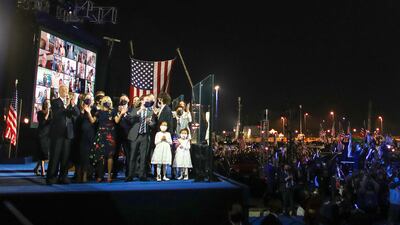
President-elect Joe Biden and Vice President-elect Kamala Harris and their families watch fireworks from stage after delivering remarks in Wilmington, Delaware. AFP -
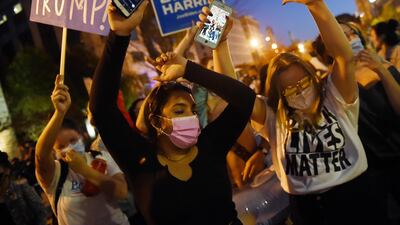
Supporters of US President-elect Joe Biden celebrate on Black Lives Matter Plaza across from the White House in Washington, DC. AFP -

People celebrate at Times Square in New York. AFP -

A woman holds a white peace flag sign as people march in Los Angeles. AFP


A successful post-Trump foreign policy would be guided by two big ideas.
Here's the first:
Success depends on willing partners.
When I worked in the George W Bush administration, the US economy was eight times the size of China's. When Barack Obama took office in 2009, the US economy was still three times the size of China's. Today, the Chinese economy is either 66 per cent the size of the US economy (at nominal exchange rates) or fully equal (if you adjust the two countries' currencies for purchasing power).
Mr Trump imagined that he could tariff and tantrum China into submission. If that was ever true, it is no longer true. China is too big to bully.
The closed and authoritarian Chinese state challenges many other nations in many ways, including through import restrictions and measures that neglect environmental impacts.
Mr Trump's answer was to start fights with China in hopes of extracting concessions. That approach failed. Either the concessions did not come, or else they were not honoured. Under the so-called “Phase One” deal, China was supposed to buy $200 billion more from the United States in 2020 than it did in 2017. As is, China is on track to meeting only about one third of that commitment.
The crass commercial self-interest of the Trump approach alienated regional allies who might have shared worries about China – e.g., South Korea, Japan – but saw scant reason to squabble with a nearby economic superpower for the benefit of US soybean growers.
The one Trump foreign policy success shows the power of partnership.
As Iran behaved in increasingly provocative and aggressive ways, formerly antagonistic states in the Middle East discovered shared interests. Past disagreements with Israel seemed less imperative than security against a common threat. The US facilitated, but it did not dictate. It helped partners to find ways to act in both their own interest and in ways that advanced US goals of regional security. What was not done in the Pacific was done in the Gulf – and the Gulf success should provide the example to correct the Pacific failure.

Here's the second big idea to guide policy in the post-Trump era.
Security policy must address risks, as well as threats.
The Bush and Obama administrations had invested heavily in pandemic preparedness. As all the world now knows, the Trump administration junked those preparations. That decision was partly motivated by Mr Trump's peevishness against his predecessors. But there was also a more serious motive: a belief that there was something soft, something escapist about this concern with germs and disease. Public health should be left to local governments; high-level policymakers should focus on military threats from hostile powers.
That view now looks criminally irresponsible. Covid-19 has taken lives and inflicted costs on a scale equivalent to a major war. Timely action to avert or mitigate pandemic risk would have been abundantly worth any cost.
We need to transfer that painfully learned wisdom to the issue of climate challenge.
Climate models often direct attention to the potential for world crisis at some later date – the 2050s, say. The accompanying graphs often suggest a steady, upward slope from now to then – implying that there is some substantial time ahead of us before the worst arrives.
But it is also possible that negative events befall more convulsively. From 1998 until 2012, the world did not warm much at all. Then temperatures spiked in the second half of the 2010s, record-breaking warms in 2015, 2016, 2017, 2018 and 2019. Possibly, we could get another respite – and only then another spike, this more catastrophic than ever.
Mr Trump added $100bn per year in military spending, much of that added money directed towards state-to-state conflict with China. But if Americans are spending so much on extra security insurance, they need to be more realistic about the hazards they are insuring against. Old concepts of "soft" and "hard", of "defence" versus "public health" look outmoded in this year of pandemic – and security policy should catch up.
The countries of the Gulf are particularly exposed to climate risk. As these nations find a more secure future for themselves by burying old quarrels with Israel, they could be effective advocates in a post-Trump Washington for a more secure future for all by preparing for large and preventable risks, as well as for sudden and dramatic threats.
In the Trump years, there was one sure way to gain attention from the Washington power establishment: pay money or favour to President Trump personally, to his businesses or to his family. Priority was openly for sale. That interval is now nearing its end. The American policy agenda will again be claimed by strong evidence and effective argument – not bribes. The states of the Gulf have the brains, contacts and sophistication to advance in the new era. Deal-making will be less simple than the previous era of cash-and-carry, but more defensible and more enduring.
David Frum is a writer at the Atlantic who was speechwriter and special assistant to former US president George W Bush

