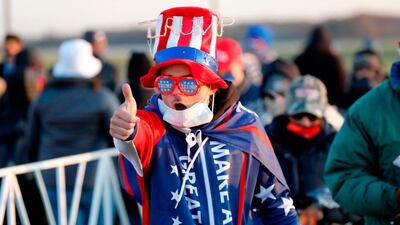
A supporter of US President Donald Trump gives a thumb's up as he arrives to attend his final Make America Great Again rally of the 2020 US Presidential campaign at Gerald R. Ford International Airport on November 2, 2020, in Grand Rapids, Michigan. / AFP / JEFF KOWALSKY
A supporter of US President Donald Trump gives a thumb's up as he arrives to attend his final Make America Great Again rally of the 2020 US Presidential campaign at Gerald R. Ford International Airpor

The next US president must establish a post-American order in the Middle East


  • English
  • Arabic

The Middle East is in the middle of a major reconfiguration, following on from what appears to be a regional breakdown of “Pax Americana”.

The process of American disengagement began under former president Barack Obama and has continued under Donald Trump, leaving a vacuum that many countries now seek to fill.

The question is whether the region can find a new equilibrium and avoid major conflict.

While Mr Obama and Mr Trump seem miles apart on most things, they shared a sense that the US had to withdraw substantially from the Middle East and from its role as the region’s primary military power.

But Mr Trump’s defenders would argue, perhaps rightly, that the President has been more consistent than his predecessor in his desire to fill the void by bolstering traditional US allies – Israel, Saudi Arabia and to an extent Turkey.

Soon before Mr Obama left office in 2016, he expressed his thinking on the matter in a much-publicised interview with Jeffrey Goldberg of The Atlantic  magazine.

At the time, he observed: “The competition between the Saudis and the Iranians … requires us to say to our friends as well as to the Iranians that they need to find an effective way to share the neighbourhood and institute some sort of cold peace.”

Mr Obama’s rationale was that if regional powers such as Saudi Arabia and Iran could “share” the region, then this could lead to stability that would allow the US to reduce its military involvement there.

A new US administration has the challenging task of finding commonalities among its allies

The detached, almost tone-deaf nature of his phrase seemed disconnected from the fact that Iran’s rivals regarded its regional rise as threatening.

In such a context, the idea of sharing anything seemed ludicrous.

Yet Mr Trump’s style of backing US allies, while it has created a front against Iran, has been unable to impose definite outcomes.

The reason is that as states in the region have adjusted to the reality of US disengagement, many of them have resorted to transactional power politics, where they might be allied with countries in one conflict and fighting them in another.

Turkey’s relations with Russia are a prime example of this detached approach.

Turkey and Russia, however, are not alone. Other countries are active in conflicts in the Middle East and North Africa – sometimes opposed to one another geopolitically or ideologically, sometimes working in alliances of convenience and sometimes operating independently.

Donald Trump speaks to the leaders of Sudan and Israel as he announces that Sudan will normalise relations with Israel, at the White House in Washington, DC, October 23. AFP

This situation suggests that the dynamics of the region are heading toward greater fragmentation. Without a framework for common action and restraint, the possibility of a broader conflict or miscalculations leading to conflict cannot be ruled out.

That is why whoever wins the US presidential election this week ought to contribute to finding a mechanism to reducing such a possibility.

The cerebral Mr Obama was no less erratic than Mr Trump in the Middle East. After withdrawing US forces from Iraq, he had to deploy thousands of troops to both Syria and Iraq after 2014 to fight ISIS.

Former US President Barack Obama at a drive-in rally as he campaigns for Joe Biden in Miami, Florida on November 2. AFP

This should have taught him the difficulty of imposing simple solutions on the region. Mr Trump faced a similar situation when he wanted to pull US forces out of Syria in 2019. After pushback from Congress, he redeployed a smaller number to the east of the country.

Can Washington help mediate a regional package deal that can bring a new modus vivendi to the Middle East? If anyone can, it is the US, but there is also a major obstacle in that Iran won’t go along with anything the Americans propose.

That leaves a new administration with an equally challenging task: finding commonalities among its allies and laying the groundwork for a consensuses that can reduce regional tensions and advance US goals.

This will have to begin with a US effort to reconcile those among its friends who are currently hostile to one another.

Many rifts in the region will be difficult to resolve, but the main thing for a Biden or Trump administration to do is to facilitate a post-American order in the region that introduces mechanisms of conflict resolution, sets consensual red lines for behaviour and even sets up functional and informal institutional forums for the parties to address their differences, perhaps under US sponsorship, similar to what Russia did with the Astana process.

This may sound fanciful at a time when states are aggressively pursuing competing interests and see no impetus to be bogged down by US-defined constraints. Perhaps it is. But after this phase of chaotic interventions, the actors of the region will need to find ways to anchor their gains.

The US may no longer want to be in the Middle East, but it will surely remain in the region, as all major players have a stake in remaining on good terms with Washington. They realise that in all likelihood their ambitions will at some stage require American acquiescence.

Michael Young is a senior editor at the Carnegie Middle East Centre in Beirut and a columnist for The National


The bio

Favourite book: Peter Rabbit. I used to read it to my three children and still read it myself. If I am feeling down it brings back good memories.

Best thing about your job: Getting to help people. My mum always told me never to pass up an opportunity to do a good deed.

Best part of life in the UAE: The weather. The constant sunshine is amazing and there is always something to do, you have so many options when it comes to how to spend your day.

Favourite holiday destination: Malaysia. I went there for my honeymoon and ended up volunteering to teach local children for a few hours each day. It is such a special place and I plan to retire there one day.

MATCH INFO

Who: UAE v USA
What: first T20 international
When: Friday, 2pm
Where: ICC Academy in Dubai

UAE currency: the story behind the money in your pockets
UAE%20v%20West%20Indies
%3Cp%3EFirst%20ODI%20-%20Sunday%2C%20June%204%20%0D%3Cbr%3ESecond%20ODI%20-%20Tuesday%2C%20June%206%20%0D%3Cbr%3EThird%20ODI%20-%20Friday%2C%20June%209%26nbsp%3B%3C%2Fp%3E%0A%3Cp%3EMatches%20at%20Sharjah%20Cricket%20Stadium.%20All%20games%20start%20at%204.30pm%0D%3Cbr%3E%0D%3Cbr%3E%3Cstrong%3EUAE%20squad%3C%2Fstrong%3E%0D%3Cbr%3EMuhammad%20Waseem%20(captain)%2C%20Aayan%20Khan%2C%20Adithya%20Shetty%2C%20Ali%20Naseer%2C%20Ansh%20Tandon%2C%20Aryansh%20Sharma%2C%20Asif%20Khan%2C%20Basil%20Hameed%2C%20Ethan%20D%E2%80%99Souza%2C%20Fahad%20Nawaz%2C%20Jonathan%20Figy%2C%20Junaid%20Siddique%2C%20Karthik%20Meiyappan%2C%20Lovepreet%20Singh%2C%20Matiullah%2C%20Mohammed%20Faraazuddin%2C%20Muhammad%20Jawadullah%2C%20Rameez%20Shahzad%2C%20Rohan%20Mustafa%2C%20Sanchit%20Sharma%2C%20Vriitya%20Aravind%2C%20Zahoor%20Khan%0D%3C%2Fp%3E%0A

Mercer, the investment consulting arm of US services company Marsh & McLennan, expects its wealth division to at least double its assets under management (AUM) in the Middle East as wealth in the region continues to grow despite economic headwinds, a company official said.

Mercer Wealth, which globally has $160 billion in AUM, plans to boost its AUM in the region to $2-$3bn in the next 2-3 years from the present $1bn, said Yasir AbuShaban, a Dubai-based principal with Mercer Wealth.

Within the next two to three years, we are looking at reaching $2 to $3 billion as a conservative estimate and we do see an opportunity to do so,” said Mr AbuShaban.

Mercer does not directly make investments, but allocates clients’ money they have discretion to, to professional asset managers. They also provide advice to clients.

“We have buying power. We can negotiate on their (client’s) behalf with asset managers to provide them lower fees than they otherwise would have to get on their own,” he added.

Mercer Wealth’s clients include sovereign wealth funds, family offices, and insurance companies among others.

From its office in Dubai, Mercer also looks after Africa, India and Turkey, where they also see opportunity for growth.

Wealth creation in Middle East and Africa (MEA) grew 8.5 per cent to $8.1 trillion last year from $7.5tn in 2015, higher than last year’s global average of 6 per cent and the second-highest growth in a region after Asia-Pacific which grew 9.9 per cent, according to consultancy Boston Consulting Group (BCG). In the region, where wealth grew just 1.9 per cent in 2015 compared with 2014, a pickup in oil prices has helped in wealth generation.

BCG is forecasting MEA wealth will rise to $12tn by 2021, growing at an annual average of 8 per cent.

Drivers of wealth generation in the region will be split evenly between new wealth creation and growth of performance of existing assets, according to BCG.

Another general trend in the region is clients’ looking for a comprehensive approach to investing, according to Mr AbuShaban.

“Institutional investors or some of the families are seeing a slowdown in the available capital they have to invest and in that sense they are looking at optimizing the way they manage their portfolios and making sure they are not investing haphazardly and different parts of their investment are working together,” said Mr AbuShaban.

Some clients also have a higher appetite for risk, given the low interest-rate environment that does not provide enough yield for some institutional investors. These clients are keen to invest in illiquid assets, such as private equity and infrastructure.

“What we have seen is a desire for higher returns in what has been a low-return environment specifically in various fixed income or bonds,” he said.

“In this environment, we have seen a de facto increase in the risk that clients are taking in things like illiquid investments, private equity investments, infrastructure and private debt, those kind of investments were higher illiquidity results in incrementally higher returns.”

The Abu Dhabi Investment Authority, one of the largest sovereign wealth funds, said in its 2016 report that has gradually increased its exposure in direct private equity and private credit transactions, mainly in Asian markets and especially in China and India. The authority’s private equity department focused on structured equities owing to “their defensive characteristics.”

UAE currency: the story behind the money in your pockets
THE%20SPECS
%3Cp%3EEngine%3A%203-litre%20V6%20turbo%20(standard%20model%2C%20E-hybrid)%3B%204-litre%20V8%20biturbo%20(S)%0D%3Cbr%3EPower%3A%20350hp%20(standard)%3B%20463hp%20(E-hybrid)%3B%20467hp%20(S)%0D%3Cbr%3ETorque%3A%20500Nm%20(standard)%3B%20650Nm%20(E-hybrid)%3B%20600Nm%20(S)%0D%0D%3Cbr%3EPrice%3A%20From%20Dh368%2C500%0D%3Cbr%3EOn%20sale%3A%20Now%3C%2Fp%3E%0A
Groom and Two Brides

Director: Elie Semaan

Starring: Abdullah Boushehri, Laila Abdallah, Lulwa Almulla

Rating: 3/5

Simran

Director Hansal Mehta

Stars: Kangana Ranaut, Soham Shah, Esha Tiwari Pandey

Three stars

ULTRA PROCESSED FOODS

- Carbonated drinks, sweet or savoury packaged snacks, confectionery, mass-produced packaged breads and buns 

- Margarines and spreads; cookies, biscuits, pastries, cakes, and cake mixes, breakfast cereals, cereal and energy bars

- Energy drinks, milk drinks, fruit yoghurts and fruit drinks, cocoa drinks, meat and chicken extracts and instant sauces

- Infant formulas and follow-on milks, health and slimming products such as powdered or fortified meal and dish substitutes

- Many ready-to-heat products including pre-prepared pies and pasta and pizza dishes, poultry and fish nuggets and sticks, sausages, burgers, hot dogs, and other reconstituted meat products, powdered and packaged instant soups, noodles and desserts

Who's who in Yemen conflict

Houthis: Iran-backed rebels who occupy Sanaa and run unrecognised government

Yemeni government: Exiled government in Aden led by eight-member Presidential Leadership Council

Southern Transitional Council: Faction in Yemeni government that seeks autonomy for the south

Habrish 'rebels': Tribal-backed forces feuding with STC over control of oil in government territory

UAE currency: the story behind the money in your pockets
Klopp at the Kop

Matches 68; Wins 35; Draws 19; Losses 14; Goals For 133; Goals Against 82

  • Eighth place in Premier League in 2015/16
  • Runners-up in Europa League in 2016
  • Runners-up in League Cup in 2016
  • Fourth place in Premier League in 2016/17
The specs

Engine: 4.0-litre, twin-turbocharged V8

Transmission: nine-speed automatic

Power: 630bhp

Torque: 900Nm

Price: Dh810,000

Ms Yang's top tips for parents new to the UAE
  1. Join parent networks
  2. Look beyond school fees
  3. Keep an open mind