
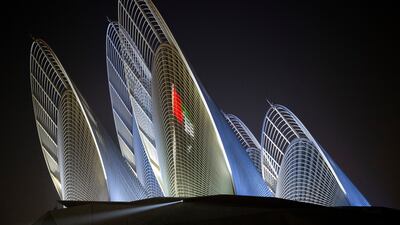
Zayed National Museum was the shining star of the 54th National Day show ahead of its grand opening, as the UAE's remarkable journey from desert land to global metropolis took centre stage.
The annual extravaganza – which celebrates the birth of the Emirates on December 2, 1971 – was beamed live to all seven emirates from the venue, which is primed to be a jewel in the crown of Abu Dhabi's Saadiyat Cultural District.
President Sheikh Mohamed inaugurated the museum on Tuesday evening, before it opens on Wednesday, alongside the rulers of the six other emirates, crown princes and other dignitaries – in a display of unity at an event marking the foundation of a nation.

The Zayed National Museum stands as a monument that pays tribute to the legacy of the late Sheikh Zayed – encompassing his leadership, vision, and enduring humanitarian values, Sheikh Mohamed said, reported state news agency Wam.
He also added the museum connects the UAE’s rich past with its present and future, and serves as a gateway for people to explore and understand the country’s culture, heritage, and traditions across generations.
The museum will have a key role in documenting milestones in the UAE's history and the achievements that have shaped its identity and global standing, said Sheikh Mohamed.
Preserving and passing on the legacy of the late Sheikh Zayed as a source of inspiration for future generations is a shared national responsibility, he added.
The UAE leader was shown taking pictures as a mesmerising show unfolded, which highlighted how the roots of the past continue to act as the firm foundation to cultivate growth.
The UAE National Orchestra – positioned outside of the spectacular museum as it was illuminated against the night sky – offered a stirring soundtrack as the show began by paying homage to the grand architect of the country, the UAE's Founding Father, the late Sheikh Zayed bin Sultan Al Nahyan.
Archive footage of the UAE's formative years and those who shaped it was projected on to the museum, which served as a stunning backdrop to a series of theatrical performances held on its sprawling grounds.
A narrator told of how Sheikh Zayed was a “guardian of the desert” and “explorer of the seas” who recognised that “true wealth lies in people” and that “God's blessings must be shared”.
-

A drone show at the 54th Eid Al Etihad official celebration at the Zayed National Museum in Abu Dhabi. All photos: UAE Presidential Court -
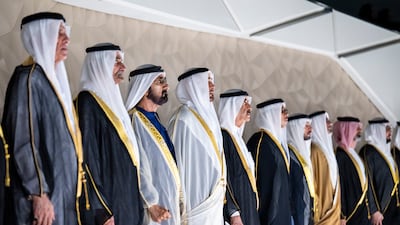
President Sheikh Mohamed, Sheikh Mohammed bin Rashid, Vice President, Prime Minister and Ruler of Dubai, Sheikh Mansour bin Zayed, Vice President, Deputy Prime Minister and Chairman of the Presidential Court, Sheikh Hamad bin Mohammed Al Sharqi, Ruler of Fujairah, Sheikh Saud bin Rashid Al Mualla, Ruler of Umm Al Quwain, and Sheikh Saud bin Saqr Al Qasimi, Ruler of Ras Al Khaimah, stand for the national anthem -
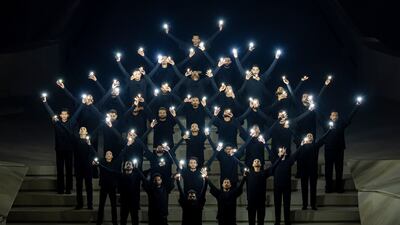
The extravaganza was beamed live to all seven emirates -
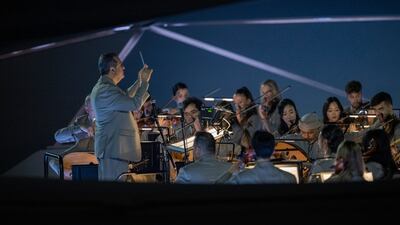
The UAE National Orchestra offered a stirring soundtrack -
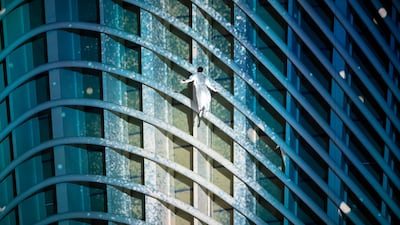
The venue is primed to be a jewel in the crown of Abu Dhabi's Saadiyat Cultural District -
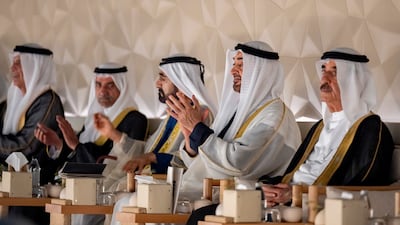
Sheikh Mohamed, Sheikh Mohammed bin Rashid, Sheikh Hamad bin Mohammed, Sheikh Saud bin Rashid and Sheikh Saud bin Saqr watch the show -

Archive footage and artistic performances documented the journey of the nation’s communities across thousands of years -
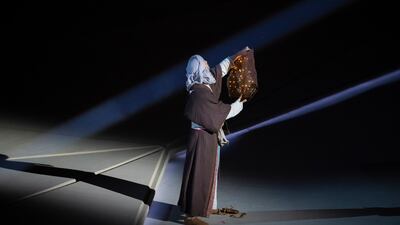
A narrator told how UAE Founding Father, the late Sheikh Zayed bin Sultan Al Nahyan, was a 'guardian of the desert' and 'explorer of the seas' -

Sheikh Zayed recognised that 'true wealth lies in people' and that 'God's blessings must be shared' -

The Zayed National Museum served as a stunning backdrop to a series of theatrical performances held on its sprawling grounds -

The show highlighted how the roots of the past continue to act as the firm foundation to cultivate growth -

Sheikh Mohamed could be seen taking photos of the event, with Sheikh Mohammed bin Rashid, Sheikh Mansour and Sheikh Saud bin Rashid -
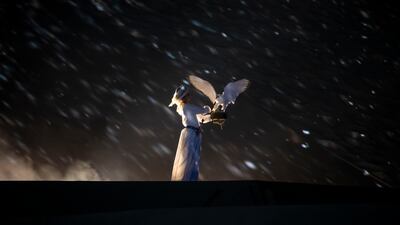
The show was non-chronological, regularly sweeping forwards and back in time during the country's history -
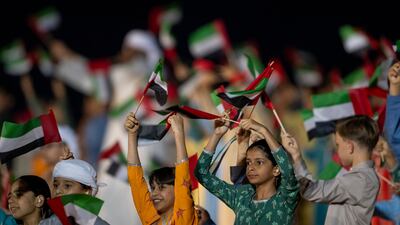
The UAE flag was a common sight -
Zayed National Museum officially opens on Wednesday


Archive footage and artistic performances documented the journey of the nation’s communities across thousands of years, leading to the unification of the seven emirates up to the present day.
A 1966 Chrysler Newport rescued and restored from sunny Californian was a fitting vehicle to help tell the rich story of the Emirates, and a reflection of the nation’s enduring love for the car.
The official ceremony marking National Day, known as Eid Al Etihad, showcased key artefacts from Zayed National Museum, which will officially open on Wednesday, and narration from the radio inside the classic Chrysler car, painted black.

Celebrating UAE's driving force
The show’s opening scene featured footage from the 1968 documentary Farewell Arabia featuring UAE Founding Father, the late Sheikh Zayed bin Sultan Al Nahyan in the Chrysler Newport car.
An almost exact match was tracked down in the US, and brought back to the UAE to go on museum display.
The footage reflected the way Sheikh Zayed envisioned roads through the desert, and how we walk those paths today.
The car’s radio acted as a time-travel device, taking the show through the ages on a tour of national growth and development.
An early scene set some 8,000 years ago was of a pearl diver who discovered what is now among the world’s oldest pearls.
It was discovered on the floor of a Neolithic settlement in 2017 and is one of the most significant discoveries on Marawah Island. The archaeological site is more than 100km west of Abu Dhabi.
As the Chrysler’s radio dial flipped forward, the show advanced 5,000 years to reveal Saruq Al Hadid, a window into the UAE’s Iron Age.
The forge produced mighty swords and delicate ornamental carvings. By the light of the Al Jabbar constellation, traveller communities made their way to this centre of industry and creativity, said the narration.
The show then travelled to around 5,000 years ago. It told the tale of carnelian beads and how they became symbols of trade and heritage.
After crossing oceans and seas, the carnelian beads found their way to women in an ancient settlement and were passed down as cherished heirlooms from one generation to the next.

To continue the show’s non-chronological theme, the narrative then went into fast-forward, taking viewers to an early period of currency and finance 2,000 years ago.
The Abiel coin was used for trade throughout coastal settlements. Over the years, coins were carefully shaped and reshaped to represent the evolving identity of the land, with the horse, standing as a local symbol of power, replacing the bird that regularly featured on coins from the time of Alexander the Great, around 4th century BCE.
Look to the stars
The story then swept forward to 600 years ago. This chapter showed how celestial navigation became a critical aspect of building a nation.

By measuring the altitude of the stars, a simple wooden tool, the kamal, transformed navigation. Its carved hands guided sailors such as Ahmad Ibn Majid across vast oceans and opened trade routes, propelling communities forward in the 1400s.
On the path to union, the foundations of a nation were then laid down in the mid-20th century.
The late Sheikh Zayed, then Ruler of Abu Dhabi, envisioned a union that could secure a safe and prosperous future for the region. He convened with the rulers and people of Dubai, Sharjah, Ajman, Umm Al Quwain, Ras Al Khaimah, and Fujairah, strengthening the ties between the brotherly emirates.
That vision became reality 54 years ago when Sheikh Zayed became the President of the UAE, and the country’s flag was raised for the first time.
The show's timeline then entered the present, with a look towards the future.
Footage highlighted innovations from key institutions in the UAE, such as the Abu Dhabi Environmental Agency, Emirates Nuclear Energy Company, M42, the Mohammed Bin Rashid Space Centre and the Technology Innovation Institute, concluding with an Mirage 2000-9 fighter jet soaring in the sky, emulating a space shuttle.
The closing scene of Sheikh Zayed’s car parked at the museum showed that his legacy will live on in the land, sea, and stars.

